Welltower’s CEO spent part of his July earnings call taking shots at the competition. Eight days later, Healthpeak’s CEO, an embattled former Welltower protege, explained why the competition looks so smart right now.
Everything here comes from Welltower, Healthpeak and Janus Living SEC filings, earnings releases, supplemental reports, and call transcripts, all linked below. Company history that predates those filings comes from archives, and press reports, and we flag it where it shows up. Welltower reported July 27, 2026. Healthpeak reported August 4. Informational only, not investment advice.
On Welltower’s July earnings call, CEO Shankh Mitra took a swing at what he called out as the “spread investing shadow banks” of healthcare real estate. His target: landlords that borrow at one rate, lease at a higher one, and call the difference a business. He didn’t name anyone. In a sector this small, he didn’t have to. Eight days later, Healthpeak’s CEO Scott Brinker opened his own earnings call with a line about how easy the business looks when demand runs ahead of supply:

“Everyone’s happy and looks really smart.”
He was thanking his team for grinding through 4 years of the opposite sentiment about real estate post-pandemic. But the line also describes the quarter Welltower had just reported, and Brinker knows Welltower from the inside. He worked there for 15 years, right up until its lawyers got involved.
Somewhere in your future is a Saturday you spend touring a senior living community with your mother, who isn’t as mobile or self-supportive as she used to be, and her doctor hinting at the need for “down sizing” or “assisted care” If you’re lucky, you have a brother or sister who already budgeted the whole thing out on a spreadsheet. The residence will have a bistro and a fitness studio, and a director of sales who calls the residents “neighbors.” Near the end of the tour, someone hands you a glossy brochure, and the tiny number on the last page stapled to the sales director’s business card, is roughly where this story starts.

Welltower collected an average of $6,059 a month last quarter for each occupied unit in its senior housing properties included in both years’ comparison, across about 100,000 units. That’s your mother’s new rent for assisted living, give or take, and it rose 5.2% in a year.
The rest of her healthcare costs are tied to real estate too. The medical office building where her cardiologist practices might belong to Healthpeak, and so might the clinic conducting FDA trials on the drug she’ll be prescribed in 5 years, or even the
Both companies are S&P 500 component REITs, and both just raised their 2026 guidance. Welltower is worth $163 billion and Healthpeak about $15 billion. The filings explain how that gap got so wide.
The Lumberyard in Lima That Invented the Healthcare REIT
Welltower’s story starts with lumber. In 1944, C.V. Wolfe and 2 partners bought the Lima Lumber Company in northwest Ohio, and his son Fritz joined in 1955 after graduating from Harvard Business School and serving in the Korean War. The family branched into construction, and by 1963 it was building nursing homes and leasing them to operators.
Building nursing homes is capital-intensive, so in 1970 Fritz Wolfe and Bruce Thompson tried something new. They formed a trust, sold shares to the public, and used the money to finance nursing homes. SEC documents of the era describe Health Care Fund as the first REIT to invest only in healthcare facilities. This makes a family-owned lumber yard from Lima the inventor of this entire asset class. The fund became Health Care REIT in 1985, headquartered in Toledo, and took the name Welltower in 2015.
One more Wolfe detail matters. In 1981, he set up “Health Care and Retirement Corp.” to operate nursing homes, then sold it 3 years later, reportedly to avoid questions about owning both the landlord and the tenant. Keep that company in mind.
Healthpeak’s CEO Got Sued the Day His New Job Was Announced
Healthpeak’s history goes back to Health Care Property Investors, which listed on the NYSE in 1985 and later became the first healthcare REIT in the S&P 500 under the HCP name. Scott Brinker rose the ranks, starting at Welltower as an intern, spent more than 15 years there, and eventually became chief investment officer. Then things got ugly.
Welltower eliminated Brinker’s position in January 2017, and he left with a non-compete attached. Four months later, HCP announced that Brinker would become its CIO the following January, exactly one year and one day after his Welltower exit. Welltower sued him that same day. By that afternoon, it had secured a restraining order. The company accused Brinker of violating his non-compete agreement by talking with a direct rival, then sharpened the allegation in an amended complaint that described HCP as his “new employer and co-conspirator.” Brinker’s lawyers fired back that Welltower was trying to turn him into “damaged goods” in an industry where everyone knows everyone.
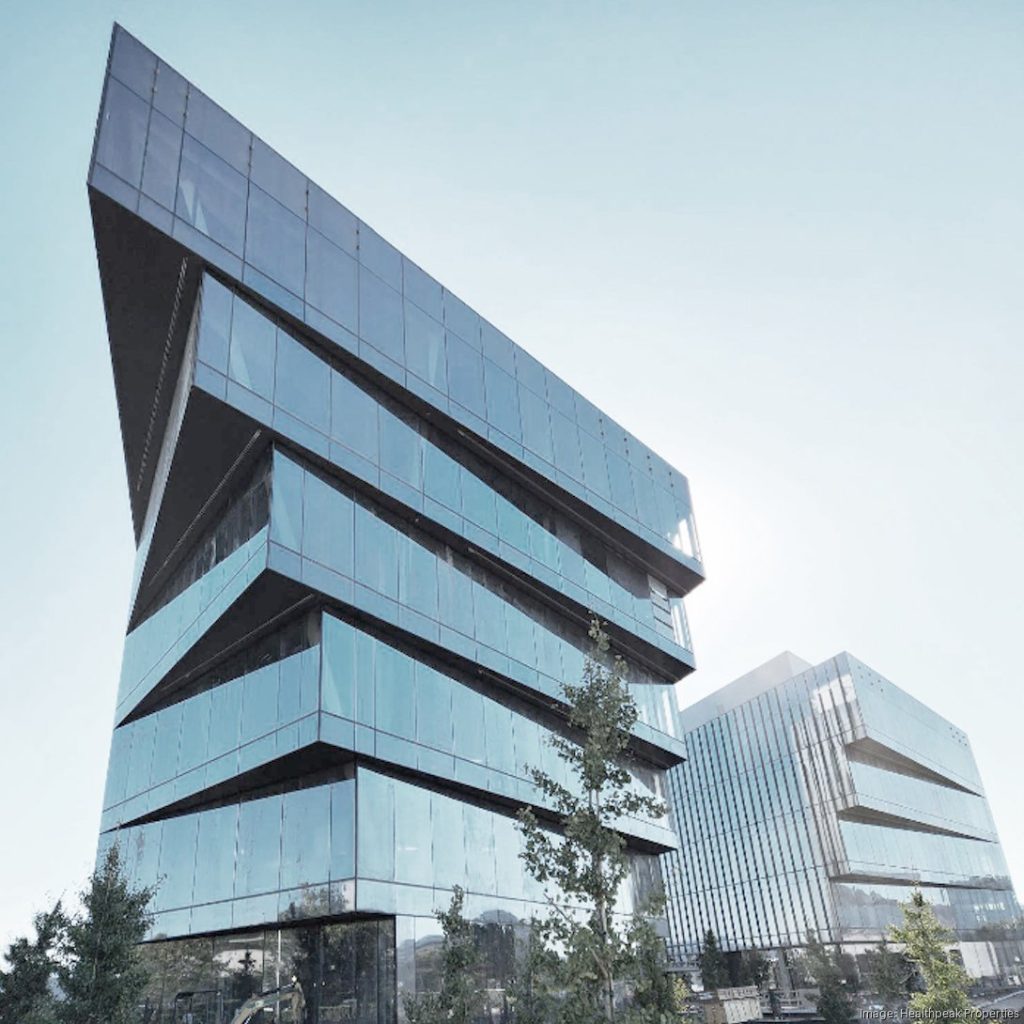
The fight settled that fall. Brinker finally joined HCP in March 2018. By October 2022, he was CEO of a company that had become Healthpeak, moved its headquarters to Denver, and was heading toward its 2023 acquisition of Physicians Realty Trust valued at about $21 billion, and changing to the DOC ticker on the NYSE.
The Nursing Homes That Boomeranged Back to Toledo
While Welltower and HCP were fighting over Scott Brinker, HCP had another piece of Welltower history sitting on its balance sheet. Remember HCR, the nursing-home company Fritz Wolfe sold in 1984? It merged with Manor Care in 1998 and became HCR ManorCare. In 2011, HCP paid $6.1 billion for the real estate under 338 ManorCare facilities, then leased the buildings right back to the operator. To say the least, it did not age well.
The Justice Department accused ManorCare of billing Medicare for therapy patients didn’t need. Rent became harder to collect, and by 2016 HCP wanted out badly enough to spin the entire portfolio off into a separate public company, Quality Care Properties.

ManorCare filed for bankruptcy in March 2018. Four months later, Welltower and Toledo hospital system ProMedica bought Quality Care Properties and ManorCare for $4.4 billion. Welltower paid $20.75 a share in cash and ended up with 80% of the real estate. So essentially, the nursing-home chain that grew out of the Wolfe family’s original business spent seven years tormenting HCP, then landed back with the REIT the Wolfes had created, headquartered in the same Ohio city where the story began.
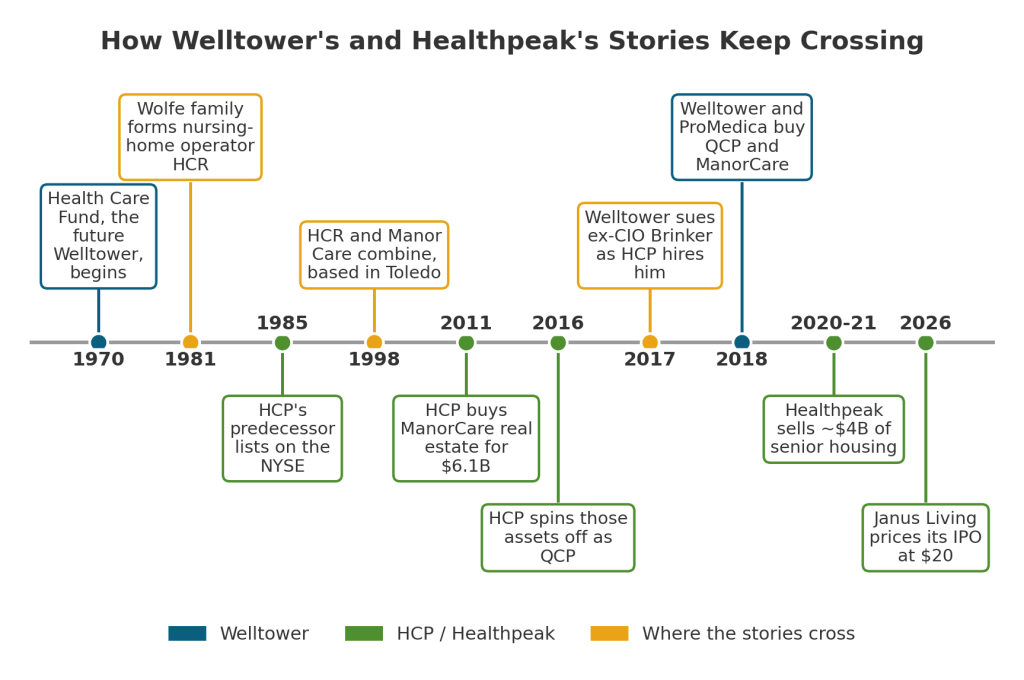
Selected events from company filings, releases, and press reports. Pre-1990 Wolfe history comes from company archives and the Toledo Blade.
Both Had a Great Senior Housing Quarter, but Only One Is a Senior Housing Company
Both companies own senior housing, and both had a great quarter in it. What separates them is how much of each company that business represents. It helps to know three pieces of REIT vocabulary first.
FFO, short for funds from operations, is the REIT version of earnings: net income with depreciation on buildings added back. Accounting assumes a building wears out a little every year, but real estate doesn’t reliably lose value that way. FFO per share works like earnings per share, and a stock’s price divided by FFO works like a P/E. Each company also strips out one-time items in its own way, which is why Welltower reports “normalized FFO” and Healthpeak reports “FFO as Adjusted.”
Net operating income, or NOI, is essentially EBITDA for a building: what a property takes in minus what it costs to run, before interest, depreciation and head-office overhead. Divide it by revenue and you get the property’s margin.
“Same-store” figures count only buildings a company has owned for more than a year, so a burst of acquisitions can’t pad the growth rate. Retailers use the same idea when they report same-store sales.
Welltower reported normalized FFO of $1.60 a share, up 25%, on revenue of $3.54 billion, up 39%. Its same-store NOI grew 15.5%. Most of that growth came from the senior housing Welltower operates itself, which grew 20.5% and produces about 73% of the company’s same-store NOI.
Healthpeak reported FFO as Adjusted of $0.46 a share, the same as a year earlier, on $772 million of revenue. Its senior housing grew 19.2%, nearly matching Welltower, but it produces less than a tenth of Healthpeak’s same-store NOI. The other 90% comes from medical offices (56%), which grew 2.5%, and labs (34%), which shrank 3.2%. Added together, Healthpeak’s same-store NOI grew 1.8%.
Search10k’s keyword treemap shows how differently the two describe themselves in their filings.
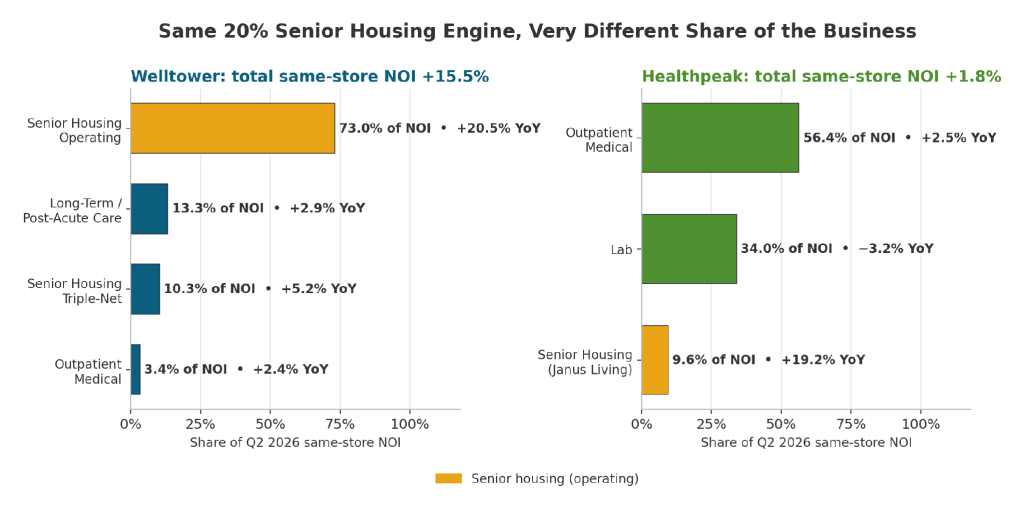
Q2 2026 same-store NOI by segment, from each company’s release. Welltower’s shares are our arithmetic from its reported totals; Healthpeak discloses its own.
Welltower Is Running Senior Housing Like a Hotel Chain
The easiest way to understand Welltower’s senior housing business is to look at the numbers a hotel operator would obsess over.
How many rooms are full? What does each occupied room bring in? What does it cost to service that room? And how much of the difference can you keep?
Welltower is moving all four in the right direction. Same-store occupancy rose 330 basis points over the past year, while revenue per occupied room climbed 5.2%. The cost of running that room rose just 0.7%. Management says the combination pushed margins up 300 basis points to more than 32%.
Welltower CEO Mitra thinks the customer can support it. Today’s retirees, in his telling, are the wealthiest generation of seniors in history, and they’re willing to pay up for a place they like to live. That gives Welltower room to behave less like a passive landlord and much more like an operator trying to improve revenue and margin at every property.
It also explains how Welltower shops. The company has $15.5 billion of acquisitions closed or under contract this year, with roughly 96% of last quarter’s deals negotiated off-market. The next $6 billion of properties in the pipeline are only about 75% occupied. That’s almost the point. A hotel chain doesn’t buy an under-performing property because it loves empty rooms. It buys one because it believes its brand, pricing, sales, and operating playbook can fill more of them.
Welltower calls its version the Welltower Business System, and its description of the company fits the strategy perfectly: “an operating company in a real estate wrapper.”
The model is producing enough cash that Welltower just raised its quarterly dividend 15% to $0.85, while still paying out less than half of FFO.
Healthpeak’s Labs Are Healing, Slowly and Expensively
Welltower buys buildings that are about a quarter empty because it’s confident it can fill them. Healthpeak’s labs, about a third of its same-store NOI, have the opposite problem: too much space and not enough tenants. Six years ago, it was the other way around.
In 2020, lab space in Torrey Pines, San Diego’s biotech hub, was so scarce that Healthpeak built a$164 million campus there with no tenants signed and leased all of it before construction finished. Then biotech funding slumped in 2022 while new labs kept opening, and Brinker says the downturn peaked only last year.

Page 17 of Healthpeak’s supplemental tracks the damage (there’s a faster way to get ahold of that info though). Lab occupancy fell from 82.2% a year ago to 77.1% at the end of 2025, and by June 30 it had climbed back only to 78.5%. Some of December’s drop was Healthpeak’s own doing. Buying the Gateway campus in South San Francisco, with more than 500,000 empty square feet, knocked over 1.5 points off occupancy. Scott Brinker prefers to call that space opportunity rather than vacancy.
All that empty space gave tenants the upper hand. Only about half the lab space up for renewal over the past year was renewed. Those renewals that started last quarter were signed 7.3% below the old rents.

Brinker believes the worst is passing, and the money is returning: public life science fundraising last quarter was the strongest since 2021. That matters for a roster that runs from Johnson & Johnson and Pfizer down to private biotechs. Small and private companies pay 11.5% of Healthpeak’s base rent, and they live on fresh funding. Healthpeak now has 480,000 square feet of lab leases under letters of intent, and Gateway has already signed or lined up about 125,000 square feet.
Back in Torrey Pines, Healthpeak owns several campuses, including Torrey Pines Science Park, next to the golf course where Tiger Woods won the 2008 U.S. Open on a broken leg. Counting signed leases and pending deals, its space there is 97% leased, up from about 65% at the end of 2025.
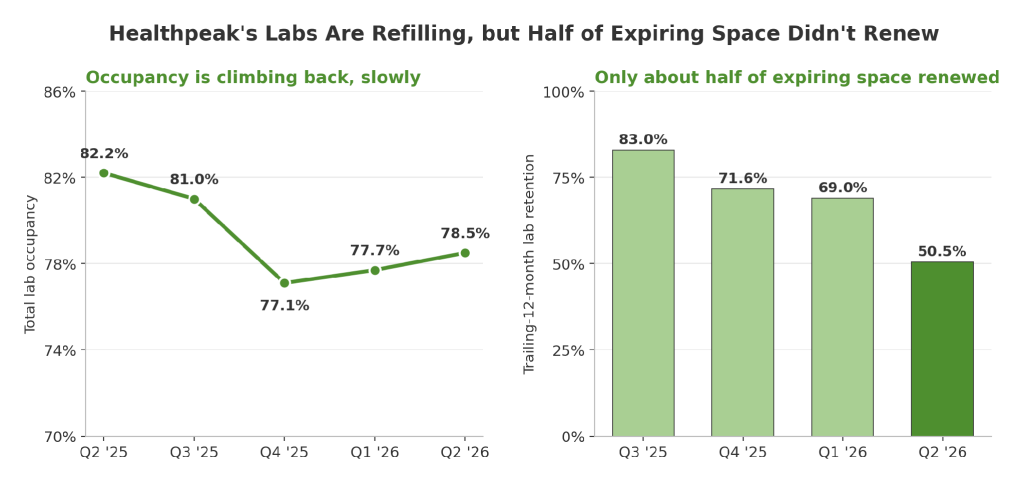
Lab occupancy and trailing-12-month retention, from Healthpeak’s Q2 2026 supplemental. Retention is renewed square feet over expiring square feet available.
Healthpeak Sold Its Senior Housing, Then Took a New One Public
Healthpeak’s lab occupancy problem gets even more interesting when you remember what it sold to become a lab company in the first place.
In 2020 and 2021, Healthpeak unloaded about $4 billion of senior housing and recast itself around labs and medical offices. Welltower even bought one of the portfolios.
Five years later, senior housing is the hottest business in healthcare real estate, and Healthpeak has found its way back in.
The company told investors the market wasn’t giving it enough credit for the senior housing sitting inside Healthpeak, so it pulled those assets into Janus Living and took Janus public. The IPO priced at $20, at the top of the range, on March 19. With the overallotment, Janus sold 48.3 million shares for $966 million. A second offering followed in August.
The timing hasn’t hurt. Janus grew revenue 45% last quarter and carries no debt. Healthpeak’s remaining stake was worth $6.3 billion on August 3, equal to roughly 42% of Healthpeak’s own market value.
It’s separate on paper, although not exactly at arm’s length. Healthpeak manages Janus for a fee, Scott Brinker runs both companies, and the potential conflicts get their own section in the risk factors.
Fritz Wolfe sold his operating company in 1984 rather than spend his time answering questions like that.
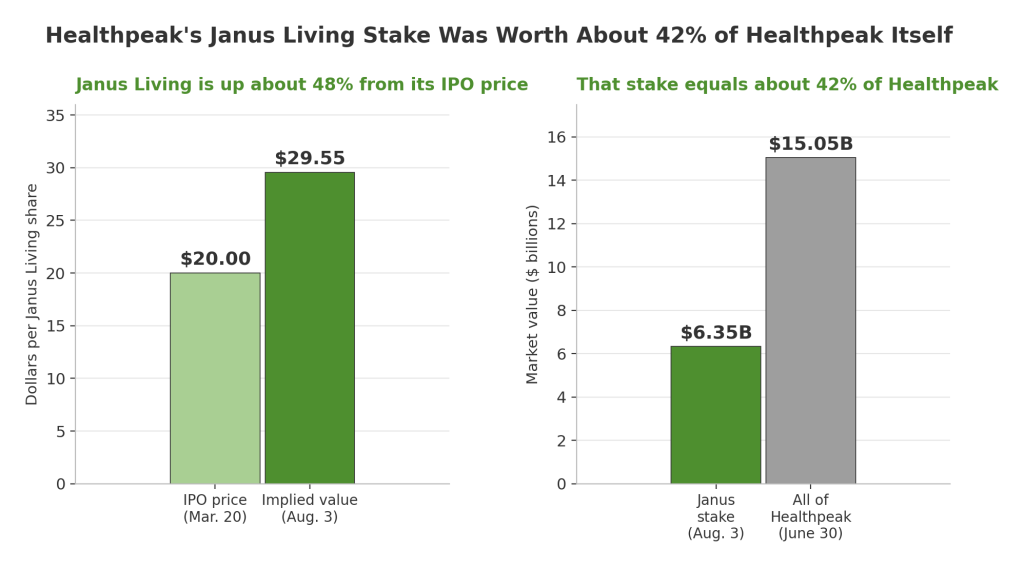
From Healthpeak’s Q2 supplemental: its $6.345 billion Janus stake (Aug. 3), the $20 IPO price, and June 30 market equity. Our arithmetic.
The WELL vs. DOC Scorecard, for Anyone Skimming
| Welltower (WELL) | Healthpeak (DOC) | |
|---|---|---|
| Quarter | Q2 2026, ended June 30 | Q2 2026, ended June 30 |
| Revenue | $3.54B, up 39% | $772M, up 11% |
| Per-share FFO | $1.60 normalized, up 25% | $0.46 as adjusted, flat |
| Same-store NOI | Up 15.5%; senior housing up 20.5% | Up 1.8%; lab down 3.2% |
| Growth engine | Senior housing, 73% of same-store NOI | Janus Living, revenue up 45% |
| 2026 FFO guidance | $6.36–$6.44 a share, raised twice | $1.73–$1.77 a share, raised twice |
| Net debt / adj. EBITDA | 2.99x | 4.7x |
| Credit ratings | A− / A3, outlooks positive | BBB+ / Baa1, stable |
| Dividend | $0.85 a quarter, just raised 15% | $0.10167 a month, unchanged for 5 quarters |
| Market value, June 30 | $163.2B | $15.1B, including OP units |
| Capital moves | Issuing stock to fund acquisitions | $100M buyback at $16.81; $500M new authorization |
| CEO | Shankh Mitra, since 2020 | Scott Brinker, since 2022 (ex-Welltower) |
| What you’re really buying | Your mother’s landlord, run like a hotel | Your doctor’s landlord, plus control of a 6-month-old IPO |
Both columns are the June 2026 quarter, from each company’s release and supplemental. Guidance ranges are company forward-looking statements.
Welltower Nearly Doubled FFO Per Share While Issuing 59% More Stock
Janus gave Healthpeak another way to surface value from senior housing. Zoom out to the parent companies, though, and there’s a simpler test for all the buying, selling, spinning and issuing they’ve done: what happened to the earnings attached to one share?
For Welltower, quite a lot. Welltower’s normalized FFO was $3.35 a share in 2022 and $5.29 in 2025, and this year’s guidance midpoint is $6.40. Welltower’s diluted share count rose 59% over that stretch, from 465 million in 2022 to 738 million in the second quarter of 2026. Even so, each share is on track to earn nearly twice what it did 4 years ago. Plenty of REITs grow by issuing shares; the rare part is growing the per-share number too.
That’s the part worth lingering on. Welltower has been issuing stock at a furious pace to fund its buying spree, yet each of those shares is still on track to earn almost twice what a share earned four years ago. REITs issue stock to grow all the time. Getting much bigger without leaving the existing shareholder with a thinner slice is the harder trick. Healthpeak’s per-share story has gone mostly sideways. Its adjusted FFO was $1.74 a share in 2022 and $1.84 in 2025, and this year’s guidance midpoint is $1.75, blamed on the life science downturn. In April it also bought back $100 million of stock at $16.81, better than a 10% FFO yield by its own math, with $500 million more authorized. The dividend, meanwhile, hasn’t changed in 5 quarters and uses about two-thirds of FFO.
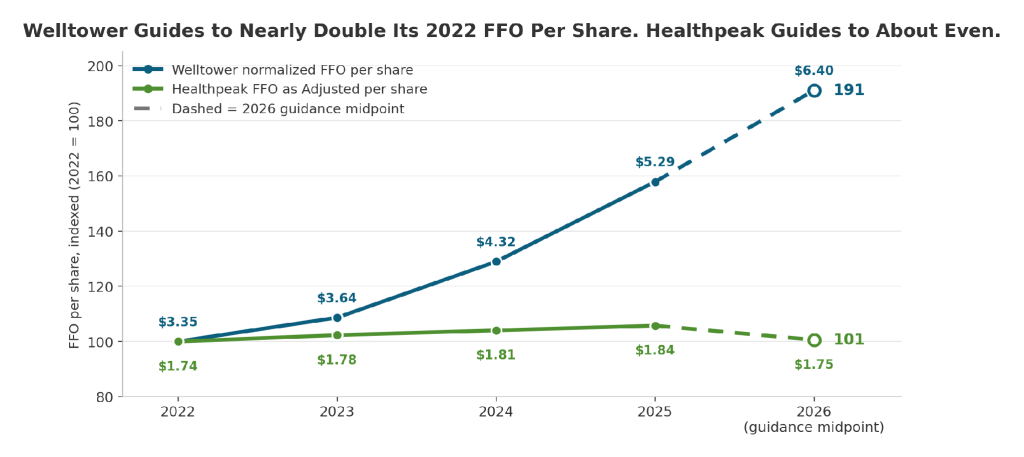
FFO per diluted share, indexed to 2022 = 100. 2026 is each company’s August guidance midpoint, a forward-looking statement. Each defines adjusted FFO differently.
The $821 Million Line in Welltower’s Proxy
If Welltower’s per-share growth explains why investors have rewarded it, the proxy shows just how much faith the company itself has put behind the people producing it. Last October, Welltower’s five named executives signed onto a 10-year compensation plan that sounds almost monkish at first. The base is $110,000 salary, no bonuses, no annual equity grants, and one stock award meant to cover everything through 2035. Half of that award only pays if Welltower beats the market.
Then you open the proxy and see $821 million next to CEO Shankh Mitra’s name for stock awards in 2025. He didn’t collect $821 million for one year of work. Accounting rules require Welltower to report the grant-date value of that decade-long award up front, which turns ten years of potential pay into one spectacular-looking number. Scott Brinker’s 2025 target compensation, by comparison, was around $10 million. The award also explains most of the $1.56 billion of fourth-quarter G&A that Welltower strips back out when calculating normalized FFO. It’s disclosed, non-cash, and exactly the kind of thing you miss if you stop at the earnings release instead of opening the filing.
Which brings us to what investors are paying for all of this. As of June 30, Welltower traded around 35 times this year’s FFO guidance and yielded 1.5%. Healthpeak was closer to 12 times and yielded 5.7%. Welltower has earned the market’s enthusiasm with much faster per-share growth. The catch is that the enthusiasm is no longer cheap. For every dollar of FFO, investors were paying roughly three times as much for Welltower while collecting about a quarter of the dividend yield.
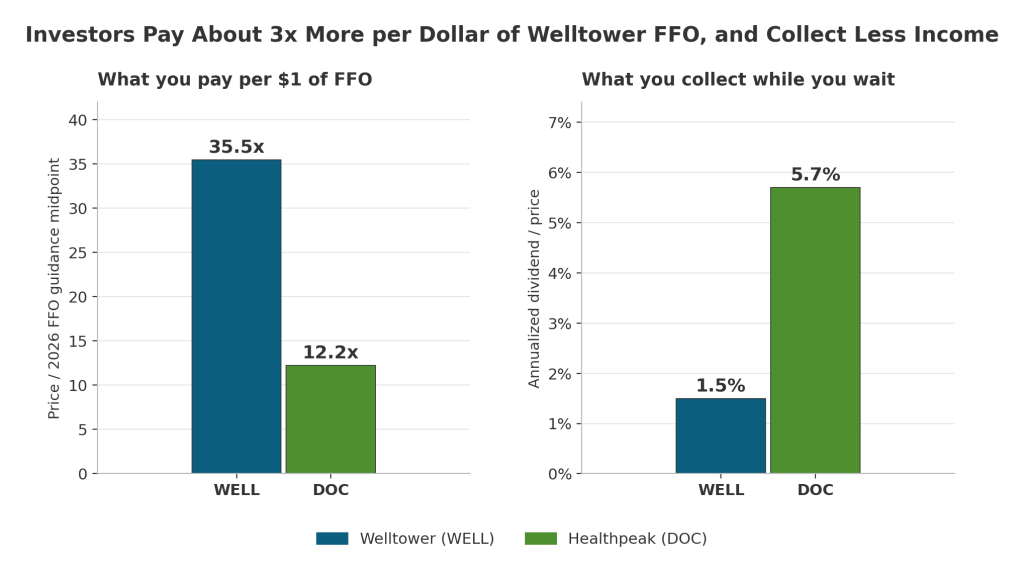
June 30, 2026 prices divided by each company’s 2026 FFO guidance midpoint, and current annualized dividends divided by the same prices. Our arithmetic.
| Mitra has volunteered to be graded on a 10-year plan. Search10k’s CEO Leadership Report grades executives against the plans in their own filings, 3 years at a time. |
So Whose Story Are You Buying?
So, back to the Saturday tour of the retirement residence with mom. Buy Welltower and you’re buying the building your mother moves into, run by executives who have tied 10 years of their own pay to the share price. It’s the better business on nearly every line in this article: faster growth, per-share FFO that has nearly doubled since 2022, and a stronger balance sheet. You pay 35 times this year’s FFO for it, which means the next several years have to go about as well as the last one, and the residents have to keep writing $6,000 checks every month. Buy Healthpeak and you’re buying mom’s cardiologist’s office, the lab where her blood tests are going, and a stake in a 6-month-old IPO that accounts for 42% of the whole company. You get a 5.7% yield for your patience, as the labs and clinics fill back up.
If you’ve followed this series, you know the filings usually tell a better story than the press release. Search10k puts both companies’ filings side by side so you can read them yourself.
| Try it on 2 companies you actually own. Drop any pair into the Screener and see what shakes out. Start free, or contact us and grab 20 minutes. |
PRIMARY SOURCES
- Welltower. Second Quarter 2026 Results, Form 8-K Exhibit 99.1 (SEC EDGAR, Jul 27, 2026). Revenue, normalized FFO, same-store NOI by segment, RevPOR, occupancy, the dividend increase, guidance, leverage and June 30 market value.
- Welltower. Fourth Quarter 2025 Results (SEC EDGAR, Feb 10, 2026) and Fourth Quarter 2023 Results (SEC EDGAR, Feb 13, 2024), Form 8-K Exhibit 99.1. Annual normalized FFO for 2022–2025, diluted share counts, fourth-quarter 2025 G&A and special incentive compensation, and the expanded 10-year program.
- Welltower. Q2 2026 earnings call transcript (Investing.com, Jul 28, 2026). Margins, unit expense growth, off-market sourcing, pipeline occupancy and Mitra’s comments.
- Welltower. Ten Year Executive Continuity and Alignment Program announcement (Oct 27, 2025) and 2026 proxy statement (SEC EDGAR). Pay terms and the 2025 Summary Compensation Table total.
- Welltower. Health Care REIT becomes Welltower, Form 8-K Exhibit 99.1 (SEC EDGAR, Sep 30, 2015); Form 8-K on the elimination of the CIO role (SEC EDGAR, 2017); QCP and HCR ManorCare acquisition, Form 8-K Exhibit 99.1 (SEC EDGAR, Jul 26, 2018); Q3 2018 Form 10-Q (SEC EDGAR).
- Healthpeak. Second Quarter 2026 Results, Form 8-K Exhibit 99.1 (SEC EDGAR, Aug 4, 2026) and Q2 2026 Supplemental Report. FFO as Adjusted, same-store NOI, lab occupancy and retention, leasing costs, tenant and geographic mix, leverage, ratings, share prices, market equity and the Janus Living stake value.
- Healthpeak. Fourth Quarter 2025 Results, Form 8-K Exhibit 99.1 (SEC EDGAR, Feb 2, 2026); December 31, 2022 Supplemental Report; Fourth Quarter 2023 Results (Business Wire, Feb 8, 2024). Annual FFO as Adjusted for 2022–2025 and the stated rationale for Janus Living.
- Healthpeak. Q2 2026 earnings call transcript (The Motley Fool, Aug 5, 2026). Brinker’s comments, Torrey Pines leasing and the lab outlook.
- Healthpeak. 2026 proxy statement (SEC EDGAR), for CEO compensation; Scott Brinker biography; Form 8-K on Brinker’s appointment as CEO (SEC EDGAR, Oct 6, 2022).
- Janus Living. IPO pricing release (Mar 19, 2026); Form 10-Q for the quarter ended June 30, 2026 (SEC EDGAR); Form 8-K on the August follow-on offering (SEC EDGAR, Aug 12, 2026). Senior Housing News, Janus Living launches IPO (Mar 16, 2026), for Brinker’s role as Janus CEO.
- HCP. HCP Appoints Scott Brinker as Chief Investment Officer (press release, May 15, 2017), for HCP’s S&P 500 first; Completion of the Quality Care Properties spin-off (PR Newswire, Oct 31, 2016). The Motley Fool, HCP’s worst business segment in 2016 (Sep 21, 2016), for the 2011 ManorCare sale-leaseback. Nareit, New Beginnings for Healthpeak Properties (2020), for the 1985 IPO.
- Senior Housing News, HCP hires Brinker; Welltower responds with lawsuit (May 15, 2017), Welltower alleges former CIO conspired with rival HCP (Jul 11, 2017) and Brinker responds to Welltower’s allegations (Jul 24, 2017); McKnight’s Senior Living, Welltower settlement delays start of former executive at HCP (2017).
- Senior Housing News, Healthpeak announces $2.5 billion in senior housing sales (Feb 9, 2021), which identifies Welltower as a buyer; McKnight’s Senior Living, Healthpeak closes final senior living dispositions (2021), for the $4 billion total.
- International Directory of Company Histories via Encyclopedia.com, Health Care & Retirement Corporation; Toledo Blade via InsuranceNewsNet, Despite recent troubles, HCR ManorCare has a rich history. Wolfe family, Health Care Fund and HCR history.
Disclaimer: This article is for informational and educational purposes only. It is not investment advice, a research report, or an offer or solicitation to buy or sell any security, including shares of Welltower, Healthpeak or Janus Living. Statements of fact come from public filings, earnings releases, supplemental reports, proxy statements, call transcripts and press reports, all linked above and historical in nature; past performance does not guarantee future results. History of the Wolfe family, Health Care Fund and HCR ManorCare, and the account of Welltower’s 2017 lawsuit against Scott Brinker, come from company-history archives and press reporting rather than current SEC filings; the allegations in that lawsuit were disputed and the case was resolved by settlement. Price-to-FFO multiples, dividend yields, payout percentages, per-share values implied for Janus Living and Welltower’s segment shares of same-store NOI are our own arithmetic from company-reported figures, not company-reported measures. Normalized FFO and FFO as Adjusted are non-GAAP measures that each company defines differently. The family scenario in the introduction is illustrative and does not describe any specific property. Any interpretation or characterization of these facts is opinion, not a statement of fact. Forward-looking items, including both companies’ 2026 guidance, Welltower’s investment pipeline, Healthpeak’s leasing pipeline and Janus Living’s plans, are the companies’ own forward-looking statements, are subject to the risks and uncertainties described in their SEC filings, and may differ materially from actual results. Readers should do their own due diligence and consult a licensed professional before making any investment decision.