
12 Value Stocks for Long-Term Investors
Discover 12 publicly traded companies across several market-cap categories and sectors that offer buy-and-hold growth opportunities. Value investing principles encompass earnings, valuation, dividends, cash flow, financial strength and long-term business prospects. Apply value investing principles to identify stocks to buy today and hold to receive compounded returns over that time.
Introduction: Finding Stocks to Buy Today for the Long Term
Finding stocks to buy today shouldn’t be about predicting which companies will experience the biggest price increases tomorrow. Long-term investors identify financially sound businesses trading at reasonable valuations, generating sustainable earnings. These companies can compound shareholder wealth over time. Value investing focuses on purchasing businesses for either at or below intrinsic value that are best positioned to grow earnings and generate cash over the long term. This article examines 12 companies across four market-cap categories: mega-cap, large-cap, mid-cap and small-cap. This avoids bias of investment decisions based on stocks that make Wall Streets headlines.
A key question to ask about long-term investments is “Will this company be around in 10 years?”. Growth can happen with mega-caps, but the small-cap indices outperform S&P 500 indices based S&P’s own research, and based on the original Fama – French paper. In the small- to mid-cap range of possibilities, so-called multi-baggers have a better chance of being found, which also includes liquidity events in favor of being acquired for higher multiples than the paper value.

Each company is evaluated using fundamental investment criteria, including price-to-earnings ratios (P/E or PE ratio for short), earnings per share (EPS), regular dividend payments, free cash flow, balance-sheet strength and return on invested capital (ROIC). The objective isn’t simply to find the cheapest stocks, but to identify businesses that combine reasonable valuations with durable earnings and attractive long-term prospects.
What Makes a Stock Worth Buying? Seven Value Investing Criteria
A stock’s share price alone tells investors very little about whether a company is attractively valued. Instead, investors should examine a combination of financial ratios, operating performance and business quality. Our screening methodology uses seven criteria:
- a reasonable price-to-earnings (P/E) ratio, preferably below 20 or below the industry average
- positive and preferably growing EPS, demonstrating an established ability to generate profits
- a non-zero dividend, providing a tangible return to shareholders. If the company doesn’t issue regular dividends, at least having share buy-backs or a “better than average” ROIC story to make up for it
- positive free cash flow, indicating that reported earnings are supported by cash generation
- manageable debt levels, measured against operating earnings and interest obligations
- consistent earnings performance over multiple years
- attractive return on invested capital (ROIC), demonstrating management’s ability to generate returns from the capital invested in the business
These criteria are intended to identify companies with the financial characteristics of long-term investments rather than speculative short-term trading opportunities. Importantly, valuation thresholds should be considered relative to each company’s industry, growth prospects and historical performance.
Search10K provides these criteria front and center in its Screener, with some examples below. Implicit in these picks include diversifying across multiple Sectors to ensure portfolio risk remains balanced.
The Best Mega-Cap Stocks to Buy and Hold
Mega-cap stocks to buy today offer investors exposure to established businesses with significant market positions, substantial resources and, in many cases, durable competitive advantages. However, size alone does not guarantee an attractive investment: even exceptional companies can become overpriced. Three companies worth examining in this category are Micron Technology (NASDAQ: MU), McKesson (NYSE: MCK) and GE Vernova (NYSE: GEV).
Micron provides exposure to the semiconductor memory market, where increasing demand for high-bandwidth memory and data-centre infrastructure creates opportunities for long-term earnings growth, although its business remains cyclical. McKesson operates in pharmaceutical distribution and healthcare services, benefiting from the essential nature of its distribution network and the recurring demand for healthcare products. GE Vernova provides exposure to electricity generation, grid infrastructure and electrification, areas that could benefit from rising electricity demand and investment in energy infrastructure. These businesses offer three distinct investment propositions: semiconductor technology, defensive healthcare distribution and power infrastructure. Investors should compare their valuations against normalized earnings, since Micron’s cyclical earnings and GE Vernova’s evolving business profile can make conventional P/E comparisons less informative.
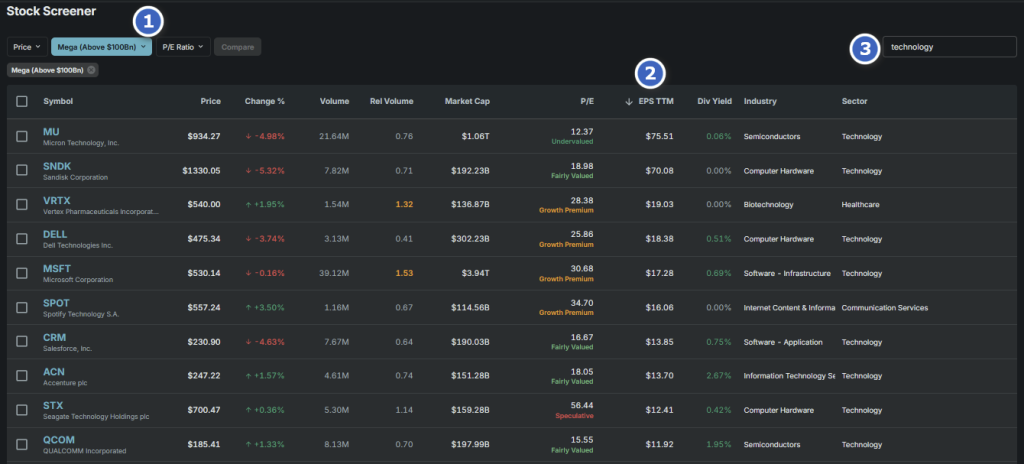
The Screener can help flesh out these opportunities below quickly and easily
- Select Mega from the Market Cap filter
- Sort by decreasing EPS TTM, which shows the highest EPS at the top
- Refine results with keyword technology
The Best Large-Cap Stocks to Buy and Hold
Large-cap stocks to buy today can offer an attractive balance between established operations and opportunities for continued growth. The three companies selected for this category are Fairfax Financial Holdings (TSX: FFH), AutoZone (NYSE: AZO) and Regeneron Pharmaceuticals (NASDAQ: REGN).
Fairfax Financial operates through insurance, reinsurance and investment businesses, providing exposure to insurance underwriting profits and the returns generated by its investment portfolio. AutoZone has an established position in automotive aftermarket parts, supported by recurring vehicle maintenance requirements and an extensive retail distribution network. Regeneron operates in biotechnology and pharmaceutical development, with an established portfolio of medicines and a pipeline of potential future therapies. These companies represent three different sources of business durability: insurance and capital allocation, automotive aftermarket demand, and pharmaceutical innovation. Their investment merits should be assessed through normalized earnings, cash generation, capital allocation and the sustainability of their competitive advantages. One consideration is that AutoZone has historically emphasized share repurchases rather than regular dividends, making it an exception to a strict dividend-paying investment screen.
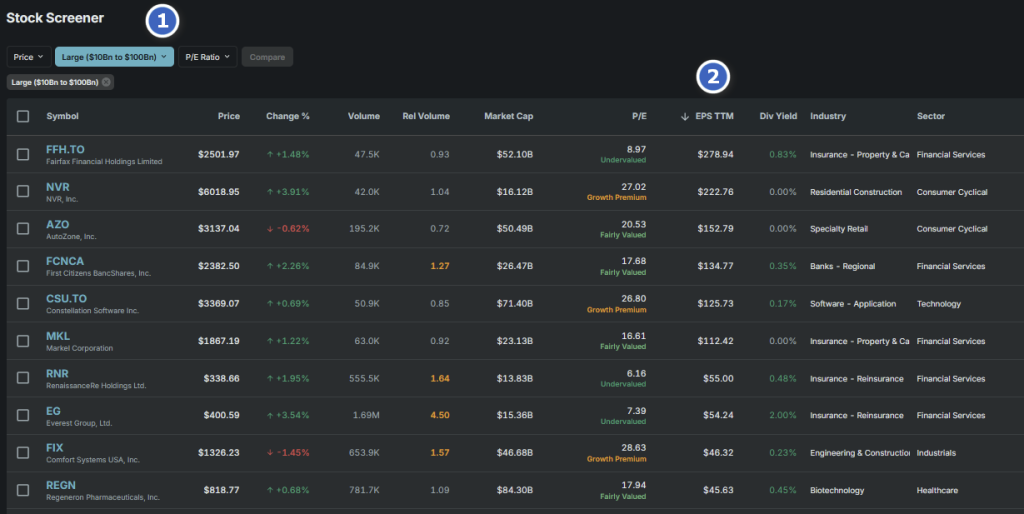
Filter on the Screener for Large Cap, and sort by EPS TTM descending
The Best Mid-Cap Stocks to Buy and Hold
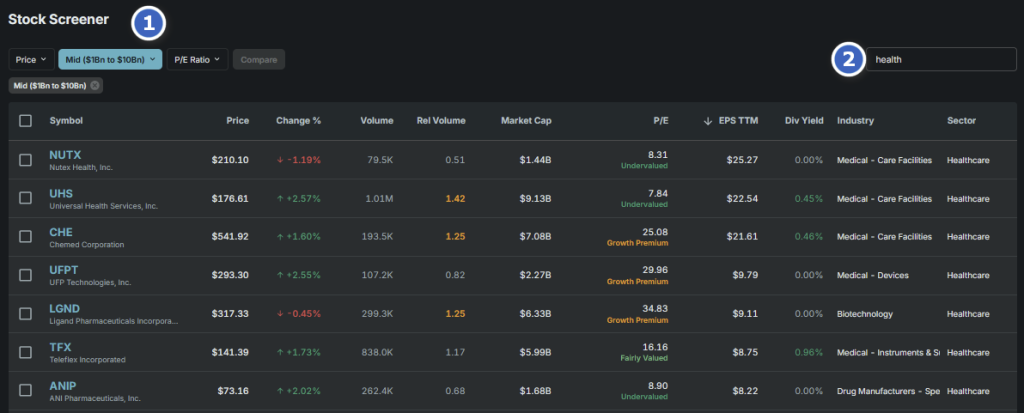
Mid-cap stocks to buy today can provide investors with exposure to businesses that have already established a market presence but may still have considerable room to expand. This category features Nutex Health (NASDAQ: NUTX), Universal Health Services (NYSE: UHS) and Lassonde Industries (TSX: LAS.A).
Nutex Health operates a network of micro-hospitals and healthcare facilities, offering exposure to the evolving delivery of outpatient and emergency healthcare services; however, its relatively concentrated operating model and financial history warrant careful examination. Universal Health Services is a much more established healthcare operator, with acute-care hospitals and behavioural health facilities generating revenue from ongoing demand for medical services. Lassonde Industries manufactures and distributes beverages and food products, including juices and other consumer packaged goods, providing exposure to relatively recurring consumer demand. These companies offer contrasting investment profiles: healthcare services expansion, established hospital operations and consumer staples manufacturing. For mid-cap investors, the opportunity is to identify businesses with sustainable earnings, attractive reinvestment opportunities and the potential to increase their market positions without taking on excessive financial risk.
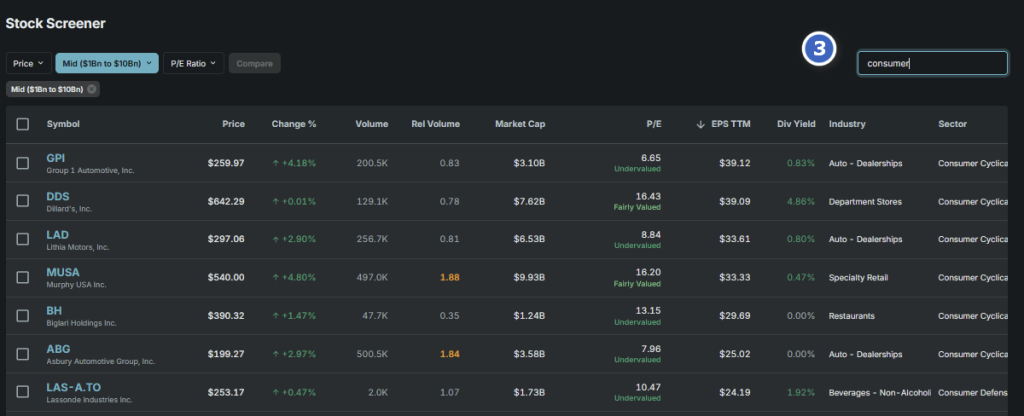
- selecting Mid-cap from Filter
- type “health” to bring in the Healthcare sector
- type “consumer” to bring in Consumer Defensive / Consumer Cyclical sectors
The Best Small-Cap Stocks to Buy and Hold
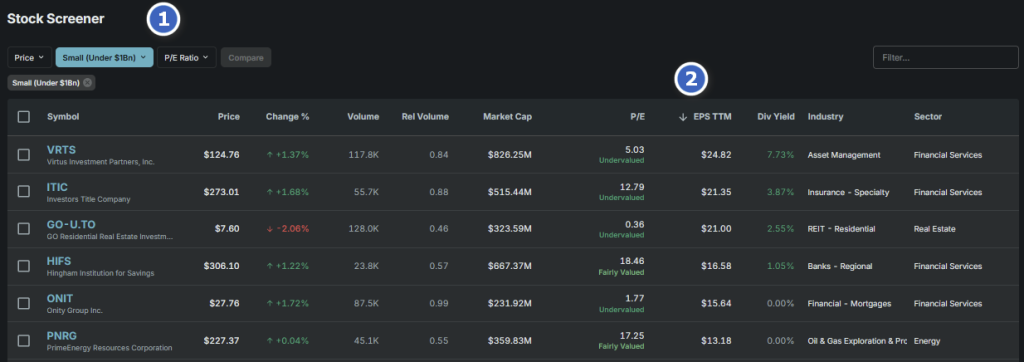
Small-cap stocks to buy today can offer opportunities that are less visible to institutional investors and large investment funds, particularly when a business is temporarily out of favour or receives limited analyst coverage. However, smaller companies generally carry greater business, liquidity and financial risks, making balance-sheet strength and cash generation particularly important. Three companies to examine are PrimeEnergy Resources (NASDAQ: PNRG), Investors Title Company (NASDAQ: ITIC) and Virtus Investment Partners (NYSE: VRTS).
PrimeEnergy Resources is an independent oil and gas exploration and production company, with investment returns influenced by commodity prices, production volumes and its ability to manage development costs. Investors Title Company provides title insurance and related services, benefiting from real estate transactions, mortgage activity and demand for property ownership protection. Its relatively specialized business model and established position in the title insurance market make it an interesting company to examine from a value-investing perspective. Virtus Investment Partners manages investment strategies and portfolios for institutional and individual investors, generating revenue primarily through management fees that are influenced by assets under management and market performance. These companies offer three distinct investment profiles: energy production, property-related financial services and investment management. Investors should pay particular attention to earnings stability, cash generation, dividend sustainability and debt obligations before considering these smaller businesses for a long-term portfolio.
In Screener, select Small for market-cap and sort EPS TTM decreasing to bring these candidates to the top
In depth review of criteria
EPS growth is the critiera, but the input to this ratio involves a stable, growing EBITDA over time. Search10K’s charts include 6 years of EBITDA growth to review the inputs. Selecting the company’s symbol, will open the company profile for you. Scroll down to the charts section for the EBITDA over time and the Net Debt and Asset Ratios chart. This brings you a great indication of EPS growth, since the “E” is Net Earnings in that ratio. It is possible a company to screen well with a high EBITDA but end up with a negative Net Earnings due to one of the factors to the right of “B” – interest/debt obligations, taxes, depreciation, or amortization. So it’s worth reviewing these charts, and then reviewing the 10K documents for what those risks entail.
Positive Free Cash Flow
FCF is really important to review, Free Cash Flow (FCF): Tracks real cash moving in and out of the business (Operating Cash Flow minus Capital Expenditures). It shows actual money available in the bank. Free Cash Flow is Much harder to manipulate because cash is tangible, EPS: Can be inflated through accounting choices, non-GAAP adjustments, or financial engineering like massive share buybacks that reduce the share count.
Share Buybacks and ROIC: Alternatives to Dividend Payments
Not all attractive long-term investments distribute earnings through regular dividends. Some companies instead return capital to shareholders through share repurchase programs, while others reinvest profits into their businesses at attractive rates of return. AutoZone (AZO), for example, has repurchased billions of dollars in shares since initiating its program in 1998 and reported adjusted after-tax ROIC of 36.3% in May 2026.
PrimeEnergy Resources (PNRG) has also demonstrated a long-standing commitment to repurchases, reducing its outstanding share count from approximately 7.6 million to 1.6 million over several decades. Nutex Health (NUTX) has introduced successive share repurchase programs, although some of its repurchases are intended to offset dilution from stock compensation and hospital development obligations. For investors, these companies illustrate why dividend yield should not be the sole measure of shareholder returns. A combination of attractive ROIC, disciplined capital allocation, earnings growth and share repurchases can potentially create more long-term value than distributing all available cash as dividends.
Comparing the 12 Stocks: Which Companies Offer the Best Value?
The following comparison brings the 12 companies together using trailing P/E ratios and dividend status. It allows investors to quickly identify companies that appear inexpensive relative to current earnings, while also distinguishing those that return cash directly to shareholders. As of October 30, 2026, several companies stand out on valuation: Fairfax Financial, Universal Health Services, Lassonde Industries and Virtus Investment Partners all have trailing P/E ratios below 12. Micron also has a relatively low reported P/E, although its earnings are currently benefiting from an exceptionally strong semiconductor cycle. Conversely, Hovnanian’s trailing P/E is above 100, reflecting a substantial decline in reported earnings rather than an attractive valuation. The table should therefore be treated as an initial screening tool, not a ranking of investment attractiveness.
| Category | Company | Ticker | Trailing P/E | Regular Dividends? |
|---|---|---|---|---|
| Mega-cap | Micron Technology | MU | 12.60 | Yes |
| Mega-cap | McKesson | MCK | 26.53 | Yes |
| Mega-cap | GE Vernova | GEV | 22.42 | Yes |
| Large-cap | Fairfax Financial | FFH.TO | ~7.8 | Yes |
| Large-cap | AutoZone | AZO | 20.81 | No (but does share buybacks) |
| Large-cap | Regeneron Pharmaceuticals | REGN | 19.25 | Yes |
| Mid-cap | Nutex Health | NUTX | 8.11 | No (but does share buybacks) |
| Mid-cap | Universal Health Services | UHS | 7.37 | Yes |
| Mid-cap | Lassonde Industries | LAS.A.TO | 10.87 | Yes |
| Small-cap | PrimeEnergy Resources | PNRG | 21.92 | No (but does share buybacks) |
| Small-cap | Investors Title Company | ITIC | 12.60 | Yes |
| Small-cap | Virtus Investment Partners | VRTS | 7.12 | Yes |
Trailing P/E figures are approximate market-data snapshots, not forecasts. FFH.TO’s available valuation snapshot is from September 2026. Canadian-listed stocks are quoted in CAD; U.S.-listed stocks are quoted in USD. Dividend status refers to regular dividends, not occasional special distributions. Snapshot based on October 2026.
Keeping the Best Stocks to Buy Today List Updated
A buy-and-hold investment strategy does not mean buying a stock and ignoring the business for the next ten years. Companies evolve, competitive advantages weaken, management teams change and valuations fluctuate. The best long-term investors continually evaluate whether the original investment thesis remains intact. Reading 10-K summaries are a great way to check these with the data right on the price chart to analyze changes in management’s strategic priorities, new business risks, capital expenditure commitments and acquisitions. Also check the CEO Report Card. Compare management’s stated objectives from 3 years ago with actual results today provides valuable insight into management quality and capital allocation discipline.
The best stocks to buy today may not be the most popular companies on Wall Street, but businesses that combine reasonable valuations, consistent earnings, sustainable cash generation and capable management. Whether investing in established mega-cap companies or exploring overlooked small-cap opportunities, the fundamental objective remains the same. Purchase businesses at attractive prices, understand the risks, and allow time and compounding to work in your favour. A disciplined buy-and-hold strategy, supported by regular financial statement analysis rather than short-term market speculation, can help investors build a portfolio designed to generate wealth over many years.
Disclaimer: This article is for informational and educational purposes only and does not constitute investment advice. Financial metrics change with share prices and company results. Investors should independently assess valuations, financial statements, dividend sustainability and risk before making investment decisions.