Two industrials just filed the biggest order books in their history, and Wall Street sold them both anyway. One is a 101-year-old cyclical that just met AI and can charge it whatever it likes. The other is an annuity Congress votes on every year, and $58.7 billion of the backlog is still waiting on the vote.
Everything here comes from Caterpillar and Northrop Grumman filings, earnings releases, and call transcripts, all linked below. Share prices are exchange closing data. Caterpillar reported on August 4, 2026. Northrop Grumman reported on July 21. Informational only, not investment advice.
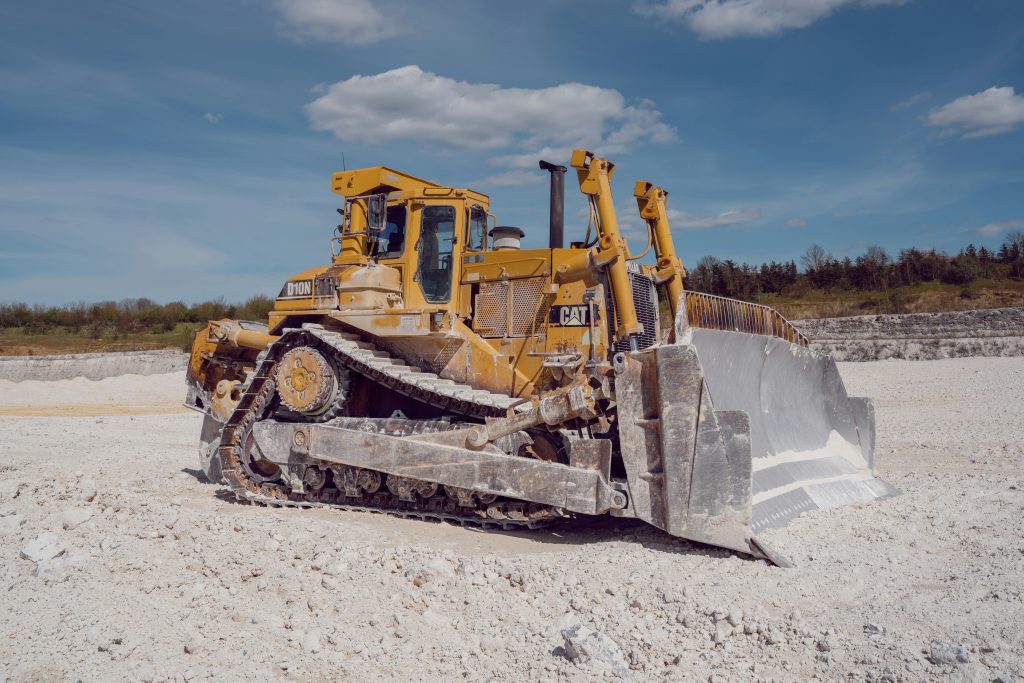
It’s early morning, you’re already cutting the drive to work close, and now traffic has slowed to 4 miles an hour because a Caterpillar excavator has decided your lane belongs to it. You know it’s a CAT before you get close enough to read the logo. The thing is enormous, yellow, and about as subtle as a school bus parked in your kitchen.
That yellow is also doing more work than you’d think. Caterpillar adopted the color in 1931 after decades of painting its machines gray, and some dealers hated the change enough to repaint the equipment themselves. Management stuck with it anyway. Nearly a century later, you can spot a CAT from half a mile away without knowing a thing about heavy machinery.
Now look to the sky.
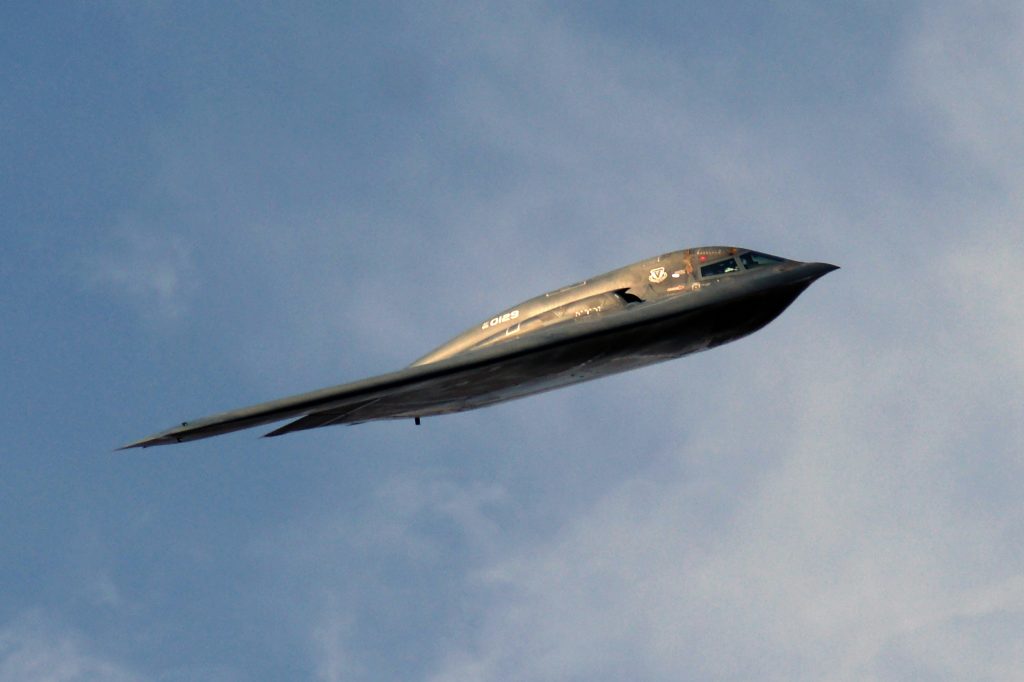
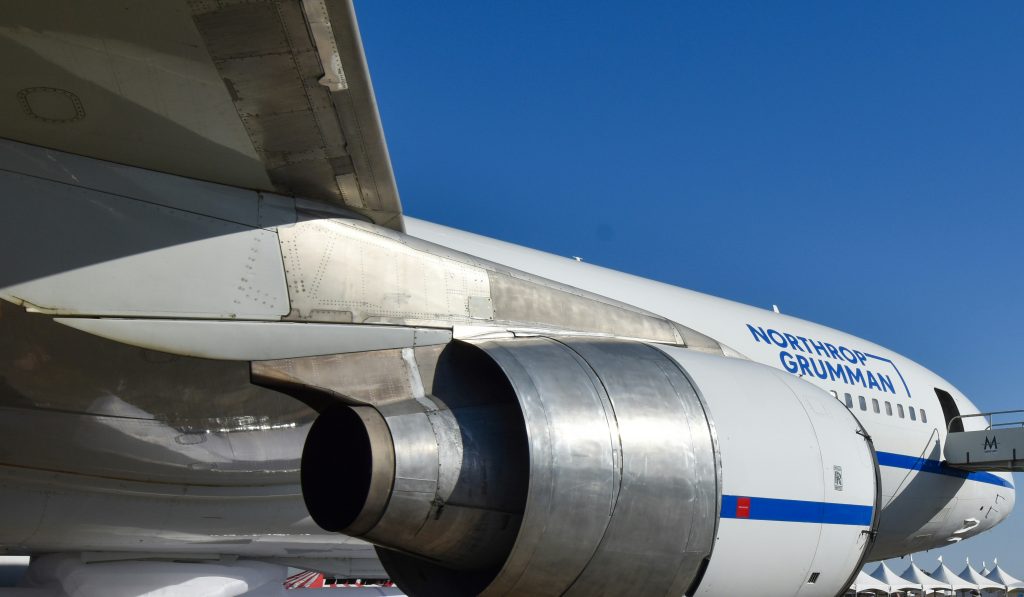
Somewhere above you, a Northrop Grumman aircraft could be passing overhead, and the entire point is that you wouldn’t know. The company helped build the B-2 Spirit, a bomber designed to disappear from radar and expensive enough that Congress eventually cut the planned fleet from 132 aircraft to 21. Caterpillar made visibility part of the brand. Northrop Grumman turned invisibility into the product.
That contrast gets even more interesting when you own the stocks.
Both companies are sitting on record backlogs. Both have enormous customers with enormous spending plans. In spite of that, both have also watched investors get nervous anyway. Caterpillar is riding the data-center and power-generation boom. Northrop Grumman lives inside defense budgets, classified programs, procurement cycles, and contracts that can stretch for years.
One company spent 100 years making sure you notice it. The other spent decades making sure you don’t.
Open the financial statements, and they’re almost as different there.
The Photographer Who Named a Company by Accident
Benjamin Holt’s problem in 1904 wasn’t engineering so much as dirt. The peat soil around Stockton, California, swallowed steam tractors the way a pond swallows a golf ball, and Holt had been watching it happen for years. So he had his crew pull the rear wheels off a tractor, bolt on a pair of tracks he’d sketched, and drive it through the mud on Thanksgiving Day. It didn’t sink. In the Stockton tractor business of 1904, that made him a genius.
He ran it again in March 1905, and this time he brought the company photographer, because Holt understood something about his business that Jack Northrop never would: if the thing works, you want a picture. The photographer was a man named Charlie Clements, and he showed up, looked at the machine, and had the reaction everybody has the first time they see a tank. “Wait, where are the wheels?”
Watching the tracks roll over the top, he said it crawled like a caterpillar, and Holt, who had apparently been waiting his whole life for someone to say something he could trademark, answered on the spot: “Caterpillar it is. That’s the name for it!”
So a machine built to keep a harvester out of the mud got a bug’s name, went to France, and dragged howitzers through muck that killed horses. A British officer heard about it and came up with the covert name for it, a “tank”, and it played a pivotal role in World War I’s trench warfare. Holt did not, as far as anyone knows, see that coming. He merged with his loudest competitor in 1925, and the yellow arrived 6 years later over the objections of everyone who sold the machines for a living. Nothing about this company has ever wanted to be subtle. Jack Northrop wanted the opposite.
The Dying Man Who Got to Hold His Own Vindication
Northrop had 1 idea and he had it for 50 years: an airplane is a wing, and everything else is dead weight you’re paying to haul around. The Air Force let him try it, and the YB-49 that came out of it in 1947 was everything he’d promised except stable, because the computer that could keep a tailless airplane pointed in one direction wouldn’t exist for another 30 years. It flew beautifully. It just kept wandering off.
In 1949 the Air Force cancelled the program and had the prototypes cut up for scrap, which even by Pentagon standards is a strong way to end a meeting. Northrop believed until the day he died that it was payback for refusing to merge with a rival. Historians have never proven it, but he quit at 57 and gave the entire aerospace industry the silent treatment for 28 years, so he certainly believed it.
Then, in April 1980, 2 men from the company came to his house. They had security clearances and they had a model. Northrop was in his 80s by then, in a wheelchair, and had lost the ability to speak. The model was a flying wing with a 172-foot span, to the foot the span of the airplane they’d scrapped 31 years earlier. He held it in his hands, shaking, and wrote on a pad: “Now I know why God has kept me alive for the past 25 years.” He died 10 months later, and the model became the B-2, the plane that’s famous for not being there.
The other name on the building belonged to a man with no theory at all. Leroy Grumman mortgaged his house for $16,950 in 1929, rented an abandoned auto showroom in Baldwin, New York, and spent the company’s first day of business on his hands and knees next to his vice president, sorting nuts and bolts. Years later, when the Navy wanted fighters that could fold up and stack on a carrier deck, he found the hinge by sticking paper clips into a soap eraser.
He also thought 250 employees was as big as the company ought to get, because any more than that and “we’re going to lose control of it.” His accountant had to tell him they were at 256. By 1943 there were 25,500, and the outfit Grumman wanted to keep small built the module that landed on the moon. Northrop bought the whole thing in 1994 for $2.1 billion, or about one B-2.
The Bulldozer Company Is Now a Power Company
CAT’s June quarter was the best in its 101 years, and not in the press-release sense where “best ever” means up 2%. The company sold $20.5 billion of machinery in 91 days, which it had never done before, and kept $4.3 billion of that as operating profit, which it had also never done before. The analysts who’d penciled in $6.20 a share got $8.17 and had to go explain to somebody why they were off by a third.
But the number that raises eyebrows is further down the release. Construction Industries, the division manufacturing bulldozers and excavators you picture when you hear the name, did $8.346 billion. Power & Energy, the division making engines and turbines, did $8.238 billion.
That leaves just $108 million between Caterpillar’s old identity and its fastest-growing one.
Power-generation sales jumped 72%, driven largely by data-center demand, and the orders are coming in far enough ahead that CAT has even brought back a 10-megawatt engine it had stopped making. When customers are trying to lock up power for projects that won’t come online until 2030, apparently the discontinued section of the catalogue becomes negotiable.
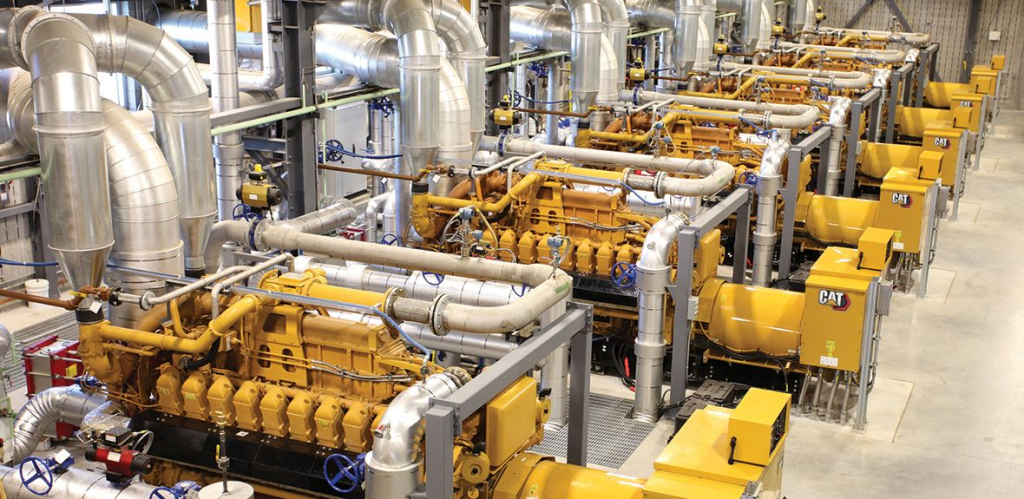
They’re not haggling much over price, either. Caterpillar pushed through another $595 million in price increases during the quarter, and customers kept ordering. That’s what a buyer looks like when getting enough power matters more than shaving a few points off the invoice.
CEO Joe Creed summed up the mood in 5 words: “No one is slowing down.”
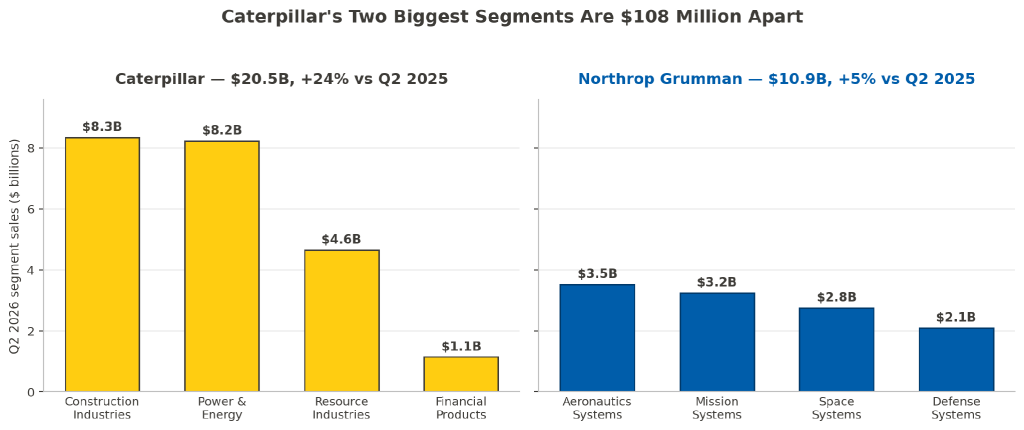
Q2 2026 segment sales, from each company’s earnings release. Growth is year over year, against the June 2025 quarter, the way both companies report it; sequentially CAT was up 18% and Northrop Grumman 10%. Financial Products is the in-house lender, which is how you sell a $2 million machine to a guy with a pickup.
Northrop Grumman Has $32 Billion More Backlog Than Caterpillar and $6 Billion Less Coming
Northrop’s quarter was a record too, in the way a good restaurant can have a record night and still comp 3 tables.
Sales grew 5% to $10.9 billion, which is fine. The orders are the story. Northrop booked $20 billion of new work in 3 months, nearly double what it sold, and $7.6 billion of that was for Sentinel, the missile that’s supposed to replace the Minuteman III. The Minuteman III has been on alert since 1970. Sentinel went so far over budget in 2024 that it tripped a federal law requiring the Pentagon to explain itself to Congress, which it did, at 81% over the original estimate, and then it kept the program anyway, because the alternative was ballistic missiles older than most of the people maintaining them. Another $4.3 billion went to “restricted programs,” which is a public company telling the SEC it got paid for something and the SEC nodding. Try that on your taxes.
All of which sounds enormous until you ask when any of it shows up. Northrop answers that question itself, on page 13: about 35% of the $104.7 billion backlog becomes revenue within 12 months, and 55% within 24. Caterpillar says 59% of its $72.1 billion ships inside a year. Do the arithmetic and CAT’s smaller order book hands over roughly $42.5 billion of revenue next year while Northrop’s bigger one hands over about $36.6 billion. The company with $32 billion more work booked delivers $6 billion less of it.
The other half of the answer is who’s paying. Of Northrop’s $104.7 billion, $45.9 billion is funded — Congress has appropriated it and the money exists somewhere. The remaining $58.7 billion is unfunded, meaning the contract exists and everybody has agreed to everything except the part where they pay. CAT’s $72.1 billion is all commercial orders, from customers spending their own money.
Bigger, slower, and more than half of it still needs a vote. Which brings you to the thing that actually separates these 2 companies, because one of them names its price and the other gets told.
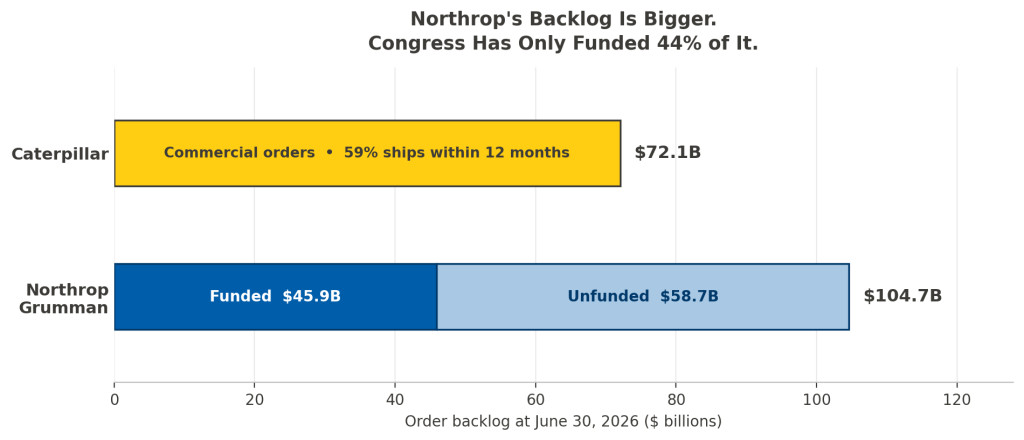
Backlog as of June 30, 2026. The funded/unfunded split is Schedule 4 of Northrop Grumman’s Q2 release. Funded means Congress has actually appropriated the money. CAT’s figure and shipping timeline come from its Q2 release and call.
The Caterpillar vs Northrop Grumman Scorecard, for Anyone Skimming
| Criterion | Caterpillar (CAT) | Northrop Grumman (NOC) |
|---|---|---|
| Quarter | Q2 2026, ended June 30 | Q2 2026, ended June 30 |
| Revenue | $20.5B, up 24% | $10.9B, up 5% |
| Operating income | $4.30B, a 20.9% margin | $1.10B, a 10.1% margin |
| What’s actually growing | Power generation, sales up 72% | Aeronautics, up 13% on B-21 and TACAMO |
| Earnings per share | $7.77, or $8.17 adjusted | $7.68, on a 6.3% tax rate |
| Backlog | $72.1B, up 92% YOY | $104.7B, with $58.7B unfunded |
| Cycle time | 59% are invoiced within 12 months of booking | 55% are invoiced within 24 months of booking |
| Who writes the checks | Contractors, miners, hyperscalers | The Pentagon. International sales were 14% |
| Who sets the price | CAT. +$595M in one quarter | The Pentagon. −$159M of overruns |
| Stuff it can’t talk about | None | $4.3B of restricted awards last quarter. A 2024 cancellation cost $1.6B |
| Dividends, first half | $7.92B | $0.75B |
| Share Buybacks last quarter | $1.5B | None |
| Dividend streak | 32 consecutive annual increases | 23 consecutive annual increases |
Both columns are the June 2026 quarter, from each company’s own release. Cash returned is for the 6 months ended June 30, from the cash flow statements.
Why Caterpillar Gets to Raise Prices, and Northrop Grumman Can’t
The difference in who’s writing the check changes almost everything.
Caterpillar sells to contractors, miners, utilities, and hyperscalers that need the equipment badly enough to keep paying up. Tariffs are expected to cost CAT about $2.2 billion this year, so it pushed through $595 million of price increases in one quarter. Yet it still managed to expand its operating margin by 430 basis points.
Northrop Grumman doesn’t have that luxury. Its customer writes the contract, audits the contract, funds the contract, and can drag executives in front of Congress when the contract goes sideways.
Last quarter, Northrop Grumman took a $68 million charge on the Stand-in Attack Weapon after testing slipped and another $91 million on the GEM 63XL rocket motor after a redesign. NOC’s Defense Systems margin fell from 12.7% to 7.5%; its Space division dropped from 10.6% to 8.6%. On fixed-price development work, there’s no customer to call afterward and explain that the job got expensive.
The B-21 is the even uglier version of cost overruns. Northrop Grumman won the bomber in 2015 and has since absorbed $1.56 billion in losses in 2024, followed by another $477 million in Q1 2025.
That’s the defense-contracting version of winning an eBay auction and discovering shipping costs $2 billion.
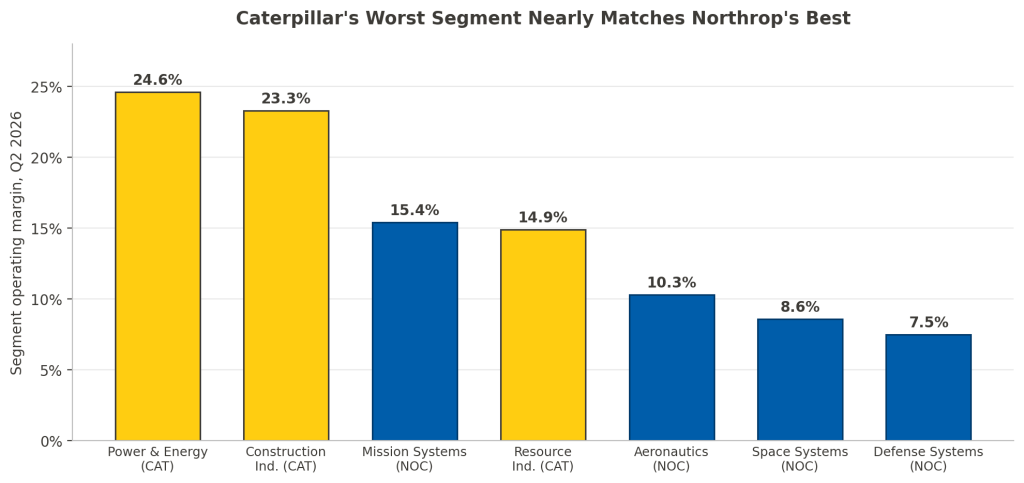
Segment operating margin, June 2026 quarter, from each company’s release. Mining is CAT’s weakest business, and it still comes within half a point of Northrop Grumman’s strongest.
Northrop Grumman ’s Best-Performing Division Last Quarter Was Its Tax Department
Northrop Grumman may not get to rewrite a fixed-price contract when costs go bad, but it did get some relief from another arm of the federal government.
If you’ve read this series before, you know where this is going. The interesting stuff is rarely in the headline.
Northrop Grumman ’s operating income fell 23%, while net income fell only 7%. The bridge between those 2 numbers was taxes. Its effective rate dropped from 17.7% to 6.3% after the company remeasured old tax positions during discussions with the IRS, shaving $179 million off the bill. Run the quarter at last year’s tax rate, and EPS lands around $6.75 instead of $7.68.
Nothing shady there. It’s disclosed, it’s real, and it’s also the kind of earnings help you don’t pencil into next quarter.
CAT had its own assist from Uncle Sam, only higher up the income statement. Operating profit included $392 million of expected IEEPA tariff refunds. Strip those out, and the margin looks closer to 20% than the reported 21.9%. Management has already said not to expect another round of tariff refunds in the second half.
CAT Is Cashing Checks While Northrop Grumman Builds the Farm
Caterpillar got some tariff money back and promptly kept doing what Caterpillar does with cash: sending an enormous amount of it back to shareholders. Northrop Grumman got its tax break and still had plenty of reasons to keep the checkbook close.
Through the first 6 months of 2026, CAT repurchased $6.5 billion of stock and paid $1.4 billion in dividends. In June, it raised the dividend another 8%, extending an annual streak that goes back to the Clinton administration. CAT’s policy is to return essentially all of the machinery business’ free cash flow, and management treats that promise like somebody’s checking the mailbox.
Northrop Grumman returned $752 million over the same stretch, almost entirely through dividends, and repurchased exactly 0 shares in Q2. Its $2.5 billion authorization has been sitting mostly untouched since December 2024, aging gracefully.
There’s a reason. First-half free cash flow was negative $845 million while capex heads toward $1.85 billion. Northrop Grumman is spending today to build programs it won years ago and may collect on for decades. CAT is harvesting. Northrop Grumman is still building the farm. That’s perfectly rational with a $104.7 billion backlog. It’s also worth remembering that $58.7 billion of it is still waiting for Congress to fund it.
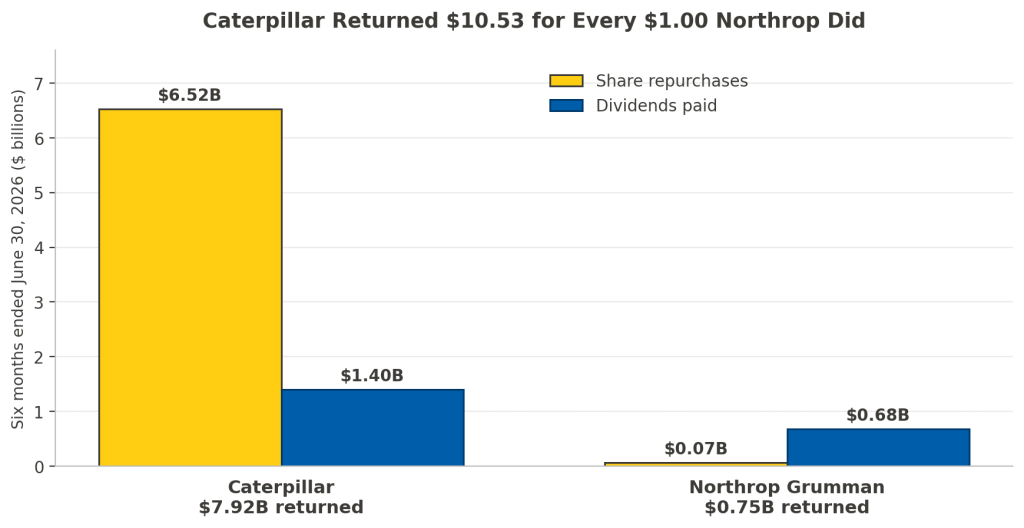
6 months ended June 30, 2026, from each company’s cash flow statement.
| Want to know whether a CEO actually did what he said he’d do 3 years ago? That’s what Search10k’s CEO Leadership Report is for. It grades executives against the plans in their own filings. |
So Whose Story Are You Buying?
By now, the excavator is probably still in your lane. The Northrop Grumman airplane, assuming there was one, came and went without introducing itself. That’s a pretty good way to remember the choice.
Caterpillar gives you plenty to look at. Dealer inventories, monthly retail sales, pricing, margins, cash returns. Right now, nearly all of it looks terrific. A 101-year-old cyclical has stumbled into a power-generation boom, pushed margins past 21%, and handed shareholders $7.9 billion in 6 months while customers kept ordering.
The risk is hiding in how good that feels. Data centers are suddenly one of CAT’s best customers, and suddenly is doing some work there. More than 300 data-center bills hit state legislatures in a matter of weeks this year. “No one is slowing down” sounds fantastic until somebody does.
Northrop asks for a different kind of faith. You’re buying classified programs you can’t inspect, $58.7 billion of unfunded backlog, contracts priced years before the final bill arrives, and one customer that can always turn a budget into a political argument. So CAT gives you visibility with cyclicality. Northrop Grumman gives you durability with opacity.
Back Testing Result
Search10k puts the filings next to each other so you can see exactly which tradeoff you’re making when comparing Caterpillar vs Northrop Grumman
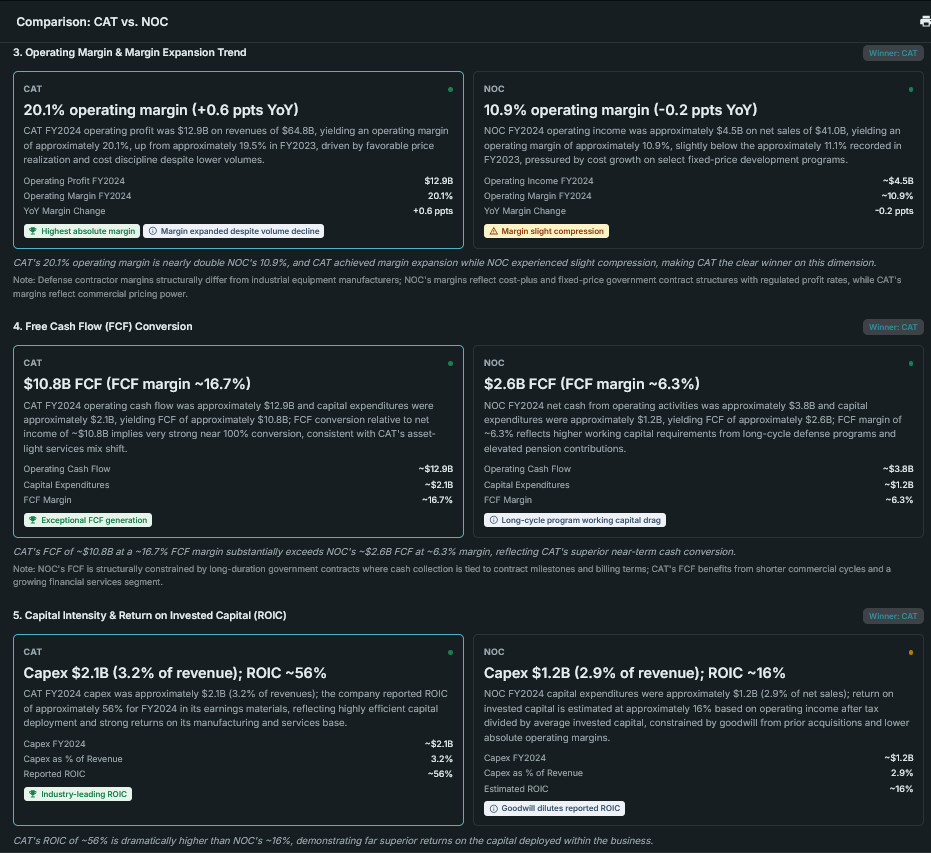
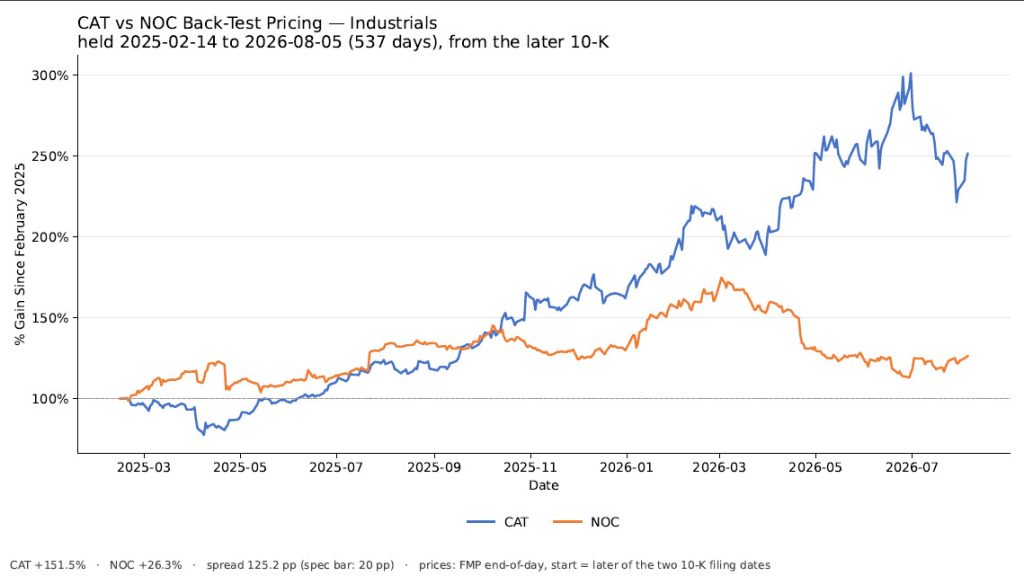
The outcome suggests that, at least over this window, the market rewarded CAT’s superior margins, cash conversion, and capital returns more heavily than it rewarded NOC’s revenue stability and backlog visibility — even though NOC’s underlying business carries meaningfully less cyclical risk. It’s a reminder that “the stronger fundamentals” in a scorecard sense doesn’t always mean “the safer bet” in a risk sense; CAT’s outperformance came with far more volatility along the way, including a roughly 20-point pullback in the final months of the test.
The excavator or the invisible bomber. At least now you know what’s inside both.
| Try it on 2 companies you actually own. Drop any pair into the Screener and see what shakes out. Start free, or contact us and grab 20 minutes. |
PRIMARY SOURCES
- Caterpillar. Second-Quarter 2026 Results, Form 8-K Exhibit 99.1 (SEC EDGAR, Aug 4, 2026). Revenue, segment sales and profit, price realization, the $392M IEEPA recoveries, cash flows and buybacks all come from here.
- Caterpillar. Form 10-Q for the quarter ended June 30, 2026 (SEC EDGAR), for the MD&A and margin detail.
- Caterpillar. Q2 2026 earnings call transcript (Aug 4, 2026), for the $72B backlog, the 59% 12-month delivery figure, the $2.2B tariff estimate and the 10-megawatt engine restart.
- Caterpillar. Dividend increase, Form 8-K Exhibit 99.1 (SEC EDGAR, Jun 10, 2026), for the 8% raise and the 32-year streak.
- Caterpillar. The Story of the Caterpillar Name (company history archive), for Benjamin Holt, Charlie Clements and the Thanksgiving Day test.
- Toromont Cat. Where Did Caterpillar’s Trademark Yellow Come From?, for the December 7, 1931 memo and the dealers who repainted.
- CNBC. Caterpillar lifts 2026 sales growth target (Aug 4, 2026), for the $9.4B of orders and the North American construction detail.
- Northrop Grumman. Second Quarter 2026 Financial Results, Form 8-K Exhibit 99 (SEC EDGAR, Jul 21, 2026). Sales, segment margins, the SiAW and GEM 63XL adjustments, the tax rate, guidance and the Schedule 4 funded/unfunded split all come from here.
- Northrop Grumman. Form 10-Q for the quarter ended June 30, 2026 (SEC EDGAR), for the Sentinel restructure status, the May dividend increase and the unused repurchase authorization.
- Air & Space Forces Magazine. Northrop Grumman Eats $1.56 Billion Loss on First B-21 Lots (Jan 2024), and Defense News, Northrop loses $477M on B-21 (Apr 2025).
- Defense News. Air Force’s next nuclear missile at risk after costs spike (Jan 19, 2024), and The War Zone, Sentinel will press ahead despite nearly doubling in cost (Jul 8, 2024), for the Nunn-McCurdy breach, the 81% overrun and the Minuteman III timeline.
- Air & Space Forces Magazine. The Low-Drag World of Jack Northrop, for the YB-49, the 1980 model and Northrop’s written note.
- MacroTrends. CAT and NOC closing price history, for the September 2026 closes and the 2026 highs.
Disclaimer: This article is for informational and educational purposes only. It is not investment advice, a research report, or an offer or solicitation to buy or sell any security. Statements of fact come from public filings, earnings releases, call transcripts and press reports, all linked above and historical in nature; past performance does not guarantee future results. Historical details of the Holt and Jack Northrop stories come from company archives and press reporting rather than SEC filings, and the account of why the YB-49 was cancelled remains contested. Quotations from Joe Creed and Kathy Warden are drawn from their companies’ second-quarter 2026 earnings releases and calls. The illustrative $6.75 per-share figure is our own arithmetic applying the prior-year tax rate to reported pre-tax earnings, and is not a company-reported measure. Any interpretation or characterization of these facts is opinion, not a statement of fact. Forward-looking items, including both companies’ 2026 guidance and Northrop Grumman’s international-sales target, are the companies’ own forward-looking statements, are subject to the risks described in their SEC filings, and may differ materially from actual results. Readers should do their own due diligence and consult a licensed professional before making any investment decision.