Con Edison CEO Tim Cawley calls the 203-year-old utility “a durable, long-term investment.” Brookfield Infrastructure CEO Sam Pollock told analysts that if supply tightens, “that’s going to make existing assets more valuable,” which is about as landlord a sentence as you’ll ever hear on an earnings call.
Updated Nov. 8, 2026, with both companies’ third-quarter results. Figures come from company filings and earnings materials, linked at the end. Informational only, not investment advice.
Every New Yorker has complained about a Con Ed bill. Almost nobody complains about Con Ed’s dividend. That’s the whole appeal of owning Con Edison (NYSE: ED). The same company that keeps your lights on and puffs steam out of those orange-and-white chimneys in the middle of the avenue has mailed its shareholders a bigger check every year for 52 years straight.

Brookfield Infrastructure Partners (NYSE: BIP) has the opposite reputation problem, which is that it doesn’t have one. You’ve probably never gotten a bill from it, but you may have paid it today. It owns a piece of Colonial Pipeline, the fuel artery that runs from Houston to New York Harbor, along with the container giant Triton and a growing pile of data centers.
Wall Street calls both of these utility stocks. We’d argue only one of them really is. The other is closer to a private equity fund that happens to own some power lines, and the difference comes down to one question: who gets to set the rent?
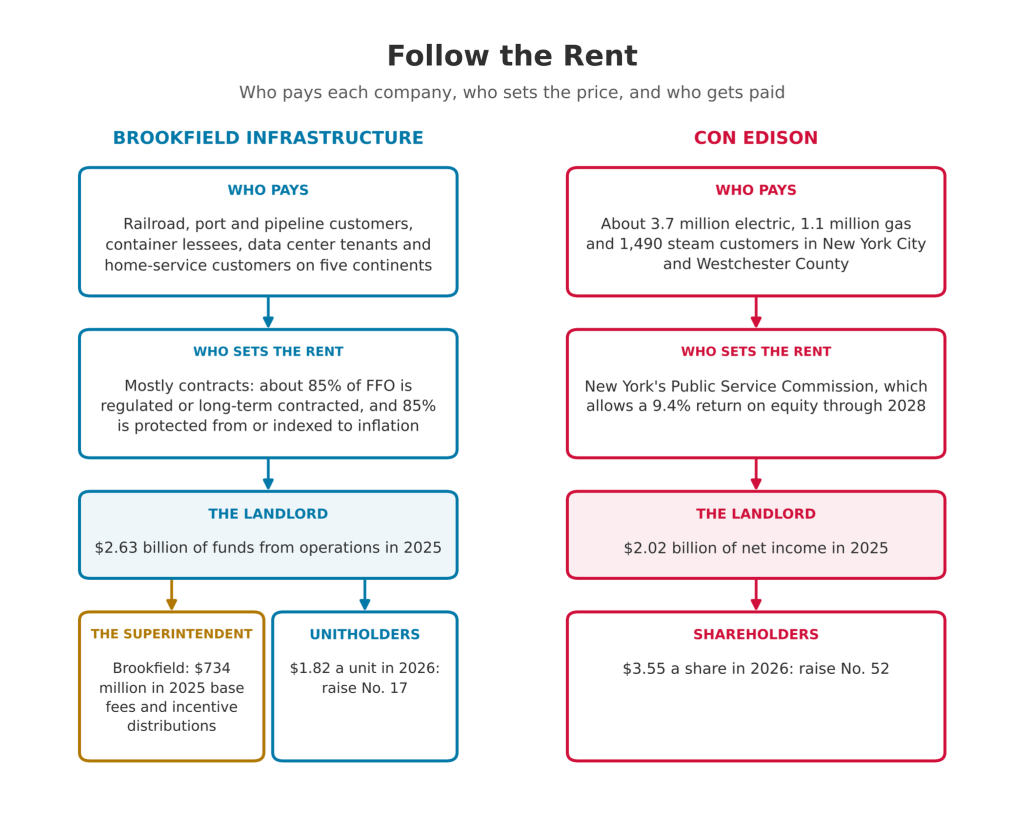
2025 figures from Con Edison’s fourth-quarter 2025 earnings presentation, 2025 Form 10-K and rate filings, and from Brookfield Infrastructure’s 2025 results release, supplemental information, Form 20-F and August 2026 corporate profile. Payouts are each company’s 2026 rate.
Con Edison Has Been Gaslighting New York Since 1823
Con Ed comes by the pun honestly. It started life in 1823 as the New York Gas Light Company, almost 60 years before Thomas Edison flipped on his Pearl Street power station near Wall Street.
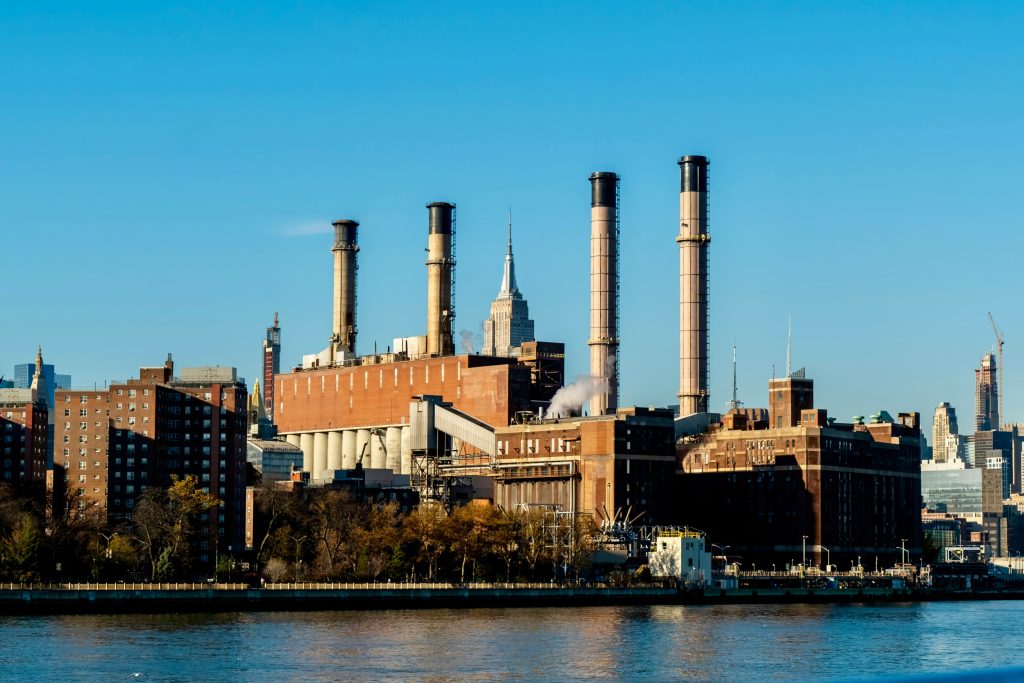
For generations, utility stocks were what your grandparents bought so they could sleep at night. People literally called them widows-and-orphans stocks. Then in 1974, with oil prices through the roof, Con Ed skipped its dividend for the first time in 89 years, and the stock lost a third of its value. Con Ed has spent every year since making it up to people, which is how you get 52 straight raises.
It did flirt with life outside New York, building a national renewables business and buying into gas pipelines. Then it sold nearly all of it, the renewables to RWE for $6.8 billion in 2023 and the Mountain Valley Pipeline stake this March. Today 94% of its profit comes from one New York utility, run by Tim Cawley, who joined in 1987, when the Mets were defending champs.
Brookfield Started as a Brazilian Trolley Company and Never Stopped Shopping
Brookfield’s story starts with streetcars instead of streetlights, about 5,000 miles south of Manhattan. The São Paulo Tramway, Light & Power Co. was founded in 1899 to run trolleys and electricity in a booming São Paulo. Its successor, later renamed Brascan, kept the lights on there and in Rio until 1979. Brascan eventually became Brookfield, now one of the world’s biggest alternative asset managers.

That part matters, because BIP is basically Brookfield’s infrastructure fund with a stock ticker. Brookfield spun it off on Jan. 31, 2008, with about $1 billion of power lines and timberland, roughly eight months before Lehman Brothers blew up. Lousy timing, you’d think. But a financial crisis is a clearance sale if you have cash, and in 2010 BIP swallowed Australia’s Prime Infrastructure. Today it reports $120.6 billion of assets.
And unlike Con Ed, it sells for a living. Con Ed’s sales were a one-time retreat to New York. BIP sells mature assets routinely and rolls the cash into new deals, a cycle it calls capital recycling. By its own count, BIP has made more than 50 sales, raising about $12.7 billion at an average 22% internal rate of return. Sam Pollock joined Brookfield in 1994 and ran its corporate investment group and its private equity business before taking charge of setting up the infrastructure business in 2007. He has run it since then.
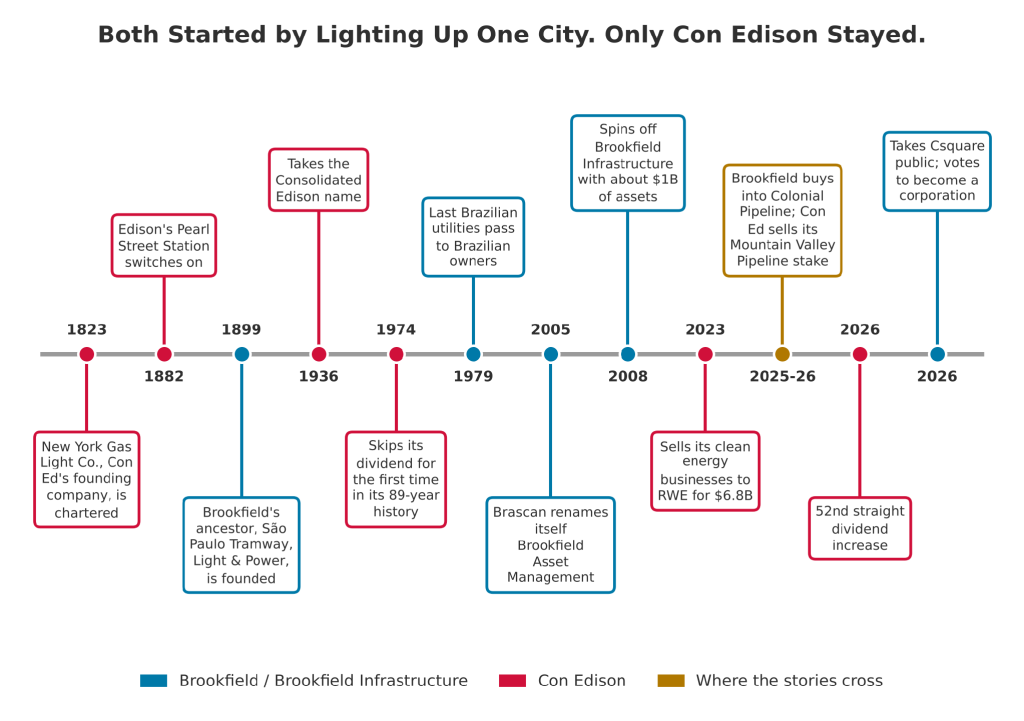
Selected events. Con Edison history from its 200th-anniversary release, its filings and TIME (May 6, 1974); Brookfield’s Brazilian history from Brookfield and press accounts; the spin-off, Colonial and Csquare from Brookfield Infrastructure filings.
Con Ed Has to Beg Albany for a Raise
The utility deal is simple. Con Ed spends money on wires, pipes, and steam mains; regulators let it earn a set return on it, and customers pay through their bills. If Con Ed wants more, it has to ask the state, in public, with every elected official in New York watching.
In January 2025, it asked for $2.05 billion more for 2026, at a 10.1% return on equity. A year later, the Public Service Commission gave it $262 million, at 9.4%, and the commission’s James Denn called that “an 87% reduction to Con Ed’s requested rates in 2026.” If you’ve ever asked your boss for a $100 raise and walked out with $13, you know the feeling.
Meanwhile Brookfield Just Writes Its Raise In
Brookfield sits through far fewer of those meetings. About 85% of its cash flow is regulated or locked into long-term contracts, many with raises baked in. Its new AI deals go even further. An executive described them on the third-quarter call as “take-or-pay.” This is basically a gym membership for data centers: you pay each month whether or not you show up.
Even the regulated part isn’t regulated the way Con Ed is. Con Ed answers to one commission for almost all of its profit, and its base rates go up only on a schedule that commission approves in a rate case. BIP’s regulated businesses, from British power and gas connections to Brazilian pipelines and power lines, answer to different regulators in different countries, so no single one has much say over BIP’s overall cash flow. Many also have inflation raises written into the rules: in its U.K. distribution business and its Brazilian gas pipeline, for example, tariffs rise with inflation without a new rate case. The rest of that 85% isn’t regulated at all. It’s contracts BIP negotiated directly with customers.
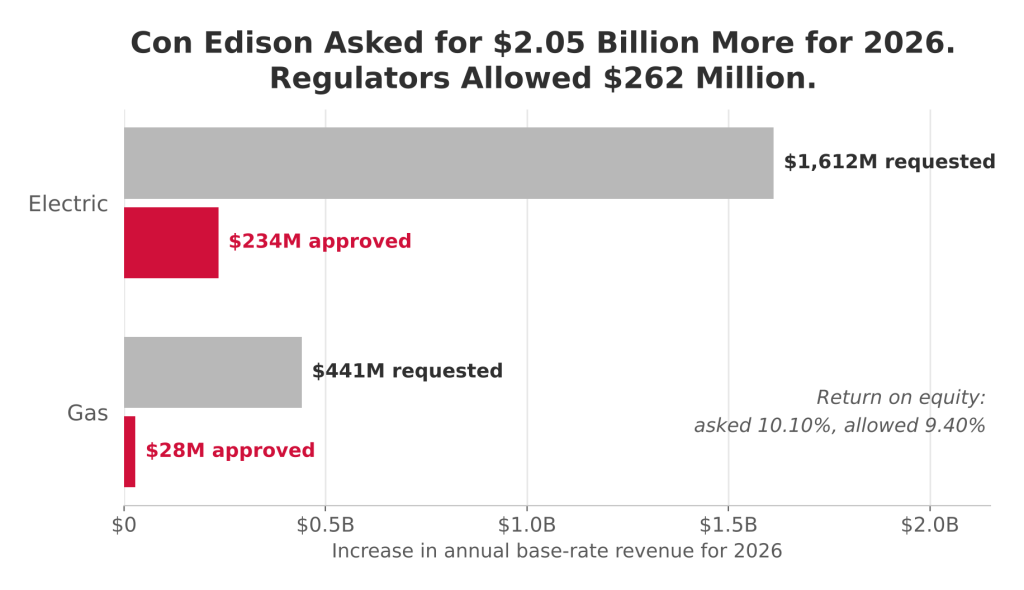
Con Edison of New York’s January 2025 request for 2026 versus the shaped base-rate increases in the joint proposal the New York PSC adopted Jan. 22, 2026, from the company’s rate filing summaries. The underlying 2026 revenue changes were $222 million for electric and −$46 million for gas.
Brookfield’s Biggest Earner Isn’t Even a Utility
Calling BIP a utility is a bit like calling Amazon a bookstore. It was true once, and it’s wildly inadequate now.
Its actual utilities (mostly Brazilian power lines, U.K. regulated distribution, and home services) made just 25% of its 2025 funds from operations (FFO) before corporate costs. The biggest chunk, 37%, came from transport, meaning railroads, toll roads, ports, and Triton’s shipping containers. Pipelines and storage, Colonial included, added 22%. And if you read our Valero vs. Phillips 66 showdown, you know what’s flowing through them. The last 16% came from data centers, towers, fiber and chip plants. That’s the part growing like a weed, up 51% in 2025 and another 25% in the third quarter.
Con Ed, meanwhile, is about as pure as utilities get. Its main subsidiary earned $1.91 billion of the company’s $2.02 billion profit last year. It also runs the largest steam system in the U.S., with customers like the Empire State Building and Grand Central.
So when we say only one of these is really a utility, we mean it.
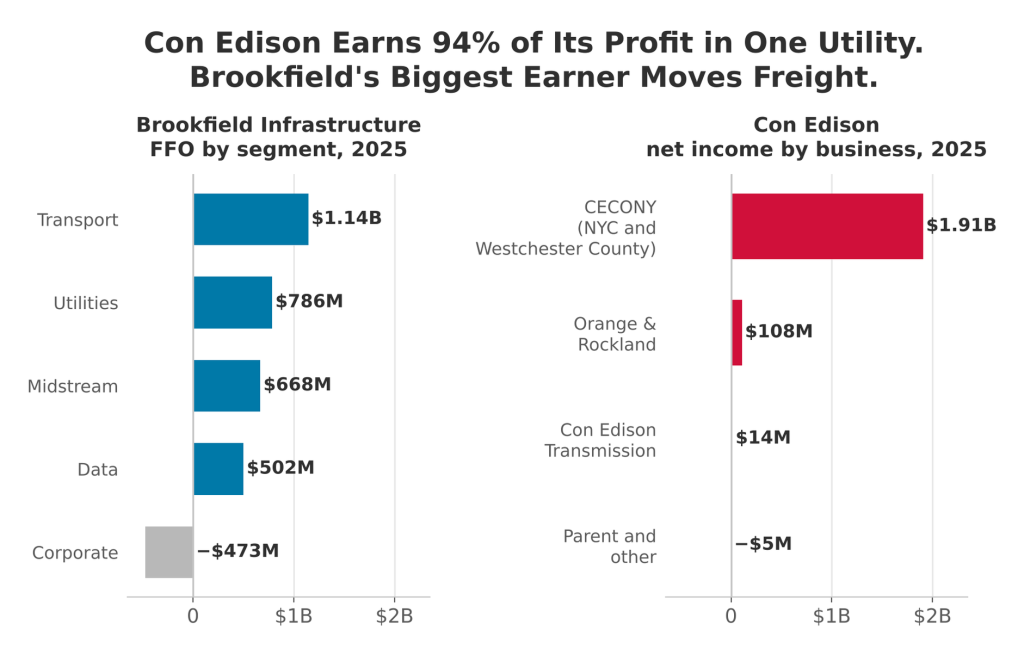
Brookfield Infrastructure’s funds from operations by segment for 2025, from its 2025 results release; Con Edison’s net income for common stock by company for 2025, from its fourth-quarter 2025 earnings presentation. FFO and net income are different measures. Shares of FFO before corporate costs are our arithmetic.
Q3 Report Card: Con Ed Aced Boring
Con Ed’s third quarter was exactly what its shareholders expected. Adjusted EPS rose 9% to $2.07, GAAP earnings matched it to the penny, and Cawley’s team narrowed full-year guidance to $6.05 to $6.15. Nobody’s making a movie about it, and that’s fine.
BIP’s quarter was more interesting, the way a magic trick is interesting. FFO, the number BIP wants you to look at, rose 10% to 91 cents a unit, right on target. (BIP is a partnership, so its owners hold units instead of shares, and they trade the same way.) Net income, the number accountants make it report, came to minus 4 cents. Both are real. FFO leaves out depreciation, the accounting charge for assets wearing out, which piles up fast when you own railroads even though no cash goes out the door when it’s booked. Net income keeps it, and then Brookfield’s own cut acting as superintendent, which we’ll get to, eats the rest. REIT investors know this game of taking a services cut out of assets from our Welltower vs. Healthpeak breakdown.
Q3 Report Card: Brookfield Got an Asterisk
That’s also how BIP keeps raising its payout while net income is negative. Distributions are paid out of cash flow, not accounting profit, and BIP’s 45.5-cent quarterly distribution is half of the 91 cents of FFO per unit it generated last quarter. That gap between cash and accounting profit is why REITs and BIP keep score with FFO per unit instead of earnings per share, though each company defines FFO its own way, so treat it as the company’s number, not an accounting standard. None of this is new, either. BIP lost 4 cents a unit for all of 2017 and still raised its distribution 8% the next year.
To be fair, BIP’s long game has been good, with FFO per unit up 131% since 2015 against 40% for Con Ed’s adjusted EPS. Con Ed’s brag is different. It grew 6.4% a year from 2020 to 2025 after promising 3% to 5%, exactly the kind of follow-through we like to see.
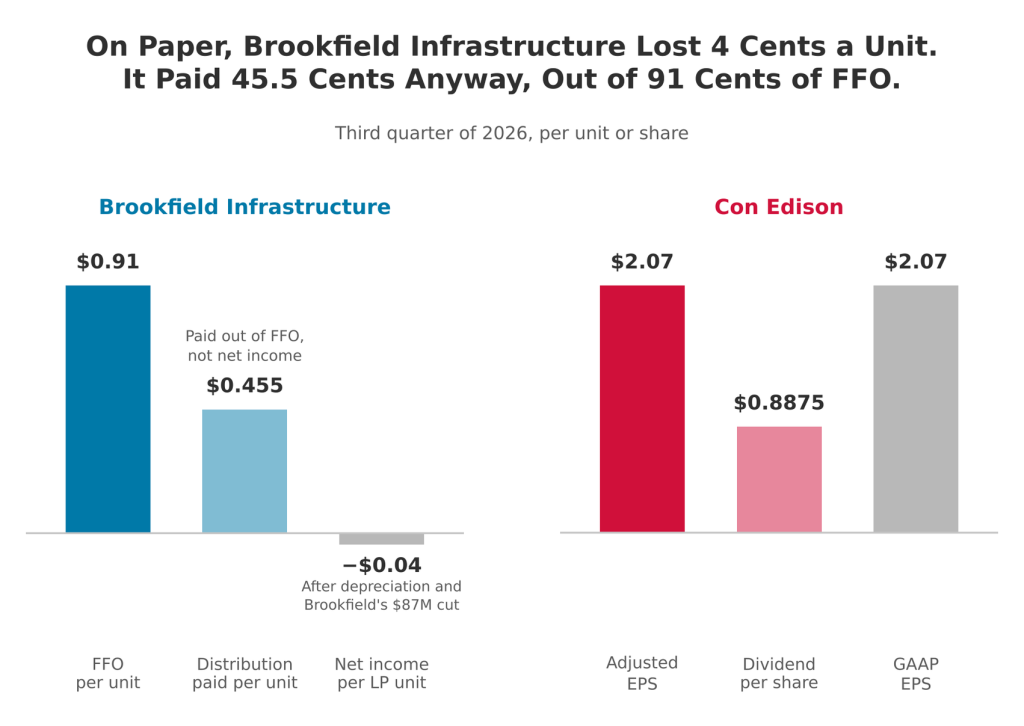
Third-quarter 2026 results from Brookfield Infrastructure’s Q3 2026 results release and Con Edison’s Q3 2026 earnings release (Form 8-K Exhibit 99.1); quarterly payouts from each company’s distribution or dividend history. FFO and adjusted EPS are non-IFRS and non-GAAP measures; net income per limited partnership unit (IFRS) and GAAP EPS are the reported measures.
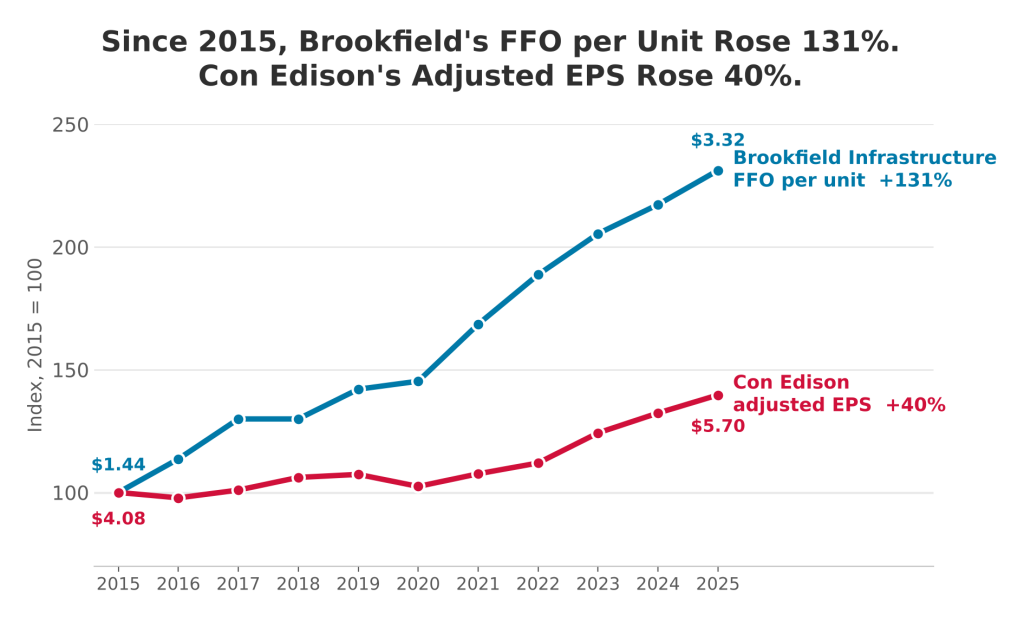
Brookfield Infrastructure FFO per unit and Con Edison adjusted EPS, both non-GAAP, indexed to 2015 = 100, from each company’s year-end results releases. We converted Brookfield’s earlier years to today’s units using its 3-for-2 splits (2016, 2022) and its 2020 BIPC special-distribution adjustment.
Fifty-Two Years of Raises, All Starting With an Apology
Most people who own either of these are in it for the checks. Con Ed is what Wall Street calls a Dividend King, meaning it has raised its payout for at least 50 straight years. January’s bump took it to $3.55 a share, up 4.4%. That’s its biggest raise in at least a decade, and it still uses only about 58% of expected earnings. Con Ed is your aunt who never forgets your birthday and sends a slightly bigger check every year.
BIP raised its distribution 6%, to $1.82 a unit, its 17th straight increase of at least 5%. Adjusted for splits and the 2020 BIPC spinoff, it’s up about 61% since 2018, against 24% for Con Ed’s dividend. The third-quarter payout used 64% of FFO, a ratio that also counts Brookfield’s incentive distributions and preferred payouts, not just unitholders’ checks.
BIP is a Bermuda partnership, so U.S. holders get a K-1 instead of a 1099. Anyone who has dealt with one knows it can ruin an April. BIP says its conversion into a corporation, expected Nov. 19, should fix that for many investors. Like most things involving Brookfield, it comes with strings attached.
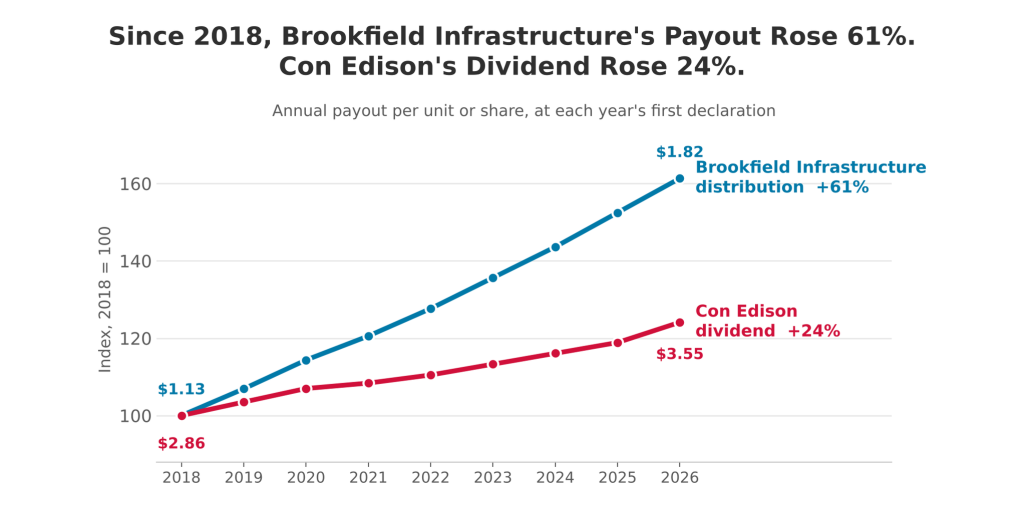
Annual payout per unit or share at each year’s first declaration, indexed to 2018 = 100, from Con Edison’s dividend history and Brookfield Infrastructure’s distribution history. We restated Brookfield Infrastructure’s earlier payouts in today’s units using its June 2022 3-for-2 split and its March 2020 BIPC special distribution (one BIPC share for every nine units). Index values and percentage changes are our arithmetic.
The BIP vs. ED Scorecard, for Skimmers
Results are for the nine months ended Sept. 30, 2026. Outlooks and plans are each company’s own.
| Brookfield Infrastructure (BIP) | Con Edison (ED) | |
|---|---|---|
| What you own | Pipelines, railroads, ports, towers and data centers worldwide | New York City and Westchester County’s wires, gas mains and steam pipes, plus Orange & Rockland |
| Who sets the rent | Mostly contracts; about 85% of FFO regulated or contracted | New York PSC; 9.4% allowed return through 2028 |
| Nine months of 2026 | FFO $2.70 a unit, up 10% | Adjusted EPS $5.08, up 5% |
| The asterisk | Net loss of 31 cents per LP unit | GAAP EPS $5.44, with a 37-cent pipeline-sale gain |
| 2026 outlook | 10%-plus FFO per unit growth target; 10% on 2025’s $3.32 would be about $3.65 a unit | Adjusted EPS $6.05 to $6.15, narrowed |
| Annual payout | $1.82 a unit, up 6%, raise No. 17 | $3.55 a share, up 4.4%, raise No. 52 |
| Payout ratio | 65% of FFO, first nine months | About 58% of guidance midpoint |
| The other boss | Brookfield: $734M in 2025 fees and incentives | Albany: rate cases and a new affordability law |
| Tax form | K-1 until the conversion (expected Nov. 19) | Form 1099 |
| The punchline | The world’s landlord, with its own greedy superintendent | New York’s landlord, with a rent control board |
Company figures from third-quarter 2026 releases, supplemental information and filings. Con Edison’s payout ratio, Brookfield Infrastructure’s fee total and the $3.65 illustration (2025 FFO per unit plus 10%) are our arithmetic. FFO and adjusted EPS are non-GAAP measures and are not comparable.
Con Ed Is Fixing the Building While Brookfield Builds an AI Wing
Both companies plow the rent back into the property. They just have very different ideas about what the place needs.
For Con Ed, it’s a renovation. The company plans to spend about $37.5 billion from 2026 through 2030, nearly all of it at its two utilities, and expects to have 28 new substations in service by 2035. Renovations aren’t cheap, either. So Con Ed is also selling up to $1.1 billion of new stock this year to help cover the bill.
What it isn’t doing is betting on a demand boom, and the numbers back that up. Con Ed’s all-time peak, meaning the most electricity its customers in New York City and Westchester County ever used at once, still dates to July 19, 2013, when demand hit 13,322 megawatts. In other words, more than nine years before ChatGPT and the energy-guzzling AI data centers even existed. What’s more, this summer’s peak landed right on forecast once you adjust for the weather, and Orange & Rockland, the smaller of the two utilities (Cawley ran it from 2013 to 2017), just cut its forecast for peak-demand growth to 2.6% a year from 4.1%. It pointed mainly to a weaker outlook for electric cars and fewer requests from big new customers to connect to its grid.
BIP, meanwhile, is building for exactly the kind of boom Con Ed isn’t betting on. Pollock told analysts the goal is to invest about $500 million a year, on average, in the AI build-out. In South Korea, BIP is putting roughly $100 million into a $9 billion AI project with NAVER. And it just signed a partnership with Britain’s Drax to potentially develop a large-scale “AI factory,” industry shorthand for a data center built to train and run AI models.
Con Ed’s Real Boss Lives in Albany
Spending the money is the easy part. Getting customers to pay for it, though, is a whole different beast, because in New York the tenants vote, and the people who set Con Ed’s rent know it. Gov. Kathy Hochul told regulators to reject the original request, and even the scaled-down version got hammered. “Affordability should come first,” Westchester County Executive Ken Jenkins said after it passed.
Con Ed’s slides argue its electric customers pay about $180 a year less than the peer average. Albany changed the rules anyway. A new state law gives regulators up to 14 months on rate cases filed after Jan. 1, 2027. Con Ed also has to submit a second, “budget-constrained” plan that holds increases to three-year average inflation. It’s like making a contractor price the budget kitchen next to the dream one. Revenue above the authorized return, beyond a 0.25-point cushion, goes back to customers.
Moody’s still has Con Ed on a negative outlook. Cawley told shareholders in May that the process is “both healthy and robust.” We’ll find out at the next rate case.
The Landlord of Everything Has to Pay the Superintendent
BIP doesn’t answer to Albany. It answers to Brookfield, which isn’t running a charity. If BIP’s unitholders are the landlord, Brookfield is the superintendent who runs the buildings for a fee. It charges a base fee of 1.25% a year on BIP’s market value plus net recourse debt, and it takes 25% of distributions above 13.2 cents a unit per quarter as incentive distributions. BIP now pays 45.5 cents, and in 2025 the two came to $734 million. Even Pollock technically works for the superintendent. BIP doesn’t employ or pay the people who manage it, its CEO included; they come from Brookfield under a services agreement.
The third quarter shows who eats first. Legally, BIP is a partnership: unitholders are its limited partners, and the general partner, which Brookfield controls, is the one whose share includes the incentive distributions. In the quarter BIP earned $69 million, and the superintendent, through that general partner, was allocated $87 million. Getting $87 million out of $69 million only works if everybody else’s share goes negative, and it did, to minus 4 cents a unit. It’s all in the filings if you enjoy Ctrl-F, though there’s a faster way.
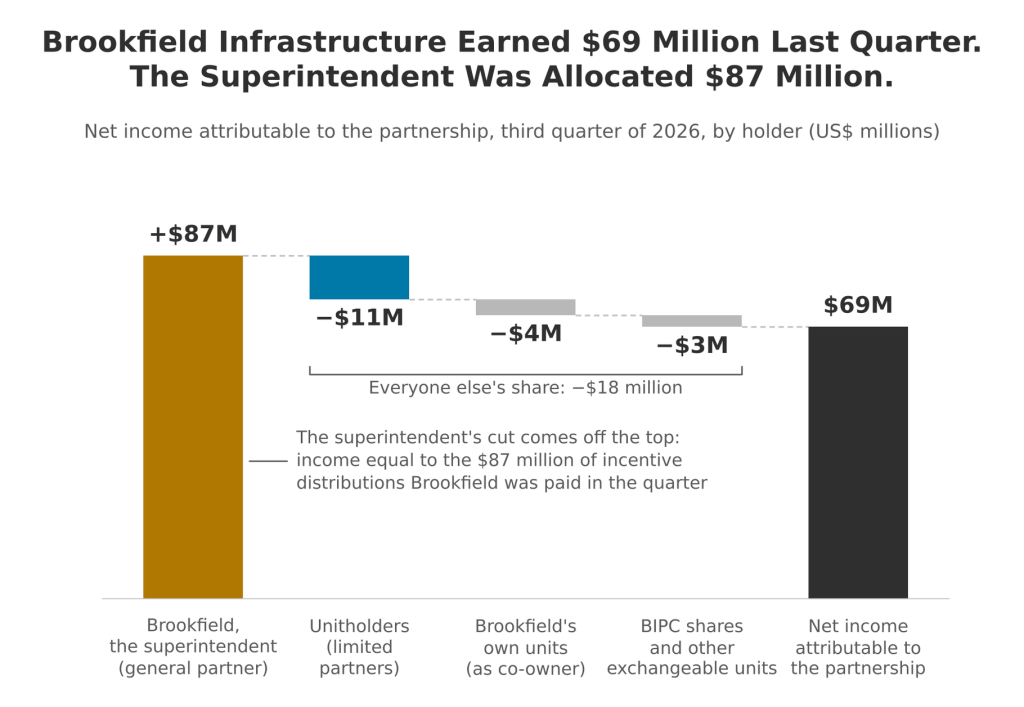
Net income attributable to the partnership for the third quarter of 2026, by holder, from Brookfield Infrastructure’s Q3 2026 results release; incentive distributions from its Q3 2026 supplemental information. The release combines BIPC exchangeable shares and other exchangeable units in one line.
BIP is moving to simplify things
BIP says its Nov. 19 conversion into BIP Inc. will spare many investors the K-1. Brookfield’s cut survives the move as a new share class, and Brookfield keeps about 63% of the votes on about 26% of the shares. Oh, and only 40% of the cash flow starts out in U.S. dollars.
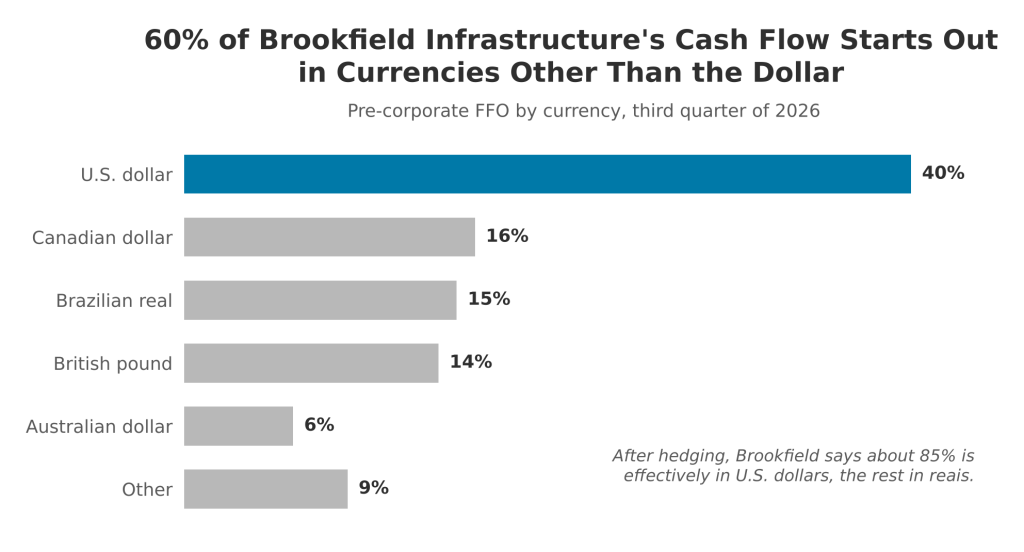
Brookfield Infrastructure’s pre-corporate FFO by currency for the third quarter of 2026, and its hedging statement, from its Q3 2026 supplemental information.
Currency has cost unitholders before. Since BIP’s 2008 spin-off, the Brazilian real has lost about two-thirds of its value against the dollar, and the pound and the Australian and Canadian dollars have each lost roughly a quarter or more. Pollock wrote in his 2016 year-end letter that converting foreign income into dollars cost BIP about $43 million of FFO that year, and the real’s slide cut 2020 FFO by about $100 million, roughly 7%. In January he wrote that 2025’s per-unit growth would have been 10%, not 6%, without currency moves and asset sales. BIP now hedges its pounds, euros, Australian and Canadian dollars and Indian rupees two years out, which smooths the bumps. The real is the one big currency left unhedged, and no hedge can stop a currency that keeps sliding.
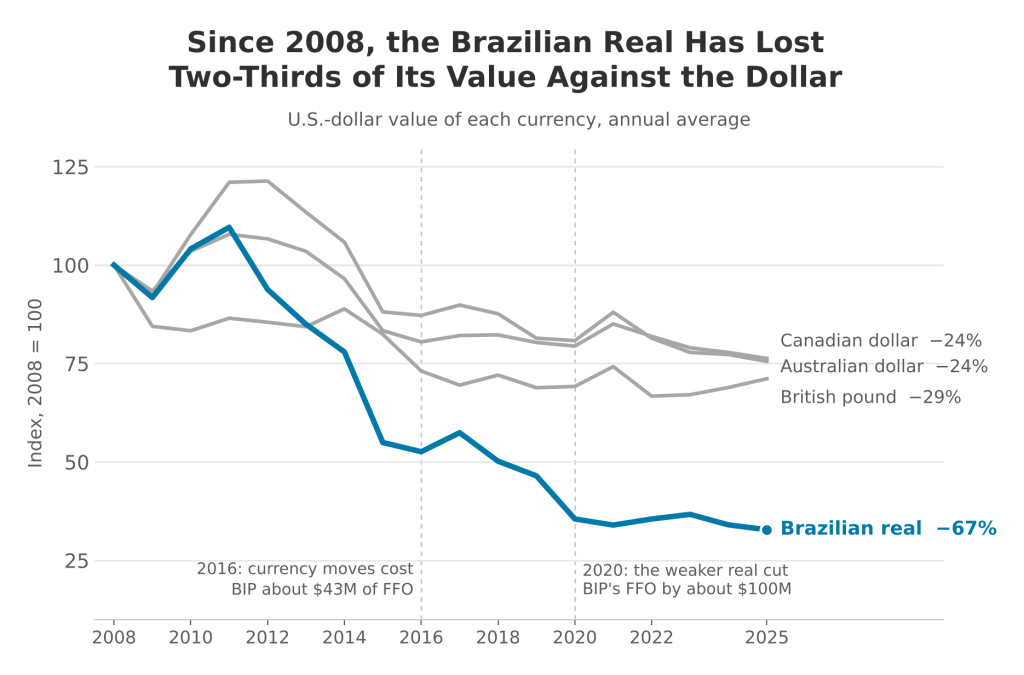
U.S.-dollar value of each currency, annual averages of daily rates, indexed to 2008 = 100, from the Federal Reserve Board’s H.10 exchange-rate data via FRED; index values and percentage changes are our arithmetic. FFO impacts from Brookfield Infrastructure’s Q4 2016 letter to unitholders and 2020 year-end results release.
Tim Cawley has run Con Edison since 2020, and Sam Pollock has run Brookfield Infrastructure since he set it up in 2007. Did either one do what he said he’d do? Search10k’s CEO Leadership Report grades executives against the plans in their own filings.
So Who Do You Want Setting the Rent?
At the end of the day, when you strip away the history and the jokes, you’re left with a choice between two bosses.
Con Ed’s boss is Albany. That gets you a 9.4% allowed return, a $37.5 billion to-do list, 52 straight dividend raises, and a permanent seat opposite New York’s affordability fight. It rarely surprises anyone, which is either the point or the problem, depending on what you want from a stock.
BIP’s boss is Brookfield. That gets you contracts with raises built in, a habit of flipping assets, a seat at the AI table, and a superintendent that gets paid before you do. The pain was felt last quarter when unitholders’ share of the profit came out negative.
Everybody pays rent to somebody. The question is whose lease you’d rather sign, and if you’ve followed this series, you know the fine print is where the story lives. Search10k lines it up side by side.
Try it on two companies you actually own. Drop any pair into the Screener and see what shakes out. Start free, or contact us and grab 20 minutes.
Back Testing Result
Search10k puts the filings next to each other so you can see exactly which tradeoff you’re making when comparing Brookfield Infrastructure vs Con Edison
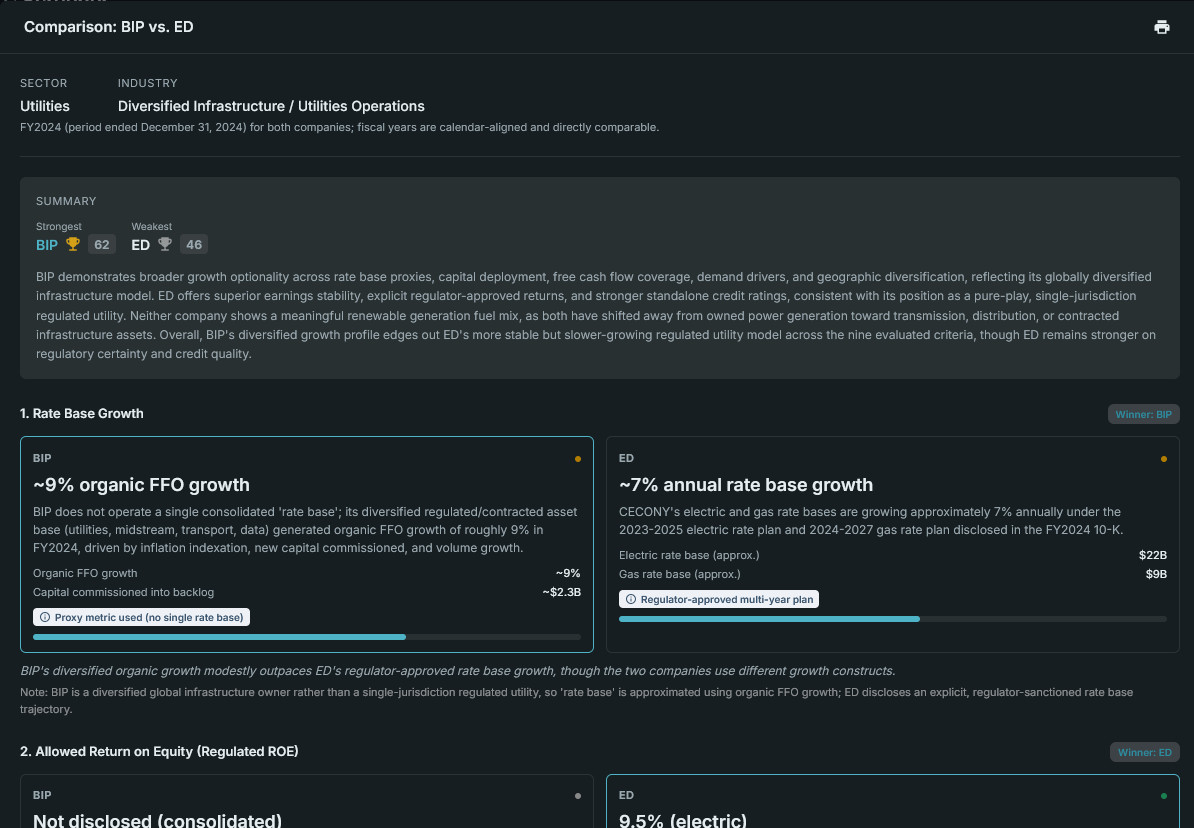
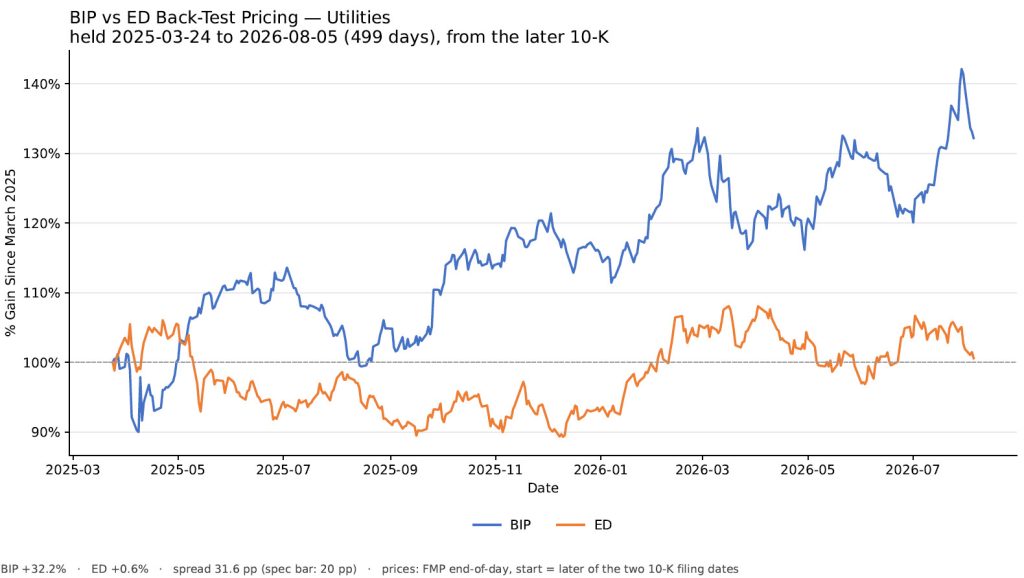
Brookfield Infrastructure demonstrated broader growth optionality across rate base proxies, capital deployment, free cash flow coverage, demand drivers, and geographic diversification, reflecting its globally diversified infrastructure model. ED offers superior earnings stability, explicit regulator-approved returns, and stronger standalone credit ratings, consistent with its position as a pure-play, single-jurisdiction regulated utility. BIP has increased in price by 32% between April. 2025 through August 2026, while ED has increased only 1%
Primary Sources
- Con Edison. Third-quarter 2026 results, Form 8-K Exhibit 99.1 and 3Q 2026 earnings presentation (SEC EDGAR, November 2026). Quarterly and nine-month EPS, the narrowed 2026 guidance, Tim Cawley’s quote, the 2026–2030 capital plan, the 2026 summer peak, Orange & Rockland’s revised peak-demand forecast (slide 35), the 28-substation plan (slide 6), the peer bill comparison, affordability-program enrollment, Chapter 58 details, equity plans and Moody’s outlook.
- Con Edison. Second-quarter 2026 results, Form 8-K Exhibit 99.1 (SEC EDGAR, Aug. 6, 2026), for the substation plan.
- Con Edison. 2Q 2026 earnings presentation and 1Q 2026 earnings presentation. Chapter 58 of the Laws of 2026 and the Mountain Valley Pipeline sale.
- Con Edison. 2025 earnings release (Feb. 19, 2026) and 4Q 2025 earnings presentation. 2025 net income by company, 2025 adjusted EPS and 2020–2025 growth versus forecast.
- Con Edison. Year-end earnings releases for 2015 through 2024 (for example, 2024 results), for adjusted EPS history; dividend history and the Jan. 27, 2026 dividend declaration.
- Con Edison. Form 10-K for 2025 and Form 10-Q for the quarter ended June 30, 2026. Customers, the steam system, peak demand forecast, long-term debt and risk factors.
- Con Edison. January 2025 rate filing summary, electric and gas joint proposal summary and rate plan information. Requested and approved rate changes and returns on equity.
- Con Edison. $2 billion at-the-market equity program (May 8, 2026) and 2026 system investment release (May 27, 2026), for the record peak of 13,322 megawatts on July 19, 2013.
- Con Edison. Celebrating 200 years of energizing New York (Mar. 26, 2023), sale of the Clean Energy Businesses (Mar. 1, 2023) and 2026 proxy statement, for company history and Tim Cawley’s career, including his years running Orange & Rockland.
- Con Edison. 2026 annual meeting transcript (May 18, 2026; third-party transcript), for Cawley’s remarks.
- Brookfield Infrastructure. Third-quarter 2026 results release and Q3 2026 supplemental information (November 2026). FFO, net income and its allocation among holders, total assets, segment results, the payout ratio, incentive distributions, currency mix and hedging, capital recycling, AI plans including NAVER and Drax, and the expected Nov. 19 closing of the corporate simplification.
- Brookfield Infrastructure. Second-quarter 2026 results, Form 6-K Exhibit 99.1 (July 30, 2026), Q2 2026 supplemental information and Q2 2026 interim report. The Colonial Pipeline stake and the Csquare IPO.
- Brookfield Infrastructure. Q3 2026 earnings call transcript (third-party transcript), for Sam Pollock’s remarks and an AI infrastructure executive’s comments.
- Brookfield Infrastructure. 2025 results, Form 6-K Exhibit 99.1 (Jan. 29, 2026), Q4 2025 supplemental information and 2025 letter to unitholders. Segment FFO, the 2026 distribution increase, 2025 incentive distributions and 2025 per-unit growth excluding asset sales and currency.
- Brookfield Infrastructure. 2025 Form 20-F. The base management fee, segment descriptions, risk factors and the Service Provider arrangements, including that BIP doesn’t employ or pay its management.
- Brookfield Infrastructure. Year-end results releases on SEC EDGAR for 2015, 2016, 2017, 2018, 2019, 2020, 2021, 2022, 2023 and 2024, and its distribution history.
- Brookfield Infrastructure. Corporate profile, August 2026 and Investor Day presentation (Sept. 29, 2026). Inflation protection, contracted share and growth targets.
- Brookfield Infrastructure. Simplification circular (Aug. 26, 2026) and Brookfield Infrastructure Corporation vote results (Oct. 29, 2026). BIP Inc., the Class I and Class B shares, voting interest and expected timing.
- Brookfield Infrastructure. Colonial Pipeline acquisition announcement (Apr. 3, 2025); Colonial Pipeline, Our Company.
- Brookfield Infrastructure. 2008 Form 20-F and Q2 2008 interim report, for the spin-off, initial assets and Sam Pollock’s role at the time.
- Brookfield Infrastructure. Year-end 2010 results (Feb. 4, 2011), for the Dec. 8, 2010 merger with Prime Infrastructure.
- Brookfield Infrastructure. Q4 2016 letter to unitholders, Q1 2018 letter to unitholders and 2020 year-end results (Feb. 3, 2021). Currency impacts on 2016 and 2020 FFO and the 2018 distribution increase. The 2017 net loss per unit appears in the 2018 year-end release listed above.
- Brookfield Infrastructure Corporation. 2025 Form 20-F. Inflation-linked tariffs at the U.K. regulated distribution and Brazilian regulated gas transmission businesses.
- Brookfield. Brazil and Sam Pollock (company website); Business Council of Canada, Sam Pollock; Wikipedia, Brookfield Corporation.
- Board of Governors of the Federal Reserve System, via FRED. Annual average exchange rates for the Brazilian real, British pound, Australian dollar and Canadian dollar, 2008–2025.
- TIME. Utilities: Shock from Con Ed (May 6, 1974). Gothamist. Con Ed bills are going up as regulators approve a rate hike (Jan. 22, 2026). Halston Media via NYSenate.gov. ‘Affordability should come first’: Leaders rip PSC over Con Ed rate hikes (Jan. 29, 2026). amNY. Steam stacks on Manhattan streets (Mar. 25, 2025).
Disclaimer: This article is for informational and educational purposes only. It is not investment advice, a research report, or an offer or solicitation to buy or sell any security, including units or shares of Brookfield Infrastructure Partners L.P., Brookfield Infrastructure Corporation or Consolidated Edison, Inc., and nothing in it should be read as a recommendation. Statements of fact come from public filings, earnings releases, letters to unitholders, investor presentations, call and meeting transcripts, Federal Reserve exchange-rate data and press reports, all linked above, and are historical in nature unless identified as forward-looking; past performance does not guarantee future results. Figures are current as of each company’s third-quarter 2026 report. Company history, including Brookfield’s Brazilian origins and Con Edison’s 1974 dividend omission, comes from company materials, encyclopedias and press reports rather than SEC filings. Brookfield Infrastructure’s FFO per unit and distributions for years before 2022 restated to today’s units, indexed growth, compound annual growth rates, 2025 segment shares, Con Edison’s payout ratio, its 2026–2030 capital plan total (our sum of the company’s annual estimates), Brookfield Infrastructure’s combined fees and incentive distributions, the payout index based on 2018 and its percentage changes, currency changes since 2008, the share of 2020 FFO lost to the Brazilian real, the $3.65-a-unit illustration of 10% growth on 2025 FFO per unit, the share of the 2026–2030 capital plan going to the two utilities and the 2026 rate-case totals are our own arithmetic from company-reported data, not company-reported measures. The $3.65-a-unit figure only illustrates what 10% growth on 2025 FFO per unit would equal; it is not a forecast by us or a figure Brookfield Infrastructure has published. FFO and adjusted EPS are non-GAAP or non-IFRS measures that each company defines differently; Brookfield Infrastructure reports under IFRS, and its net income per limited partnership unit reflects its own allocation of net income among holders. Quotations and paraphrased remarks from Sam Pollock and from a Brookfield AI infrastructure executive on the third-quarter call come from a third-party transcript of Brookfield Infrastructure’s third-quarter 2026 earnings call, Pollock’s remarks on currency come from Brookfield Infrastructure’s letters to unitholders, and Tim Cawley’s annual meeting remarks come from a third-party transcript of the May 18, 2026 meeting. Characterizations of the companies, their executives, regulators and lawmakers, metaphors, jokes and any interpretation of these facts are opinion, not statements of fact. The “gaslighting” heading refers to Con Edison’s origin as the New York Gas Light Company, and descriptions of either company as a “landlord” and of its prices as “rent,” of Brookfield as Brookfield Infrastructure’s “superintendent,” of Brookfield Infrastructure as resembling a private equity fund, and of Albany or Brookfield as either company’s “boss” are figurative and reflect our opinion. Forward-looking items, including Con Edison’s 2026 guidance, 2026–2030 capital plan, equity issuance, substation plans and peak demand forecasts, the effect of New York’s Chapter 58 of the Laws of 2026 and the timing of future rate filings, and Brookfield Infrastructure’s FFO, distribution and payout targets, asset sale expectations, AI investment objectives and projects, including those with NAVER and Drax, and the expected Nov. 19, 2026 completion and terms of its corporate simplification, are forward-looking statements by the companies, are subject to the risks and uncertainties described in their filings, and may differ materially from actual results. Readers should do their own due diligence and consult a licensed professional before making any investment decision.