YouTube took over American television without buying a single show. Netflix spends $20 billion a year doing exactly the opposite. In July, both companies filed the receipts, and the receipts are worth reading.
Everything here comes from Alphabet and Netflix filings, earnings releases, shareholder letters and call remarks, all linked below. Viewing-share figures are Nielsen’s public Gauge reports, and market moves come from press coverage; both are flagged where they appear. Netflix reported July 16, 2026. Alphabet reported July 22. Informational only, not investment advice.
It’s 9:40 PM on a Tuesday, and both screens in your house are on. You’re watching Squid Game, a show Netflix paid for up front, sight unseen, the way it pays for everything it streams. Down the hall, your kid is watching MrBeast, with over 514 million followers on YouTube alone. MrBeast famously rebuilt Squid Game’s sets for a video of his own, published it on YouTube for free, and waited for the ad money to arrive after the views did. Nobody dies in his version, to be clear. Eliminated players just fall over theatrically and walk off, and the last one standing collects $456,000.
It was more or less the same show, minus the body count. The difference was who took the risk of making it, and that difference, multiplied across a few hundred million living rooms, is the entire argument between Alphabet and Netflix.
Netflix, to its credit, saw the fight coming before Wall Street did. Back in January 2019, when analysts were still asking about HBO, the company warned shareholders that “we compete with (and lose to) Fortnite more than HBO.” In other words, Netflix competed on overall entertainment with video games, not with other television networks. It was a strange sentence to put in an investor letter, and it turned out to be the honest one. Seven years later, only the winner’s name has changed. Nielsen’s June Gauge puts YouTube at 13.8% of all US television time, the most of any media company in America, broadcast networks included. Netflix, the most successful subscription product ever built, has compounded revenue at roughly 21% a year for a decade, from $6.8 billion in 2015 to $45.2 billion in 2025, and still runs second among streamers at about 8%.
The two reported their June quarters in the same July week, and the market treated them very differently. Netflix fell as much as 9% overnight for the sin of guiding “only” 12% growth. Alphabet got dinged for spending too much money, then earned it all back within weeks. Underneath both moves sits a question older than either company: who should pay for television, the person watching it or an advertiser who’d like a word before the show starts?
The Empire That Never Greenlights a Show
YouTube started in 2005 in an office above a pizzeria in San Mateo, California. The first video ever uploaded to it was 19 seconds of a co-founder standing in front of elephants at the zoo. Google bought the whole thing in 2006 for $1.65 billion, a price serious people called reckless at the time. Two decades later, that reckless purchase is the biggest thing on American television, and $1.65 billion is roughly what Netflix now spends on content in a month.
The rest of Alphabet’s quarter reads like 3 businesses stacked in a trench coat. Search did $63.3 billion, up 17%, and Alphabet swears its AI answers are growing queries rather than eating them. Google Cloud grew 82% to $24.8 billion, with $514 billion of signed work waiting behind it. YouTube’s ads brought in $11.1 billion, up 13%. Once you add subscriptions and devices, the whole company booked $119.8 billion of revenue, up 24%, keeping 34 cents of every dollar as operating profit.
YouTube’s ad business alone lands within shouting distance of Netflix’s entire company, and it got there without ever writing a check in advance. Creators upload first, YouTube sells the ads, and the two split the take, roughly 55/45 in the creator’s favor. The check MrBeast waited on after publishing his Squid Game knock-off video was one of millions of creator payments, and over the last 4 years they’ve added up to more than $100 billion.
It’s the only major studio on Earth whose content cost is a percentage of what worked, rather than a bet on what might.
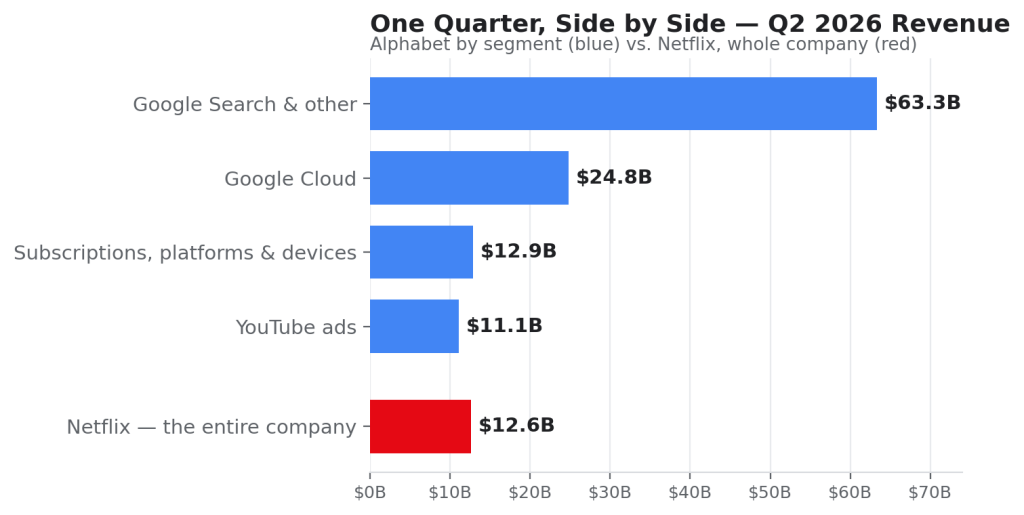
Q2 2026 revenue from each company’s July release. YouTube’s ad line alone comes within $1.5 billion of Netflix’s whole quarter, and that excludes YouTube’s subscription money, which Alphabet books elsewhere.
The Studio That Pays Before You Press Play
Netflix is 9 years older than YouTube and has nearly died more times. Reed Hastings and Marc Randolph started it in 1997 mailing DVDs in paper envelopes, and in 2000 they flew to Dallas and offered to sell the whole company to Blockbuster for $50 million. Blockbuster’s executives reportedly struggled not to laugh them out of the room. They didn’t acknowledge the threat of a new entrant or change in medium.
But who’s laughing now? Blockbuster is gone now, thanks to the ubiquity of high-speed internet and the advent of content streaming. The company it passed on adapted to the streaming from physical media, and literally became the brand “Netflix n Chill” representing a movie streaming experience.
Netflix first started paying serious money for original content in 2011, when it committed to 2 full seasons of House of Cards, a bet that ultimately cost about $100 million. When the series premiered in 2013, Netflix refused to publish ratings, but outside network data estimated that 1.5 million to 2.7 million U.S. viewers watched at least 1 episode the day after its release, while Netflix said it had already become its most-watched show in every country where the service was available. Nowadays, Netflix greenlights about $20 billion of films and series a year across more than 50 countries, still guessing what the world wants in fresh content, still paying in full, still finding out on a Friday night.
It’s the process that bought Squid Game for pocket change and the Stranger Things finale for a fortune, and nobody in the building knew ahead of time which one was the bargain. That’s the deal Netflix has made with its shareholders for the past 15 years: trust the taste, accept the misses, and let the hits pay for everything.
Last quarter, the taste held up fine. Revenue rose 13% to $12.6 billion, operating income hit $4.2 billion at a 33.4% margin, and EPS grew 11% to $0.80. Members watched 97 billion hours of programming in the first half of the year, up 2% even with a Winter Olympics and a World Cup in the room. What’s more, the young ads business is on track to roughly double, to about $3 billion.
Yet, the stock fell anyway, as much as 9% after hours, to its lowest in over a year, because Netflix guided third-quarter growth of 12%. After 3 years of mid-to-high-teens quarters, 12% sounded to Wall Street like a slowdown. That’s the tax on 20 years of excellence: the market charges Netflix a subscription for perfection, and “in line” isn’t covered. Netflix has consistently delivered with high ROIC.
Alphabet versus Netflix Scorecard, for Anyone Skimming
| Alphabet (GOOG, GOOGL) | Netflix (NFLX) | |
| Quarter | Q2 2026, ended June 30 | Q2 2026, ended June 30 |
| Revenue | $119.8B, up 24% | $12.6B, up 13% |
| Operating income | $40.8B, a 34% margin | $4.2B, a 33.4% margin |
| Growth engine | Google Cloud, up 82% | Ads, doubling to ~$3B in 2026 |
| Net income | $112.1B, mostly unrealized marks | $3.4B, no asterisks this quarter |
| Free cash flow | Negative $5.9B in the quarter | $1.5B; ~$12.5B expected for 2026 |
| 2026 spending plan | $195B–$205B capex, just raised | ~$20B content budget; $219M capex |
| Already promised | $514B of signed cloud work | $25.1B of content obligations |
| Capital moves last quarter | Sold $49.6B of new stock; pays a $0.22 dividend | Bought back $4.7B of stock, a company record |
| Who makes the shows | Partner creators, paid $100B+ over four years, after the views | ~$20B a year of greenlights, before the views |
| Who pays to skip ads | YouTube Music + Premium has 125M+ subscribers globally, including trials. YouTube still doesn’t break out Premium-only paid subs. | In Q1 2026, 46% of new U.S. Netflix subscriptions chose ad-free; 54% chose the cheaper ad tier. By August, Netflix said 60%+ of new subscribers in ad markets were choosing ads |
| How sticky is it? | Alphabet doesn’t disclose YouTube Premium churn or retention. What it does disclose is heavy usage: Premium subscribers watched 800M+ hours of podcasts in April 2026 alone. | Netflix remains the stickiest major streamer, with monthly churn around 2.11%. Antenna’s broader SVOD data found 39% of ad-free signups still subscribed after 12 months, versus 37% for ad-supported. |
| What you’re really buying | An AI buildout with television attached | A hit factory that pays for its own hits |
Both columns are the June 2026 quarter, from each company’s release and shareholder letter. Creator payouts are YouTube’s own four-year figure, announced at Made on YouTube.
The Fight for the Biggest Screen in the House
For most of its life, YouTube was the thing people watched on their phones while television happened somewhere else. But things have changed considerably. According to Nielsen’s June Gauge, YouTube now accounts for 13.8% of all U.S. TV time, ahead of Disney at 9.6% and Netflix at 7.9%. Not to mention, Nielsen is only counting television sets.
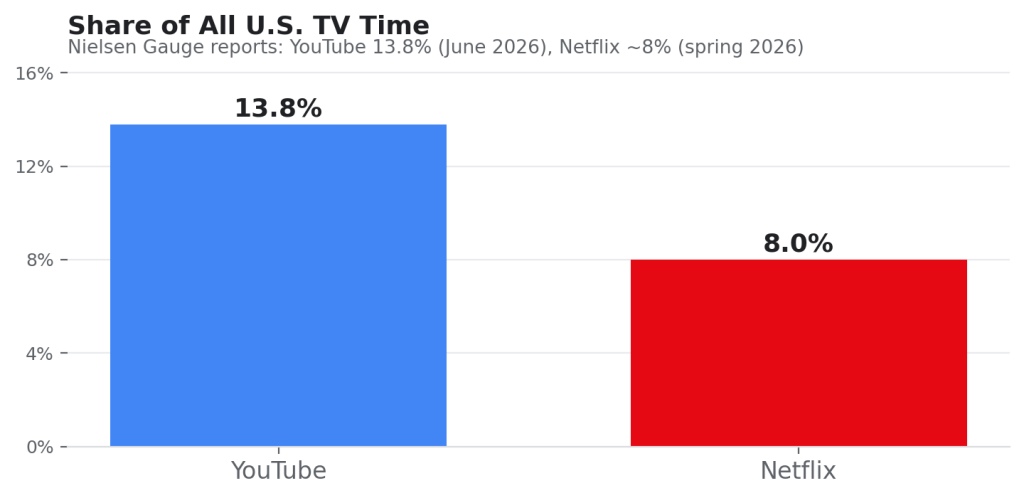
Nielsen’s Gauge and Media Distributor Gauge reports, via Nielsen and trade coverage: YouTube held 13.8% in June 2026, while Netflix ran near 8% through spring (7.8% in April, 9.0% in January).
That alone changes the way to think about the Netflix-YouTube fight. One still spends billions commissioning shows and movies. The other has spent 20 years building an audience machine where the talent, formats and fandoms often arrive before Google spends a dollar producing them.
The World Cup made that difference unusually easy to see. So does the growing list of creators Netflix is now pulling across the aisle.
FOX Owned the World Cup. YouTube Owned a Lot of What Happened Around It.
FOX still had the exclusive U.S. English-language television rights, with all 104 matches airing across FOX and FS1 and streaming through FOX One. So when Sundar Pichai told investors that 1.7 billion unique viewers watched World Cup-related videos on YouTube, he wasn’t saying YouTube had somehow streamed 1.7 billion people’s worth of FOX’s matches.

FIFA had made YouTube an official Preferred Platform, giving rights-holding broadcasters room to publish the first 10 minutes of matches, select full games, extended highlights, Shorts and behind-the-scenes footage. Creators were producing commentary, reactions and their own tournament coverage around it.
Google doesn’t break the 1.7 billion down by format, which is important. It could include official clips, broadcaster uploads, creator videos and everything else orbiting the tournament. The interesting part is that FOX could own the games while YouTube still captured an enormous share of what people watched before, after and around them.
Netflix Played the Same Tournament From a Different Angle
Netflix didn’t own the men’s World Cup matches either, but it wasn’t exactly ignoring the biggest sporting event on Earth. Gary Lineker, Alan Shearer and Micah Richards brought The Rest Is Football to Netflix as a daily show during the tournament. Netflix released the USA 94 documentary, built a World Cup collection and launched a FIFA World Cup game for members. Then it told shareholders that viewing hours still grew 2% in the first half despite competition from the Olympics and World Cup.
That’s a pretty good snapshot of the difference between the 2 businesses. YouTube can absorb an event it doesn’t own because thousands of channels immediately start talking about it. Netflix has to commission, license or build its way into the conversation. Increasingly, it’s doing that with people that YouTube already made famous.
Netflix Shops from YouTube’s Graduating Class
Ms. Rachel may be the cleanest example. Forbes estimates she has 34.2 million followers and earned $26 million in 2026. Netflix didn’t have to invent her, teach parents who she was or gamble that toddlers might like her. It initially licensed and repackaged videos that had already worked on YouTube.
The audience followed. Ms. Rachel generated 69 million Netflix views across 2 seasons in the first half of 2026 and spent 27 weeks in the Global Top 10.
Danny Go! followed a similar route. His YouTube channel has roughly 5.1 million subscribers and 5.8 billion lifetime views. Netflix began with 5 existing episodes rather than funding a brand-new kids franchise from scratch. Those episodes went on to generate 26 million views in the first half.
That’s a very different content bet from writing a $100 million check for an unproven drama and hoping everybody stays home Friday night.
Mark Rober Shows What Happens After the Test Works
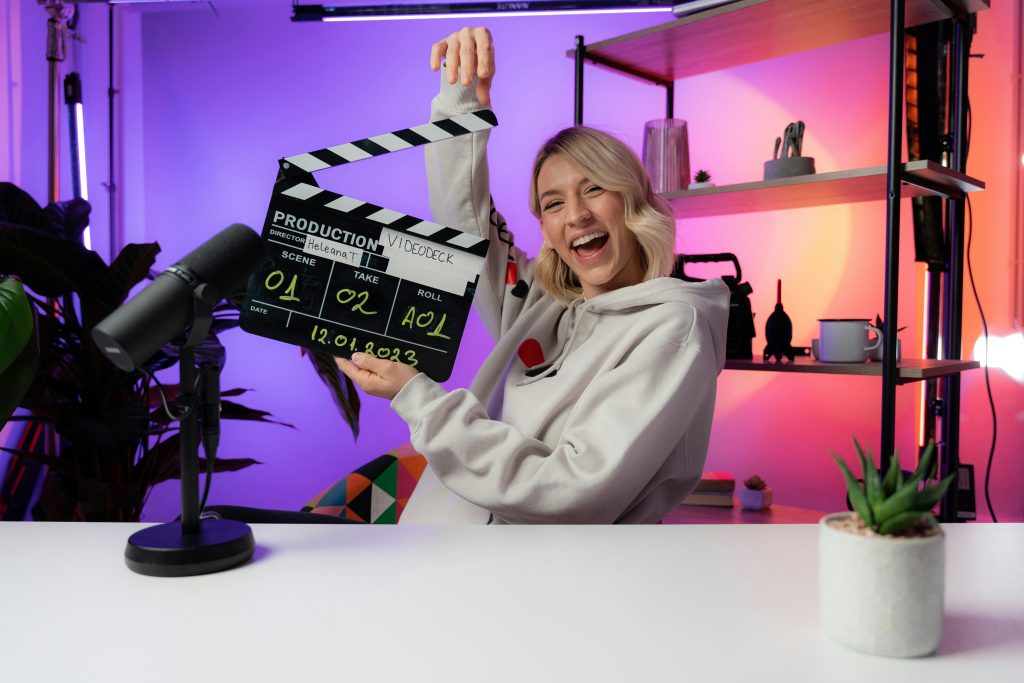
Mark Rober takes the model one step further. Forbes estimates 90.7 million followers and $30 million in 2026 earnings, which means Netflix wasn’t exactly discovering somebody filming science experiments in his garage. It first licensed material from Rober’s existing library. Then, after seeing that his audience would watch him on Netflix too, it commissioned SCHOOLED!, an original competition series produced with Rober’s CrunchLabs. That sequence is worth paying attention to. License something already proven. See whether the audience travels. Then spend real production money.
The Stokes Twins are now following almost the same path.
The Stokes Twins May Be the Biggest Test Yet
This unique act come with an audience most television executives would have struggled to imagine a decade ago. Forbes estimates 177.5 million followers and $12.4 million in 2026 earnings. Netflix again started conservatively, licensing an archive of their most-watched videos. Now it’s moving into an original long-form series scheduled for 2027. There’s something almost backwards about the economics. Traditional television spends money first, builds the show, markets it and then discovers whether anybody cares. YouTube creators can spend years proving the audience before Netflix ever enters the picture.
By the time Netflix calls, the subscriber count, viewing history and fan base are sitting there in public.
YouTube is both a Competitor and a Farm System
YouTube still wins plenty when those creators stay put. On ordinary long-form videos, Google keeps roughly 45% of the advertising revenue, while creators assume much of the cost and risk of figuring out what people want to watch. Netflix gets a different opportunity. It can watch that enormous laboratory from the outside, identify the people who survived it, license their proven libraries and then spend on originals once it knows some portion of the audience will come along. That doesn’t make Netflix dependent on YouTube. Netflix is still one of the biggest content buyers on Earth, and most of its slate has nothing to do with creators graduating from another platform. But the dynamic is hard to miss. Netflix and YouTube are fighting for the same television screen, while one of Netflix’s increasingly useful sources of proven talent happens to be the company sitting right beside it on that screen.
One Raised $70 Billion, the Other Set a Share Buyback Record
Then there’s the money itself, which is where the two stories fully separate.
Alphabet spent $44.9 billion on capital projects last quarter, double a year ago, and raised its 2026 budget to somewhere between $195 and $205 billion for chips, data centers and power. That works out to about 10 Netflix content budgets, and Alphabet intends to spend it again every year for the foreseeable future. The bill was heavy enough to push quarterly free cash flow to negative $5.9 billion, a rare sight at a company that has gushed cash for 20 years, so Alphabet passed the hat on Wall Street: $49.6 billion of new stock sold in June, plus another $20.3 billion of fresh debt. It still pays its 22-cent quarterly dividend, almost as a courtesy.
Netflix, the company everyone spent years calling capital-intensive, spent $219 million on capex all quarter, roughly what Alphabet spends before lunch on a Tuesday. Its “factory” is a spreadsheet of greenlights, and its cash moves in the opposite direction. Free cash flow was $1.5 billion in Q2, after $5.1 billion in Q1, bringing the first-half total to $6.6 billion. Netflix still expects roughly $12.5 billion for the full year. The board added $25 billion of share buyback authorization in April, and the company repurchased $4.7 billion of its own stock in the quarter, the most in its history.
Somewhere along the way, the roles flipped under the radar: the content company is handing cash back to shareholders while the software company is out raising it.
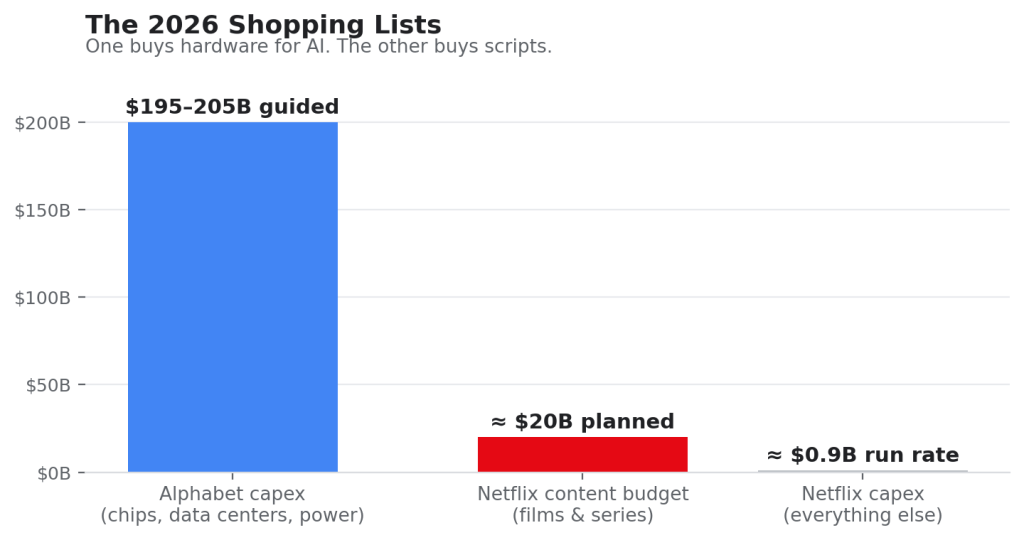
Alphabet’s guided 2026 capital budget versus Netflix’s stated content plan and annualized Q2 capex, from company guidance and statements. The line items differ on purpose, since Alphabet’s money buys hardware while Netflix’s buys the shows themselves.
The $99 Billion Footnote and the $2.8 Billion Consolation Prize
Regular readers of this comparison series know to check the bottom of the income statement, and this quarter both companies rewarded the habit. Alphabet reported $112.1 billion of net income, up 298%, a number that looks like a misprint until you find the footnote. About $99 billion of it, pre-tax, came from unrealized gains on stakes in SpaceX and Anthropic. These are paper marks that supplied $6.26 of the quarter’s $9.11 in earnings per share, by Alphabet’s own disclosure. Underneath the confetti, the operating business earned a very real $40.8 billion. The rest is a valuation opinion, and opinions have a way of reversing.
Netflix’s footnote is stranger, and better. In December it agreed to buy Warner Bros.’ studios and HBO Max for about $83 billion, the biggest bet in its history and a deal that would have handed it a century of Hollywood. Then Paramount Skydance countered at $111 billion for all of Warner Bros. Discovery, which the board called the rival offer superior. Netflix looked at the new price, said congratulations, and walked away in under an hour, collecting a $2.8 billion breakup fee on its way out the door. That check, booked in the first quarter, is the main reason full-year free cash flow guidance rose from $11 billion to $12.5 billion. Netflix spent a decade being told it should buy a studio, finally tried, and made more money not buying one. Sometimes the best deal is the one that pays you to leave.
| Both CEOs filed three-year plans before they filed these quarters. Search10k’s CEO Leadership Report grades executives against the promises in their own filings, so you can see who delivered and who explained. |
So Whose Story Are You Buying?
All of it comes back to the couch where this story started. Your household already pays both of these companies, one with a credit card and one with your patience for ads. Each stock is finally just a bet on which of those habits grows faster from here.
Buy Alphabet, and you’re buying the house: Search, Cloud and the biggest thing on television, funded by an ad machine strong enough to pour $195 billion to $205 billion into infrastructure this year and still produce a 34% operating margin. Management isn’t pretending the construction ends there, either. It expects spending to climb significantly again in 2027, betting that a $514 billion Cloud backlog, more than half of which should become revenue within 2 years, eventually makes all those data centers look cheap. The risk is whether the return catches up before the spending gets away from them.
Buy Netflix, and you’re buying the tenant who became indispensable. They have one product, an audience closing in on a billion people, and margins now within a point of Alphabet’s. Furthermore, they have a management team trying to make that same audience worth more without building a $200 billion factory underneath it. Ads should roughly double to $3 billion this year, while live programming takes barely 5% of content spend but has already produced 6 of Netflix’s 10 biggest signup days of the past 5 years. Games, creators and broadcaster partnerships are getting their own experiments too.
That leaves 2 very different promises about the future. Alphabet is borrowing, issuing stock and pouring concrete because demand is arriving faster than capacity. Netflix is trying to make each hour on the couch more valuable without owning the concrete at all. Only one pays a dividend, and it’s also the one that just went cash-flow negative building the future.
Back Tested Results
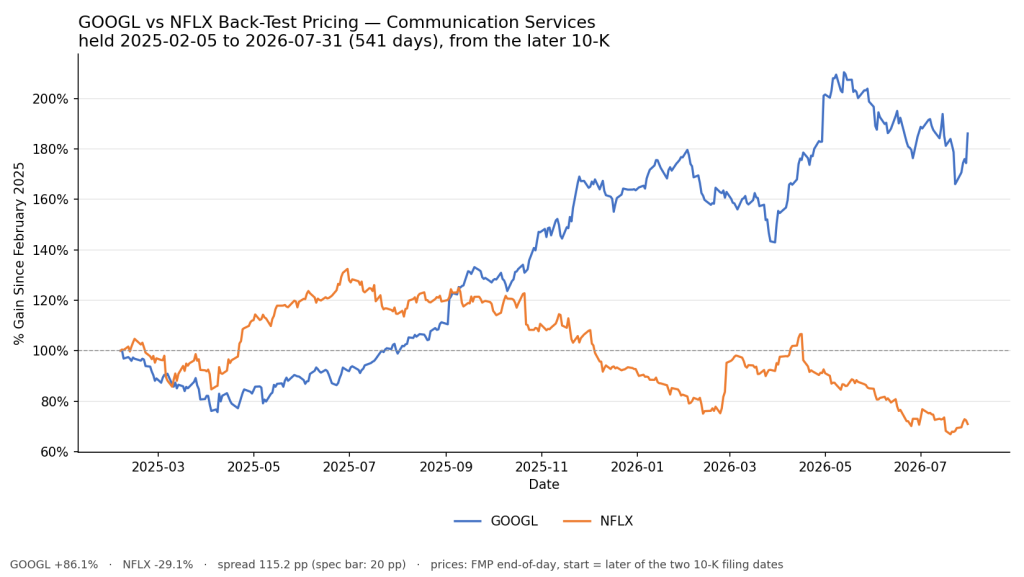
Search10k stacks the filings side by side so you can decide which story more deserves your money. The comparison between GOOG and NFLX based on FY2024 filing analysis would have scored GOOG at 76 and NFLX at 58. An investment in GOOG at that time would have beaten NFLX growth to July 2026 by 115%.
| Try it on two companies you actually own. Drop any pair into the Screener and see what shakes out. Start free, or contact us and grab twenty minutes. |
PRIMARY SOURCES
- Alphabet. Q2 2026 Earnings Release (July 22, 2026). Revenue, segments, operating income, net income, other income and the equity-gain disclosure all come from here.
- Google. Sundar Pichai’s Q2 2026 earnings call remarks (July 22, 2026), for the $514B cloud backlog, Search growth and YouTube’s World Cup audience.
- CNBC. Alphabet Q2 2026 live coverage (July 22, 2026), for the capex raise to $195B–$205B and the after-hours reaction; Yahoo Finance for the June stock sale, notes issuance and dividend; Variety for YouTube ad revenue and quarterly capex; Tickeron’s earnings recap for free cash flow and the SpaceX/Anthropic mark, as reported.
- Netflix. Q2 2026 Shareholder Letter, Form 8-K Exhibit 99.1 (SEC EDGAR, July 16, 2026), for revenue, margin, engagement, ads, creators, buybacks, content obligations and guidance; Q1 2026 letter for the free-cash-flow raise tied to the termination fee.
- Variety. Netflix Q2 2026 earnings (July 16, 2026), for the after-hours drop and Q3 outlook; CNBC for the engagement-disclosure change.
- Netflix. Form 8-K on the Warner Bros. Discovery merger termination (SEC EDGAR, Feb 27, 2026); Variety on the $83B and $111B bids; Deadline on the fee payment; The Hollywood Reporter for the one-hour exit and the ~$20B 2026 content plan.
- Nielsen. The Gauge and Media Distributor Gauge, June 2026 reports (Aug 18, 2026), for YouTube’s 13.8% of U.S. TV time; spring Netflix shares via Nielsen data reported by trade press.
- YouTube. Creator payouts of more than $100B over four years, per the company at Made on YouTube (TechCrunch); Fortune on the long-standing 55/45 revenue split.
- Netflix. Investor letter archive, including the January 2019 letter with the Fortnite line.
Disclaimer: This article is for informational and educational purposes only. It is not investment advice, a research report, or an offer or solicitation to buy or sell any security. Statements of fact come from public filings, earnings releases, shareholder letters, call transcripts and press reports, all linked above, and are historical in nature; past performance does not guarantee future results. Viewing-share figures come from Nielsen’s publicly released Gauge and Media Distributor Gauge reports, which are third-party audience measurements, not company disclosures. Alphabet’s reported net income includes approximately $99 billion of pre-tax unrealized gains on equity investments, primarily its stakes in SpaceX and Anthropic; these are marks on securities as disclosed by the issuer and may reverse in future periods. Quotations from Sundar Pichai, Ted Sarandos and Greg Peters are drawn from their companies’ earnings materials and public statements. Any interpretation or characterization of these facts is opinion, not a statement of fact. Forward-looking items, including Alphabet’s $195–$205 billion 2026 capital-expenditure guidance and cloud backlog, and Netflix’s 2026 revenue, operating-margin, advertising, free-cash-flow and content-spend targets, are the companies’ own forward-looking statements, are subject to the risks and uncertainties described in their SEC filings, and may differ materially from actual results. Readers should do their own due diligence and consult a licensed professional before making any investment decision.