Two pharmaceutical giants, two very different origin stories — one built on antiseptic surgery, the other on wartime penicillin. Nearly 140 years later, their SEC filings tell an equally different story: diversified strength versus a costly turnaround still in progress. Nine standardized criteria, scored straight from the 10-Ks, reveal which company’s fundamentals actually held up — and which one is still proving itself.
Johnson & Johnson: Born From a Broken Promise on Infection
Johnson & Johnson traces back to 1886, when brothers Robert, James, and Edward Mead Johnson founded the company in New Brunswick, New Jersey, after Robert heard surgeon Joseph Lister’s lectures on antiseptic surgery. At the time, surgical infection killed a staggering share of patients who survived the operation itself. The brothers began manufacturing sterile surgical dressings and first-aid supplies, then expanded into baby powder, sutures, and eventually pharmaceuticals and medical devices. That founding instinct — treat the whole patient, not just the disease — still shows up in the diversified, two-segment company J&J is today.
Pfizer: A Chemical Shop That Found Its Calling in Penicillin
Pfizer began in 1849 in Brooklyn, New York, when German immigrant cousins Charles Pfizer and Charles Erhart started a fine-chemicals business, first known for making palatable, candy-flavored antiparasitic medicine. The company spent decades as an industrial chemical supplier before World War II, when it pioneered deep-tank fermentation to mass-produce penicillin, becoming the world’s largest antibiotics manufacturer almost overnight. That wartime breakthrough pushed Pfizer decisively into pharmaceutical research, setting the template for a company built on scientific reinvention at scale — a pattern that recurred with Lipitor, and again with its COVID-19 vaccine.

Why the Analysis Favored JNJ, and What the Market Did With It
The comparison behind this back-test wasn’t a coin flip between two pharma giants — it was a systematic scoring of both JNJ’s and PFE’s FY2025 10-K filings across nine standardized healthcare criteria: revenue diversification, pipeline strength, R&D intensity, gross margin, regulatory risk, free cash flow, patent exclusivity, clinical execution, and capital allocation discipline. JNJ won eight of the nine categories, losing only on R&D intensity, where Pfizer’s R&D-to-revenue ratio of 17.5% edged out JNJ’s 15.9% — though even there, JNJ spent more in absolute dollars.
The scorecard reflects two companies at different points in their strategic cycles. JNJ entered FY2024 with a diversified two-segment model (Innovative Medicine and MedTech) generating $88.8 billion in revenue, a 68.3% gross margin, and roughly $18.6 billion in free cash flow. Its patent cliff, centered on Stelara losing exclusivity, was real but manageable, and it was being offset by fast-growing products like Darzalex, up 21% year-over-year. Capital allocation was disciplined: a $13.1 billion bolt-on acquisition of Shockwave Medical, sustained buybacks, and a growing dividend.
Pfizer, by contrast, was mid-turnaround. It was digesting the $43 billion Seagen acquisition, which compressed gross margin to roughly 44.8% through purchase-accounting amortization and inventory write-downs, while COVID-era revenue normalized sharply lower. Net debt had climbed to about $31 billion, buybacks were suspended, and the company faced a concentrated 2025–2030 loss-of-exclusivity cliff worth an estimated $17–18 billion in at-risk revenue from products like Eliquis and Ibrance. Pfizer’s underlying score of 38 reflected a company managing real structural headwinds, even as its Seagen-derived oncology pipeline offered a credible, if unproven, long-term growth path.
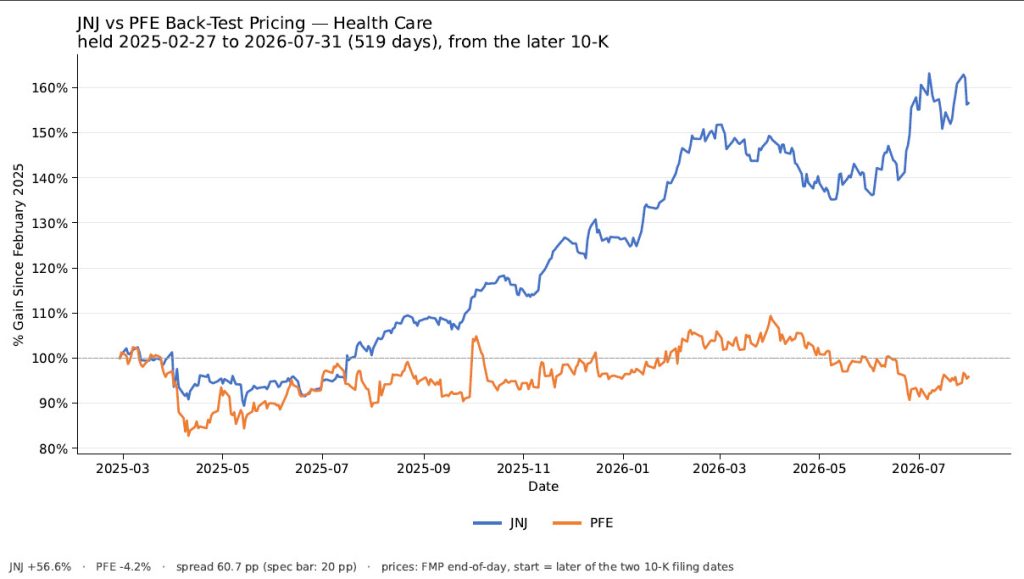
That 82-to-38 scoring gap is what the back-test then put to the market. Starting from the later of the two companies’ 10-K filing dates — February 27, 2025 — and holding through July 31, 2026 (519 days), JNJ shares gained 56.6% while Pfizer shares fell 4.2%, a spread of roughly 61 percentage points. The two stocks moved together through the spring 2025 drawdown, tracking within a few points of each other into mid-2025. The divergence began in earnest around August 2025, as JNJ pulled steadily higher through the back half of the year and into 2026, while PFE oscillated in a tight band around its starting price and never sustainably broke above it.
In other words, the fundamentals scorecard — built entirely from each company’s own regulatory filings — anticipated the market outcome well before it fully played out. JNJ’s structural advantages in margin, cash generation, and capital discipline translated into sustained price outperformance, while Pfizer’s post-Seagen integration and patent-cliff overhang kept its stock range-bound. None of this guarantees the pattern repeats, but it illustrates why comparing companies on filing-based fundamentals, rather than headlines, can offer a useful lens on subsequent price behavior.
Back-tested Pricing of Johnson & Johnson vs Pfizer
Compare Stocks with Search10K today!