Elon Musk let something slip about what Tesla really sells. Eight days later, Amazon made the same point with a much bigger number.
Everything here comes from Amazon and Tesla filings, earnings releases and call transcripts, all linked below. Anything on Optimus, robotaxis or Zoox that isn’t in a filing comes from company statements or press reports. We flag it where it shows up. Amazon reported July 30, 2026. Tesla reported July 22. Informational only, not investment advice.
Partway through Tesla’s July earnings call, Elon Musk was asked a routine question about demand. His answer came so casually that it nearly disappeared into the rest of the call:
“For a lot of people, they’re actually buying Tesla Full Self-Driving with a car attached.”
The analysts moved on, even though Musk had just turned Tesla’s current business inside out. The company builds cars in enormous factories across three continents, and those cars generated 73% of last quarter’s revenue. Yet Musk spoke about them as containers for Full Self-Driving (FSD). In the Tesla he wants investors to imagine, all that steel, glass, labor, and factory floor has become the supporting cast.
Eight days later, Amazon offered its own glimpse of a future run by machines, and Andy Jassy barely bothered to sell it. The company slipped a Zoox update into its earnings release between water efficiency and NASCAR viewership: NHTSA had given Amazon’s purpose-built robotaxi the federal clearance it needed to charge passengers. Amazon has also invested more than $1 billion in Rivian, with more than 40,000 of its electric vans already moving packages through Amazon’s delivery network.
Musk has been promising Tesla robotaxis since 2019. Had Tesla received the same clearance, the announcement probably would’ve come under stage lights. That difference in presentation tells you everything. Amazon can fund Zoox, Rivian, and warehouse robots with money earned elsewhere, then give those bets time to develop. Tesla needs autonomy and robotics to transform a company still dependent on the cars Musk just called an attachment.
Clearly, the market had both quarters in hand for less than a week before picking a side as well. In the Amazon vs Tesla investment debate, Tesla lost about $140 billion the day after it reported. Amazon shares gained roughly 7%.
Where Amazon’s Money Comes From
Jeff Bezos started Amazon in 1994 as an online bookstore, then spent the next decade building enough computing power to keep it standing through Black Friday. The holiday rush left expensive hardware underused for much of the year, and Bezos and Andy Jassy saw a business in the infrastructure Amazon had built for itself: storage and processing power that other companies could rent when they needed it. Jassy had joined Amazon in 1997 and went on to build and run AWS from its 2006 launch before taking over from Bezos as CEO in July 2021.
Open Amazon’s filing and you can see what that decision became. The Amazon truck parked outside your house helped move $200.6 billion of goods and services in 91 days. It employs 1.6 million people, with 1 million robots working alongside them in the largest retail operation ever built.
Yet while that operation fills the top line, it doesn’t fully explain where most of Amazon’s profit comes from.
AWS supplied about one of every five revenue dollars last quarter and three of every five dollars of operating income. Revenue grew 37%, its fastest pace since 2021. The online bookstore now has a cash machine behind the cash register.
Advertising followed a similar path. Amazon already owned the storefront, the search results, and the attention of millions of shoppers, then found a way to rent all three to brands. Those sponsored listings you scroll past on the way to checkout, along with the annoying two-minute break in your Prime movie, brought in $19.8 billion in three months. That’s nearly 10% of Amazon’s revenue coming from space it already controlled.
Amazon finished the quarter with $27.5 billion in operating income and a record 13.7% margin. “AWS is booming,” Jassy wrote in the release, which for the man who spent two decades building it might as well count as shouting.
That mix lets Amazon keep pouring money into warehouses, delivery vans, Zoox, and a growing army of robots without asking any one of them to save the company. Tesla’s machines have been given a much heavier job.
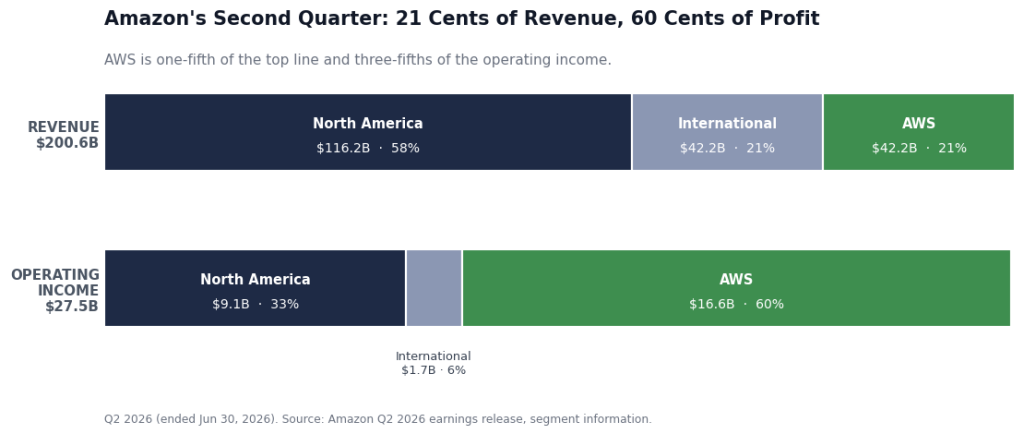
Amazon’s Q2 2026 segments, from the earnings release.
Tesla’s Future Still Comes With 480,126 Cars Attached
Tesla was formed in 2003 by a group of engineers who believed an electric car could be quick, desirable, and genuinely fun to own. Elon Musk arrived in 2004 as its chairman and largest early investor, then became CEO in October 2008, when Tesla had delivered only a few hundred Roadsters and was still fighting to prove it could manufacture a car. The Model S, Model 3, and Model Y eventually forced the rest of the auto industry to take EVs seriously.
That history explains why Musk still has so many people willing to back the next promise. He made his first fortunes through Zip2 and PayPal, created enormous wealth for early Tesla shareholders, and built SpaceX into a company that lands reusable rockets and carries astronauts into orbit. Musk has missed plenty of deadlines, sometimes by years. Yet enough of his wildest claims have become real businesses that investors continue giving him time no ordinary CEO would receive.
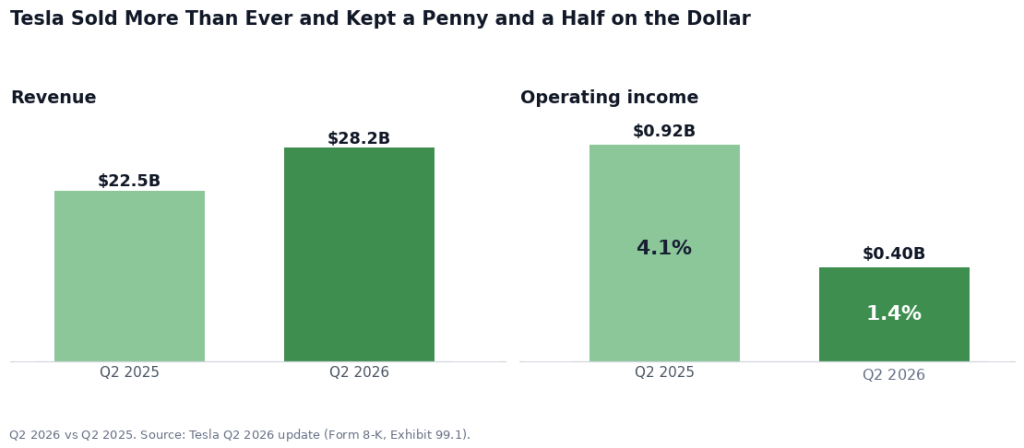
Tesla’s latest quarter gave those investors plenty to point to. Revenue reached a record $28.2 billion, up 26%, after the company delivered a second-quarter record of 480,126 cars. The cheaper Standard versions of the Model 3 and Model Y carried much of that volume, while energy storage climbed past 13.5 GWh..
FSD subscriptions also rose 56% to 1.48 million. Nearly 1.5 million people now pay Tesla each month to add software to a car they already bought. Toyota has sold a lot of Camrys, but it never figured out how to keep sending the owner a monthly bill.
A few lines farther down, the filing shows what Tesla paid for all that growth. Operating income fell 57% to $398 million, leaving the company with 1.4 cents of operating profit from each dollar of sales. That’s where the penny and a half belongs in this story, after the record deliveries and subscription growth, and beside Amazon’s 13.7 cents.
Regulatory credits, once about as close as a carmaker gets to free money, dropped from $439 million to $146 million. Costs rose 47%, capital spending jumped 142%, and free cash flow finished at negative $1.1 billion. Tesla’s deck calls this its “largest investment period,” which is asking three fairly calm words to carry an awfully large bill.
Musk’s backers have watched him spend through ugly quarters before and come out with the Model 3 or a reusable rocket. They’re giving him the same room to build robotaxis and Optimus. The scorecard below shows how much more heavily Tesla depends on that bet than Amazon does.
The Amazon vs Tesla Scorecard, for Anyone Skimming
| Amazon (AMZN) | Tesla (TSLA) | |
|---|---|---|
| Quarter | Q2 2026, ended June 30 | Q2 2026, ended June 30 |
| Revenue | $200.6B, up 20% | $28.2B, up 26% |
| Operating income | $27.5B, a 13.7% margin | $398M, a 1.4% margin |
| Growth engine | AWS, up 37% | Services up 50%, storage up 40% |
| Net income | $62.6B, but $53.4B of it non-operating | $1.11B, but ~$1.0B a SpaceX mark |
| Free cash flow | Negative $7.6B, twelve months | Negative $1.1B in the quarter |
| 2026 capex | About $220B, just raised | North of $25B, per the CFO |
| Already promised | $496B of signed AWS work | 1.48M monthly FSD subscribers |
| Robots working now | 1M+ in warehouses, Zoox cleared to charge | Optimus pre-production, 7 robotaxi metros |
| Dividend or buyback | Neither | Neither |
| What you’re really buying | The cloud, with a store attached | The software, with a car attached |
Both columns are the June 2026 quarter, from each company’s release.
The $53.4 Billion Footnote
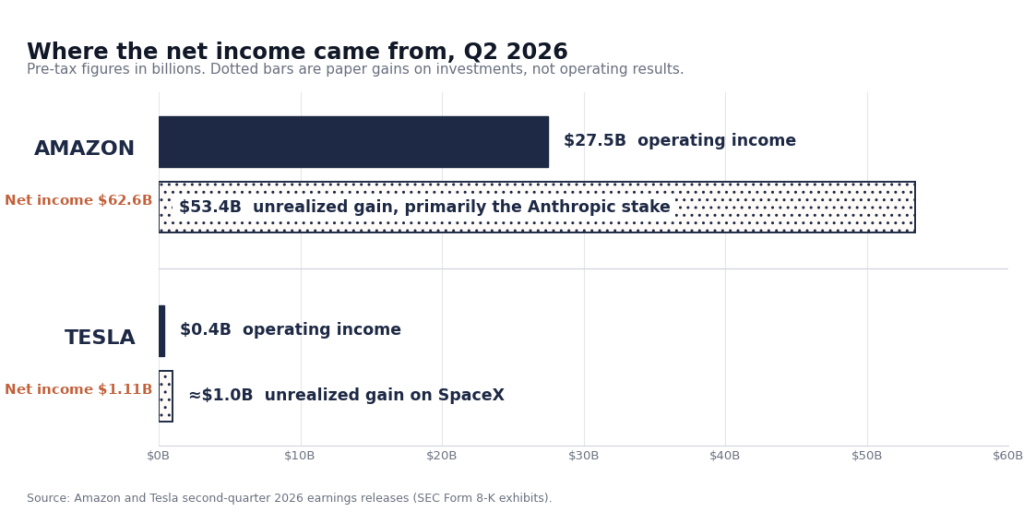
The two companies had one more thing in common last quarter, and neither put it near the top of the release. Most of the net income each reported came from owning a piece of somebody else.
Tesla’s version came first. It reported $1.11 billion in net income after producing $398 million in operating income and burning $1.1 billion in free cash flow. The bridge between those numbers was SpaceX: Tesla booked an unrealized gain of about $1 billion on its stake. Put plainly, a rocket business with no connection to EVs or robots did roughly 2.5 times more for Tesla’s bottom line than building and selling 480,126 cars did.
Amazon then made that billion look small. Net income reached $62.6 billion, up 245%, after a $53.4 billion pre-tax, non-operating gain tied primarily to the rising value of its Anthropic stake. The scale takes a moment to absorb: Amazon’s warehouses, servers, ads, and Prime subscriptions earned $27.5 billion in operating income, and a fresh valuation of its Anthropic slice added nearly twice as much.
So what’s underneath the number? Real revenue, for a start. Anthropic says more than 1,000 businesses now spend at least $1 million a year on its models, and AWS points to DoorDash, Perplexity, Strava, and Intercom running Claude through Bedrock. But Amazon also sits on every side of the deal: it had invested $18 billion in Anthropic by quarter-end, Anthropic has committed to buy more than $100 billion of AWS capacity, and AWS sells Claude to its own cloud customers. The paying customers are real. So is the fact that Amazon funds, hosts, and distributes the company whose rising valuation just added $53.4 billion to Amazon’s earnings.
SpaceX has since given that private-market math a public stress test. Its record $75 billion IPO priced at $135 a share and opened at $150; the stock closed July 31 at $108.37, about 20% below the offer. If Anthropic ever follows it onto the market, a hot debut could hand Amazon another outsized markup, and the weeks after could take part of it back.
Silicon Valley Retools for Autonomy
Whatever Anthropic and SpaceX are worth on paper, the robot spending has already reached the factory floor. Tesla and Amazon are building their next big products 20 minutes apart along Interstate 880, and both expect those products to walk or drive themselves.
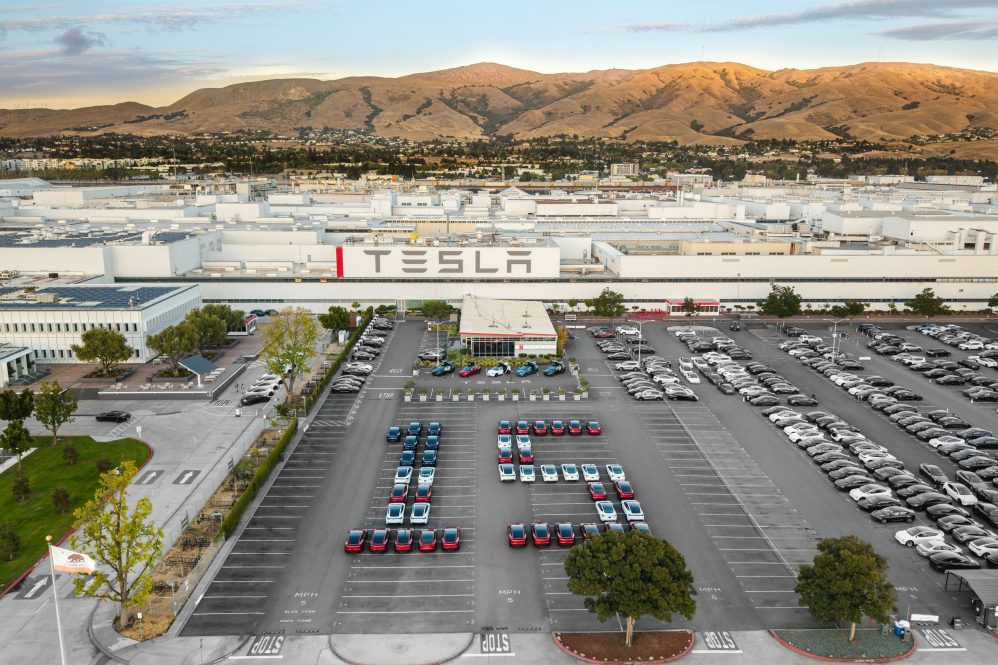
Amazon vs Tesla is duking it out in the East Bay. This spring, a crew at Tesla’s Fremont plant removed the assembly line that built the Model S and began installing machinery for Optimus, Tesla’s humanoid robot for factory work. The Model S is the car that made Tesla. Starting with its launch in 2012, Tesla built roughly 750,000 Model S and Model X vehicles over 14 years. But their old floor now belongs to something Musk calls “the biggest product ever” and “the hardest product to scale manufacturing that we’ve ever made.”
Tesla is developing the robot and its supply chain at the same time. The first Optimus units will remain in Tesla’s factories, where they’ll perform basic work and collect the data needed to train later versions.
Musk knows the driving side will face even greater scrutiny. He pointed out that 30,000 to 40,000 Americans die in car crashes each year with little national attention, while one robotaxi fender-bender can make national news. Tesla is expanding carefully under that microscope, although paid miles are climbing more than 10% a week.
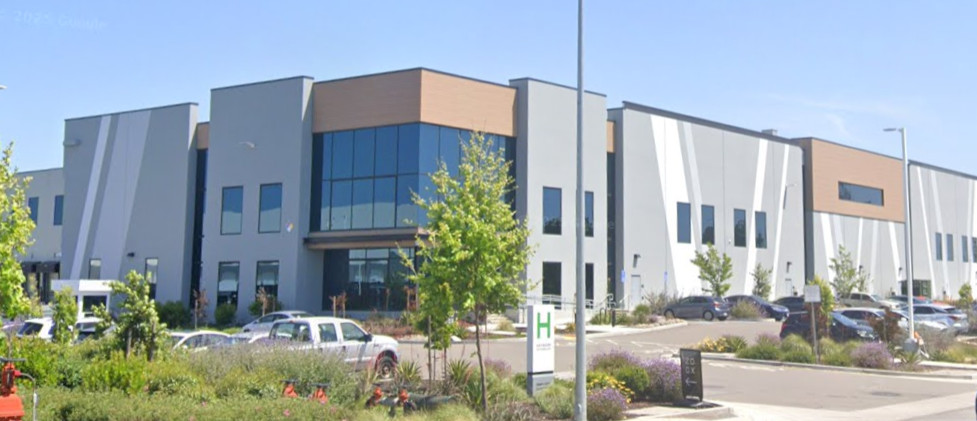
A twenty minute drive up the freeway in Hayward in a non-descript stucco box, Zoox builds a 4-seat pod with no steering wheel or pedals in a plant tooled for about 10,000 vehicles a year. Amazon also has around 1 million robots working full shifts inside its warehouses. The newest can lift 1,300 pounds and follow spoken instructions. Amazon can give each of those machines a job, track the work it performs, and calculate what it saves.
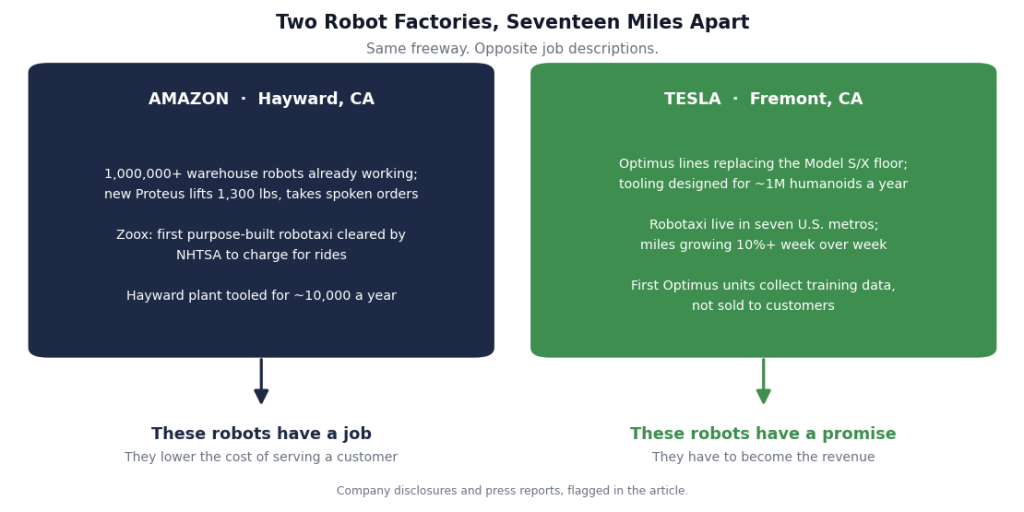
Company disclosures and press reports, flagged in the text.
Amazon’s Capital Budget Went Up Again
None of this is cheap, and Amazon has stopped pretending otherwise. On their Q2 call Jassy raised the 2026 capital budget to about $220 billion, up from the $200 billion that knocked 8% off the stock in February. He blamed memory prices.
Then he said that even at $220 billion, Amazon “will still not have enough capacity to meet all the demand we have in 2026.” What’s already booked for 2028 is, in his words, “striking.”
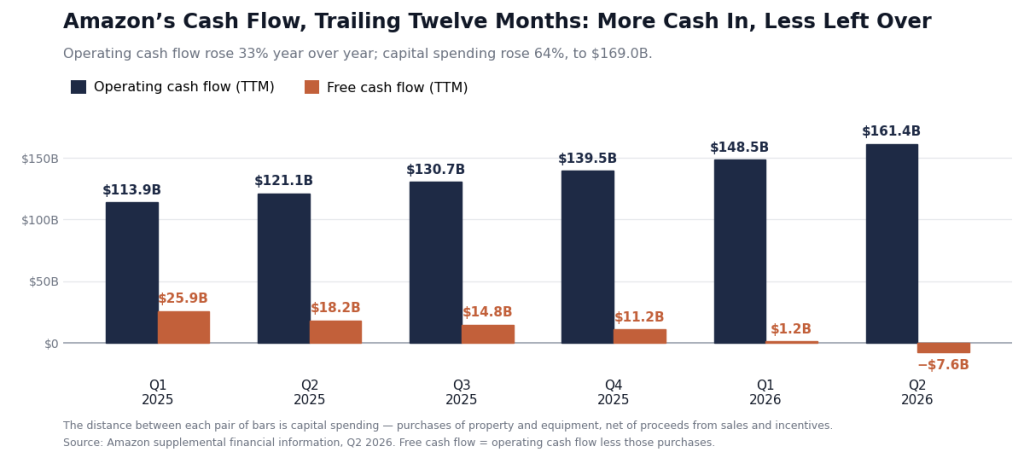
The filings show what that confidence costs. Capital spending hit $169 billion over twelve months, up 64%. Free cash flow finished at negative $7.6 billion, against positive $18.2 billion a year earlier. Long-term debt roughly doubled in six months, to $128.9 billion.
What makes any of that tolerable is the $496 billion of AWS work already under contract. That’s the number investors were looking at when they bought instead of sold.
Not everything went Amazon’s way. Third-quarter guidance came in under what analysts wanted, because Prime Day moved into June. And Tesla’s CFO had summed up his own year a week earlier in four words: “a massive CapEx year.” That goes for both of them. Only one has half a trillion dollars of signed work waiting at the far end.
| Want to know whether a CEO actually did what he said he’d do three years ago? That’s what Search10k’s CEO Leadership Report is built for. It grades them against the plans in their own filings. |
So Whose Story Are You Buying?
Beyond the excitement of robots, Rivians, retooling and rockets, you’re left with a question about who can afford to be wrong.
Buy Amazon and you’re buying a cloud and advertising business that happens to own the world’s biggest shop, paying for a $220 billion wager out of its own pocket. If the robots disappoint, AWS still grows 37%, the ads still grow 26%, and $496 billion of signed work still arrives. The worst case is a long, expensive argument about capital allocation.
Buy Tesla and you’re buying the wager itself, in Musk’s own words a robot company with a car business attached that keeps a penny and a half on the dollar. Plenty of people take that trade on purpose and know exactly what they’re holding. There’s just less underneath them if the robots run late.
Neither company pays a dividend. Both are spending like the argument’s already over. But when it comes down to it, Search10k stacks the filings side by side so you can decide which one’s earned that.
| Try it on two companies you own. Drop any pair into the Screener and see what shakes out. Start free, or grab twenty minutes and we’ll drive. |
PRIMARY SOURCES
- Amazon. Second Quarter 2026 Results, Form 8-K Exhibit 99.1 (SEC EDGAR, Jul 30, 2026). Revenue, segment profit, the $53.4B of non-operating income, cash flow and the Zoox clearance all come from here.
- CNBC. Amazon Q2 2026 earnings and AWS earnings Q2 2026 (Jul 30, 2026), for the capex raise, the $496B backlog and third-quarter guidance.
- Fortune. Jassy on $220 billion and still not enough capacity (Jul 30, 2026).
- Stocktwits. AMZN’s after-hours move (Jul 30, 2026).
- Amazon. The millionth warehouse robot (About Amazon, Jul 2025).
- Tesla. Q2 2026 Update, Form 8-K Exhibit 99.1 (SEC EDGAR, Jul 22, 2026), for revenue, deliveries, the Fremont conversion and the seven robotaxi markets.
- Investing.com. Tesla Q2 2026 earnings call transcript (Jul 22, 2026), for Musk on FSD, Optimus and robotaxi growth, and the CFO on capital spending.
- CNBC. Tesla Q2 2026 earnings (Jul 22, 2026), for FSD subscriptions and the Optimus training-data detail.
- Quartz. Tesla Q2 2026 results and Electrek, Tesla Q2 2026 financials (Jul 22, 2026), for margins, credits and the SpaceX gain.
- Electrek. Tesla sheds $140B after the miss (Jul 23, 2026).
- CNBC. Shareholders approve Musk’s $1 trillion pay plan (Nov 6, 2025).
- CNBC. Zoox unveils its redesigned robotaxi (Jun 24, 2026); AP via Barchart, inside the Hayward plant.
Disclaimer: This article is for informational and educational purposes only. It is not investment advice, a research report, or an offer or solicitation to buy or sell any security. Statements of fact come from public filings, earnings releases, call transcripts and press reports, all linked above and historical in nature; past performance does not guarantee future results. Details of the Optimus, robotaxi and Zoox programs not contained in SEC filings come from company statements and press reporting, and are identified as such. Amazon’s reported net income includes $53.4 billion of pre-tax non-operating income, primarily from its investments in Anthropic, and Tesla’s includes an approximately $1.0 billion unrealized gain on its SpaceX investment; both are unrealized marks on privately held companies, as disclosed by each issuer, and both may reverse in future periods. Quotations from Elon Musk, Andy Jassy and Vaibhav Taneja are drawn from their companies’ second-quarter 2026 earnings calls and releases. Any interpretation or characterization of these facts is opinion, not a statement of fact. Forward-looking items, including Amazon’s approximately $220 billion 2026 capital-expenditure plan, its AWS backlog and demand commentary, Tesla’s robotaxi and Optimus production plans, and the milestones in Tesla’s 2025 CEO Performance Award, are the companies’ own forward-looking statements, are subject to the risks and uncertainties described in their SEC filings, and may differ materially from actual results. Readers should do their own due diligence and consult a licensed professional before making any investment decision.