Tim Cook’s Apple and Satya Nadella’s Microsoft are run on different instincts, and the filings tell the story.
Sources: Apple, Microsoft and Spotify SEC filings and earnings releases, linked throughout. Figures for OpenAI and for the Apple and Google arrangement are company statements and press reports rather than filings, and are flagged as such. Updated July 2026. For informational purposes only; not investment advice.
Tim Cook has called inventory “fundamentally evil.” His word, evil, not some analyst’s. He meant it, too. Electronics lose value while they sit. Therefore, Cook compared managing them to running a dairy: sell the milk before it spoils. After joining Apple in 1998, he dismantled much of the company’s manufacturing and storage network and closed ten of its nineteen warehouses. By the end of that fiscal year, Apple was carrying just six days of inventory.
Satya Nadella runs Microsoft on almost the opposite instinct. Cloud computing and AI require enormous physical infrastructure, and he’s buying it as fast as Microsoft can build it: data centers, chips, power and cooling. Apple spent $12.7 billion on capital projects last year. Microsoft spent $64.6 billion, with spending expected to reach roughly $190 billion in calendar 2026. Though they may share the “Big Tech” label, they are making very different bets about what the next decade will reward. To compare Apple vs Microsoft, let’s consider each revenue engine, and each philosophy on delivering shareholder value.
Cook’s Machine: Sell the Phone Once, Bill the Owner Forever
To compare Apple vs Microsoft, we need to start where Cook started, on the factory floor. Apple sold $416 billion of hardware last year, roughly half of it iPhones. Read only that line and you’d file the company away as a superb manufacturer catching a superb wave. However, the real money, shows up after the sale’s done. Every phone that manufacturing machine ships is a customer who now lives inside the Apple ecosystem, and there are more than 2.5 billion of them switched on right now. Picture the lady who sat beside you on your last flight. Phone in hand, Apple watch on the wrist, one AirPod in, a MacBook wedged in the seat pocket. Cook’s machine sold her four devices off a single sales pitch. After that it started charging monthly rent the instant her free 5GB of iCloud storage filled up, which it always does.
Put it all together and the shape of the business changes. Services, meaning the App Store, Apple Music, iCloud, Apple Pay, and even the ads on those platforms, pulled in $109 billion last year at a margin of 76.7 cents on the dollar against 38.7 on the hardware.
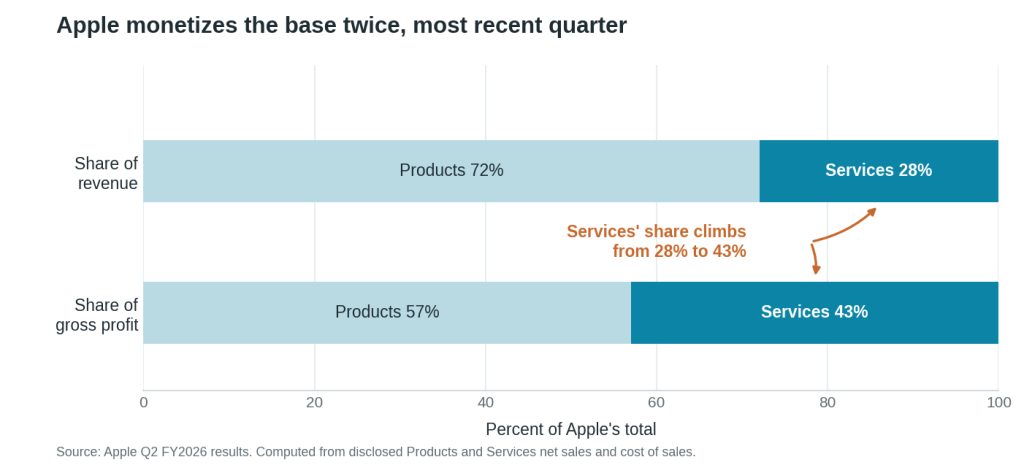
Backed out of the Products and Services net sales and cost of sales Apple prints each quarter, and it ties to the 49.3% blended margin Apple reported, which is how you know the split is straight.
Nadella’s Bet: The Software You’d Have to Get Fired to Remove
Satya Nadella ran Microsoft’s cloud business before he ran Microsoft. He joined in 1992, came up through the server side rather than Windows, and by 2011 was running the Server and Tools division, where he placed the company’s early bet on Azure. When he succeeded Steve Ballmer as CEO in 2014, he pointed the whole company at the cloud business he had spent years building.
Which brings us to today.
Microsoft currently makes its money in three places: the software people work in all day (Microsoft 365, LinkedIn, Dynamics), the cloud other companies rent to run their own operations (Azure and its servers), and a stack of consumer holdovers that survive mostly on habit, meaning Windows, Xbox and the ads around search (Bing, Edge and Copilot). The growth is almost all cloud. Revenue rose 15% last year, to $282 billion, and another 18% in the latest quarter, with Azure up 40% on its own.
Once a company keeps its email, its documents, its employee logins, and its servers on Microsoft, leaving for a rival means moving all of it at once, retraining everyone, and hoping nothing breaks. The result is a $627 billion backlog of contracts already signed but not yet delivered, nearly double what it was a year ago. Very little of it will ever go anywhere, due to the high cost of switching.
There’s a catch in that backlog, though. About $250 billion of the $627 billion is a single contract, with OpenAI, of which Microsoft owns 27%. So a big chunk of it is really Microsoft paying itself, and that’s not the last time you watch its money leave through one door and come back through another.
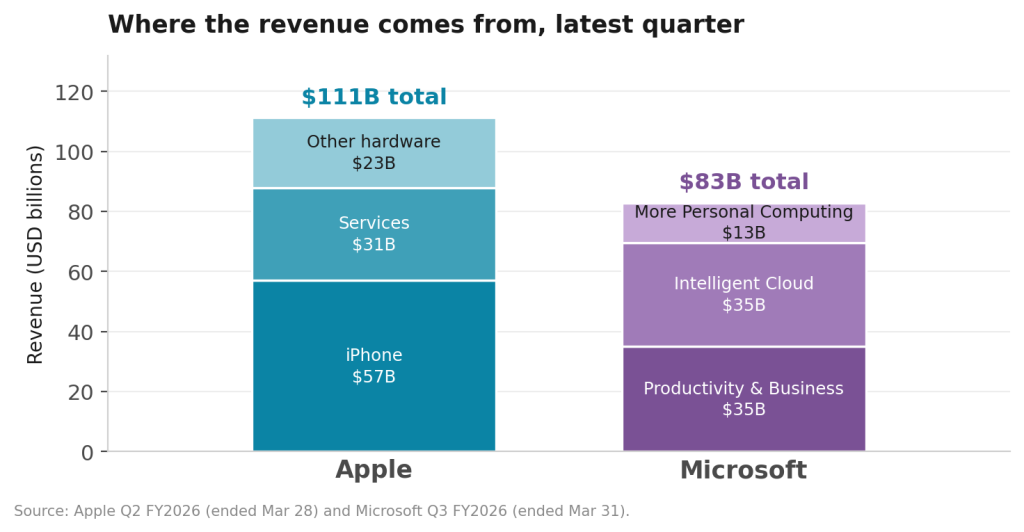
Last quarter, by segment. Apple runs on essentially one product. Microsoft’s revenue splits three ways, with the cloud in the middle. Apple’s “other hardware” is Mac, iPad and Wearables.
Apple vs Microsoft SCORECARD
| Metric | Apple (AAPL) | Microsoft (MSFT) |
| Latest fiscal year | FY2025 (ended Sep 2025) | FY2025 (ended Jun 2025) |
| Revenue / YoY growth | $416.2B / +6% | $281.7B / +15% |
| Most recent quarter | $111.2B / +17% (Mar 2026) | $82.9B / +18% (Mar 2026) |
| Gross margin | 46.9% | 68.8% |
| Operating margin | ~32% | 45.6% |
| Net income | $112.0B | $101.8B |
| Free cash flow (margin) | $98.8B (24%) | $71.6B (25%) |
| Capital expenditure | $12.7B | $64.6B |
| 2026 capex plan | Modest (capital-light) | ~$190B guided |
| Capital returned, latest FY | ~$106B | ~$37.7B |
| R&D (% of revenue) | $34.6B (8.3%) | $32.5B (11.5%) |
| Core moat | Device ecosystem, 2.5B+ devices | Enterprise cloud + software lock-in |
Apple vs Microsoft: The 47-Cent Business That Out-Earns the 69-Cent One
The margin comparison looks like a mismatch. Microsoft keeps 69 cents of gross profit from each dollar of revenue. Apple keeps 47 cents. That 22-cent difference makes perfect sense when one company can reproduce software for next to nothing and the other has to build millions of phones, ship them across oceans, and put them on shelves.
The surprise comes at the bottom of the income statement. Apple still walked away with $112 billion of net income last year, well ahead of Microsoft’s $101.8 billion. Why?
Bring back the lady sitting beside you on the flight. She does not represent one iPhone sale for Apple. She buys an iPhone today, then the newest one three years from now, a MacBook when her current laptop starts slowing down, Airtags for tracking her luggage (and children) on her next vacation, iPads to entertain her niece and nephew, and a fresh pair of AirPods after one disappears somewhere between the hotel and the airport.

Apple collected $23 billion from non-iPhone hardware in a single quarter. That alone was nearly twice the size of Microsoft’s entire Windows, Xbox, and Bing operation.
One Hands the Money Back, One Plants a Seed
Nowhere do the two temperaments show up more plainly than in what each man does once the cash lands.
Cook, the operations man to his core, refuses to tie money up. Apple’s capex ran just $12.7 billion last year, a tenth of what the business generated, partly because Apple’s factories belong to other people. Whatever it can’t use, it gives back. Roughly $106 billion went out to shareholders in buybacks and dividends. Then, in April, the board calmly authorized another $100 billion on top.
Nadella is doing the exact reverse. Microsoft laid out $64.6 billion on capital projects last year, up 45%, and has told the market to expect something in the region of $190 billion this year. If Microsoft reaches that mark, nearly half of what it earns will go into land, power, cooling systems, and chips. Shareholders received $37.7 billion, about a third of Apple’s payout, because Nadella believes the systems to catch the larger prize still need to be built.
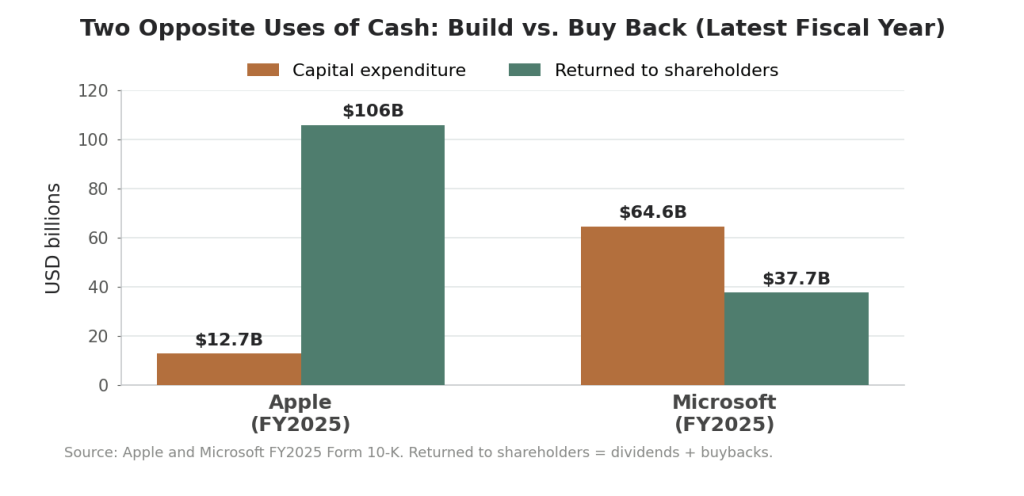
Latest fiscal year, and the bars are not a metaphor for anything. They are simply two men who read the same decade and reached opposite conclusions about what a dollar is for.
Nadella’s Circle and Cook’s Toll Booth
Trace Microsoft’s money through the AI boom and it moves in a circle. Microsoft put about $13 billion into OpenAI. OpenAI turned around and committed $250 billion back to Azure. Microsoft is now spending $190 billion a year building the data centers, some of them to house the workload of the very company it partly owns. Then it books what comes back as 40% Azure growth and a $37 billion AI run rate. Round and round the same buck goes.
Yet while circle may prove highly profitable, it also asks investors to trust numbers they can’t fully inspect: OpenAI has never published an annual report, and its claims of 900 million weekly users and $25 billion in annualized revenue come from the company itself. The cost of Microsoft’s infrastructure has already begun to weigh on margins.
Cook found a cheaper route. Apple reportedly pays Google about $1 billion a year to put Gemini behind Siri, while Google pays Apple roughly $20 billion to remain the iPhone’s default search engine. Apple gets the model it needs, keeps about $19 billion from the same partner and leaves Google to pay for the expensive part. Cook keeps the tolls, while Google is performing the “AI road maintenance”.
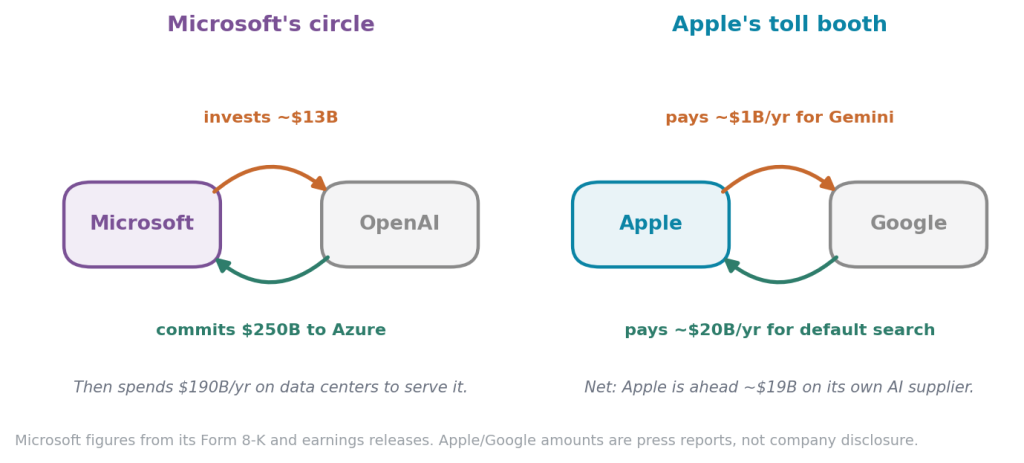
Two ways to pay for artificial intelligence. Microsoft’s figures come from its SEC filings and earnings releases, while the Apple and Google amounts are press reports rather than company disclosure, and neither firm has confirmed them.
The Questions Both Men Would Rather You Not Ask
Figuring out what those dollars are defending is harder. Cook’s buybacks depend on Apple’s ecosystem continuing to throw off cash as Nadella’s buildout depends on AI revenue arriving fast enough to justify the bill. Once you try to test either assumption, the disclosures become much less generous.
Tim Cook: How Much of Services Depend on App Store and Search?
Cook tends to settle the moat argument with a number so large that nobody asks a second question. Apple passed 2.5 billion active devices in December, which gives him every right to bring it up.
Apple’s 10-K tells the less flattering half of the story. The company holds a minority share of the smartphone, computer, tablet, and wearables markets. Cook has made that position wildly profitable by owning the paying end of each market and giving those customers enough reasons to keep buying inside Apple.
Services are where that relationship turns into money. Revenue reached $109.2 billion last year, and the business kept 75.4 cents of gross profit from each dollar. Apple gives investors the total, then says growth came from advertising, the App Store, and cloud services. It doesn’t say how much came from each one. According to estimates, Apple Music’s market share in the US is at 31%, second only to Spotify. Apple Watch holds 23% of global smartwatch shipments, with Huawei second place.
That missing breakdown has also become important because two of those profit streams now sit inside active legal fights. Apple’s 2025 Form 10-K acknowledges court-ordered changes to App Store commissions, Europe’s new platform rules, and the risk that Google could eventually lose the right to pay Apple for search placement. A change to either arrangement could reach straight into the cash Cook returns to shareholders.
| Search10K’s CEO Leadership Report on the Company Profile page reports how well leadership is doing based on its own past goals. Start free, or book twenty minutes and we’ll drive. |
Satya Nadella: What’s Hiding Behind 40% Azure Growth?
Nadella’s favorite numbers right now are Azure’s 40% growth and Microsoft’s AI business reaching a $37 billion annual revenue run rate. The questions he’d rather avoid begin with what that growth costs.
Microsoft spent $31.9 billion on capital projects in the March quarter, with two-thirds going toward shorter-lived GPUs and CPUs. Cloud margins fell to 66%, management expects 64% next quarter, and free cash flow dropped to $15.8 billion. The earnings release still doesn’t tell investors what Azure itself earns.
OpenAI adds another complication.
Microsoft’s commercial backlog nearly doubled to $627 billion once OpenAI was included; without it, growth was 26%. Microsoft has also committed $13 billion to a company it funds, supplies, shares revenue with, and increasingly competes against. That competition turned real in June, when Microsoft launched its own family of models, the MAI line, and began routing parts of Copilot, Excel and GitHub to them instead of OpenAI’s to cut its own compute bill. Copilot also sells head to head against ChatGPT, and Microsoft 365 undercuts OpenAI’s enterprise pricing by bundling AI into software companies already buy. Microsoft is now building the alternative to the very models it helps fund.
Security remains an older embarrassment as well. A federal review called the 2023 Exchange Online breach preventable and said Microsoft’s security culture needed an overhaul. Nadella has since assigned 34,000 engineers to the repair effort, which tells the sheer size of the problem.
So Whose Story Are You Buying?
After all the talk about devices, ecosystems, chips and moats, Apple and Microsoft are arguing over where the next AI dollar will land.
Cook’s September handoff to hardware engineer John Ternus keeps Apple’s answer inside the device in your hand. Custom silicon, private AI and 2.5 billion active devices do not have to produce the world’s best model; they only have to make Siri useful enough that an old iPhone starts to feel old.
Nadella wants to capture that same dollar earlier, before it ever reaches the device in your hand. Azure rents the computing power, Foundry (Microsoft’s AI-model marketplace) supplies the models, and Copilot carries them into the workday, giving Microsoft several chances to get paid whether or not an Apple device is anywhere in the picture.
All you need to know is that Search10k puts the filings side by side so you can see the choice clearly: a bet that AI will restart Apple’s upgrade cycle, or a bet that it will settle into the corporate budget as another monthly bill from Microsoft.
| Go do this to two companies you actually own. Drop any pair into Search10k’s screener and see what falls out. Start free, or book twenty minutes and we’ll drive. |
PRIMARY SOURCES
- Apple. Second Quarter Fiscal 2026 Results (Apr 30, 2026).
- Apple. Q2 FY2026 Form 8-K, Exhibit 99.1 (SEC EDGAR), for Products and Services net sales and cost of sales.
- Apple. Q1 FY2026 Form 8-K, Exhibit 99.1 (SEC EDGAR), for the 2.5 billion active-device installed base.
- Apple. Fourth Quarter and Fiscal 2025 Results (Oct 30, 2025).
- Apple. Form 10-K, fiscal year ended Sep 27, 2025 (SEC EDGAR), including the competition risk factors.
- Apple. Tim Cook to Become Apple Executive Chairman; John Ternus to Become Apple CEO (Apple Newsroom, Apr 2026).
- Microsoft. Third Quarter Fiscal 2026 Results (Apr 29, 2026).
- Microsoft. Form 8-K, Exhibit 99.2: the next chapter of the Microsoft and OpenAI partnership (SEC EDGAR, Oct 28, 2025).
- Microsoft. Fourth Quarter and Fiscal 2025 Results (Jul 30, 2025).
- Microsoft. Form 10-K, fiscal year ended Jun 30, 2025 (SEC EDGAR), including segment definitions.
- Spotify Technology S.A. Q1 2026 Form 6-K, Exhibit 99.1 (SEC EDGAR), for premium subscribers.
Disclaimer: This article is for informational and educational purposes only. It is not investment advice, a research report, or an offer or solicitation to buy or sell any security. Statements of fact are drawn from public filings, earnings releases and investor materials, which are linked throughout and are historical in nature; past performance does not guarantee future results. Figures attributed to OpenAI, and the amounts described in the Apple and Google arrangement, come from company statements and press reporting rather than SEC filings, and are identified as such. Any interpretation or characterization of these facts is opinion, not a statement of fact. Forward-looking items, including Apple’s and Microsoft’s capital-return plans and Microsoft’s capital-expenditure guidance, are the companies’ own forward-looking statements, are subject to the risks and uncertainties described in their SEC filings, and may differ materially from actual results. Readers should perform their own due diligence and consult a licensed professional before making any investment decision.