For long-term investors, the most powerful signal of management quality is not the ambition of its strategy but the consistency with which leadership executes on those promises over time. One of the most rigorous ways to evaluate that execution is by reviewing a company’s past U.S. Securities and Exchange Commission (SEC) filings—particularly Form 10-K and Form 10-Q reports—from earlier years such as 2021, 2022, and 2023, and comparing them with the most recent filings in 2025. When companies that lay out objectives in earlier filings and achieve them in later filings, it provides compelling evidence of disciplined leadership, credible strategy, and strong governance—qualities that materially strengthen the investment case. In essence, the investor is asking if the leadership did what they said they were planning to do within a reasonable time window of 3 to 5 years.
SEC Filings as a Strategic Roadmap

Public companies in the United States must file detailed reports with the SEC that disclose financial results, operational performance, and strategic developments. These filings serve as standardized disclosures designed to provide investors with reliable information about a company’s condition and prospects. (Corporate Finance Institute)
The Form 10-K, in particular, is the most comprehensive of these documents. It includes audited financial statements, risk factors, business descriptions, and the Management Discussion and Analysis (MD&A) section, where executives explain the drivers of performance and discuss the company’s strategic direction. (nextbrl.com)
Because the format and disclosure requirements are standardized, investors can track a company’s statements about its strategy and performance over multiple years. In essence, each 10-K becomes a timestamped record of management’s commitments and expectations.
Strategy in Early Filings: Setting the Benchmark
When examining filings from 2021 through 2023, investors should focus on sections where leadership articulates strategic priorities. These typically include:
- Long-term growth initiatives
- Market expansion plans
- Capital allocation strategies
- Technology or innovation investments
- Margin improvement targets
The MD&A section is especially valuable because it provides management’s interpretation of the company’s results and future outlook. (investor.gov)
For example, a management team might describe a strategy to expand into a new geographic market, invest heavily in automation to reduce costs, or pursue acquisitions to consolidate industry share. These statements effectively create a strategic baseline against which future performance can be evaluated.
Comparing With 2025 Filings: Measuring Execution
Fast-forward to 2025 filings, and the same sections reveal the company achieved the earlier objectives. Investors can evaluate execution by examining:
- Operational Outcomes – Did revenue grow in the targeted segments or markets?
- Capital Allocation – Were investments made in the areas management promised?
- Margin and Efficiency Metrics – Did cost reductions or productivity improvements materialize?
- Strategic Milestones – Were acquisitions completed or technology initiatives deployed?

Because financial data in the 10-K includes multi-year comparisons, it becomes easier to track whether the outcomes align with earlier commitments. (Corporate Finance Institute)
When leadership achieves the objectives outlined in earlier filings, it demonstrates that strategic planning was realistic and operational execution was effective.
Accountability and Transparency
One of the reasons this analysis is particularly meaningful is the legal accountability embedded in SEC filings. Companies are prohibited from making materially false or misleading statements in their disclosures, and the CEO and CFO must certify the accuracy of the reports. (investor.gov)
This certification requirement raises the credibility of strategic statements contained in filings. While executives may present optimistic projections in earnings calls or investor presentations, the disclosures in a 10-K are made within a stricter regulatory framework.
Moreover, the transparency of SEC reporting helps investors hold management accountable for its decisions. Public filings provide detailed information about governance, strategy, and performance, enabling investors to evaluate leadership effectiveness and corporate integrity. (nextbrl.com)
When investors compare past commitments with later outcomes, they are effectively auditing management’s credibility.
Pivots in Strategy – Adapting to Market Conditions
Companies frequently pivot their strategies from year to year because the economic and competitive environment changes faster than long-term corporate plans. Shifts in consumer demand, regulatory policy, and capital availability can alter the profitability of an existing business model. For example, the removal of government subsidiescan reduce margins and slow adoption, forcing firms to reconsider future growth. For example, the removal of electric vehicle credits forced Tesla to rethink how it deploys autonomous technology. Likewise, new technologies or emerging markets may present more attractive opportunities than a company’s legacy products.

A recent example is Tesla’s strategic shift beyond electric vehicles toward robotics and artificial intelligence. Facing slowing EV demand and the reduction of subsidies in some markets, the company has begun reallocating resources toward its humanoid robot project, Optimus, and related AI technologies. Tesla has even discussed repurposing vehicle production capacity to manufacture robots as part of this transition. (economy.ac)
For investors, such pivots often reflect management’s attempt to reposition the firm toward higher-growth markets and maintain long-term competitive relevance.
Leadership Quality and Execution Consistency
Strong leadership is often defined not by visionary statements but by consistent delivery against clearly stated goals. Companies that demonstrate such follow-through typically exhibit several favourable characteristics:
1. Strategic Discipline
Management teams that achieve previously stated objectives usually demonstrate disciplined planning and realistic goal-setting.
2. Operational Competence
Execution success implies that the organization has the operational capabilities to translate strategy into measurable results.
3. Credible Capital Allocation
When promised investments produce expected outcomes, it signals that management allocates capital effectively.
4. Trustworthiness With Investors
Repeatedly meeting stated objectives builds investor confidence and reduces uncertainty regarding future guidance.
These attributes are critical in long-term investing, where sustained value creation depends on leadership’s ability to execute consistently over many years.
The Investment Signal
From an investment perspective, companies that demonstrate strategic follow-through across multiple filing cycles often deserve a premium valuation. The reason is straightforward: predictability of execution reduces risk.
Markets typically reward businesses that deliver outcomes consistent to their stated strategy. This is because investors can model future performance with greater confidence. Conversely, companies that repeatedly revise or abandon strategic goals often suffer from credibility issues that increase perceived risk and depress valuation multiples.
By systematically reviewing filings from earlier years and comparing them with recent disclosures, investors can separate companies that merely promise growth from those that actually deliver it.
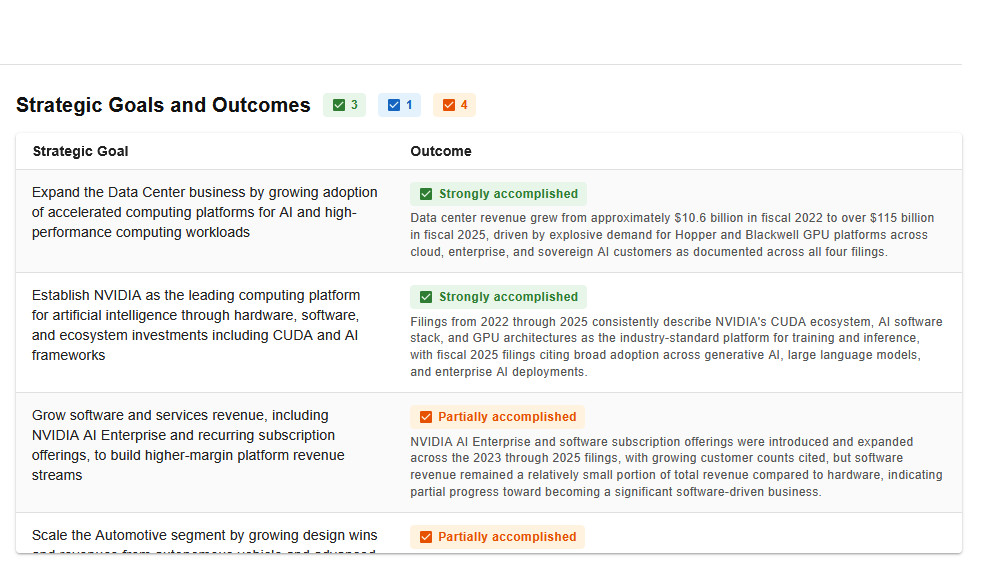
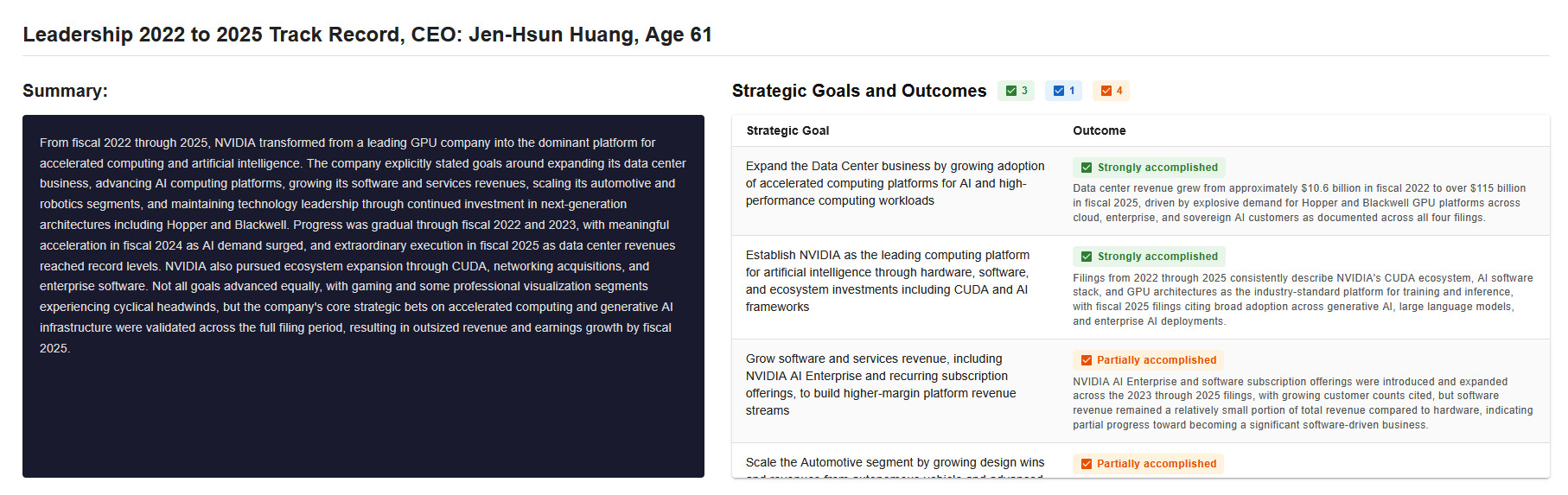
Because SEC filings provide standardized, publicly accessible disclosures, this process can be applied across companies and industries. Search10K provides you a summary of a Leadership Follow-through report containing how well the executive accomplished their strategic objectives in a convenient summary form, and also statistical form. The statistics are categorized by 4 possible outcomes: strongly accomplished, partially accomplished, failed, or pivoted / bonus objectives. Search10K delivers these reports in an easy to read format, backed by the underlying regulatory disclosures.
Conclusion
Evaluating corporate leadership requires more than reviewing recent earnings or listening to quarterly conference calls. A deeper and more reliable approach is to examine the strategic commitments made in earlier SEC filings and assess whether those commitments were fulfilled in later disclosures.
When a company’s 2025 filings demonstrate that leadership successfully executed the objectives outlined in 2021–2023 reports, investors gain powerful evidence of management credibility, operational strength, and strategic discipline. In the context of long-term investing, this consistency is often one of the clearest indicators that the company’s leadership is capable of sustaining value creation—making the business a far more compelling candidate for investment.

Comments are closed